our services:
Enlighta Solutions
were on social media:
Search
People also search for:
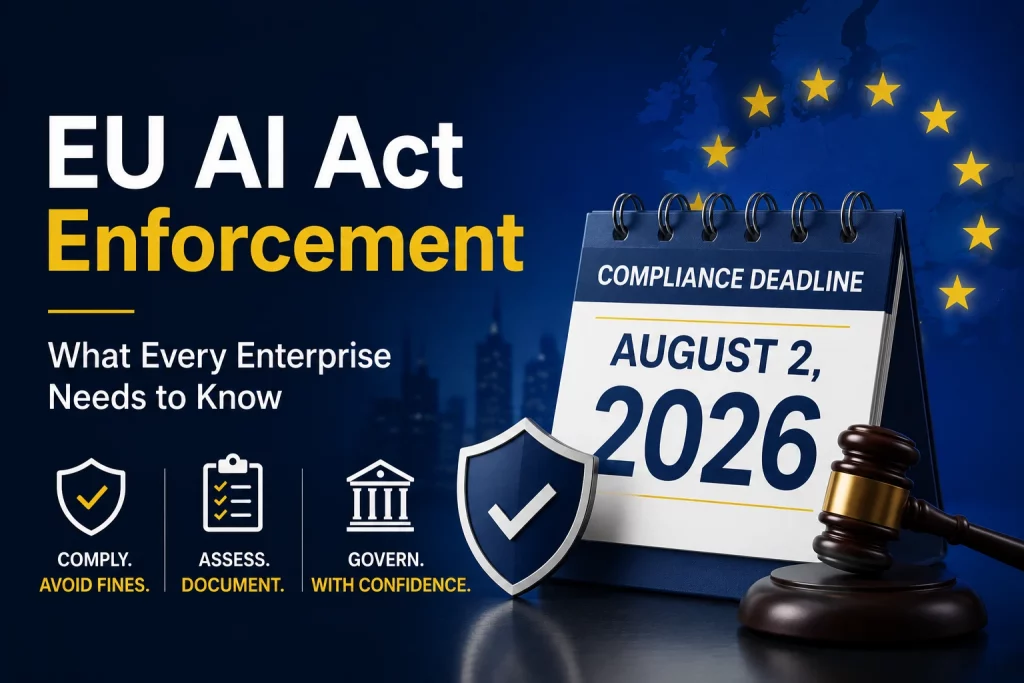
EU AI Act Enforcement Deadline
The Clock Is Running: August 2, 2026 Is No Longer a Future Date
With fewer than 90 days until the EU AI Act’s most consequential compliance deadline, enterprises operating in or serving the European market are running out of time to treat AI governance as a future priority. From August 2, 2026, the full requirements for high-risk AI systems come into force—bringing mandatory conformity assessments, technical documentation requirements, EU database registration, and the activation of national enforcement infrastructure across EU member states.
Enlighta GovernAI is already helping enterprises close these gaps. Organizations using GovernAI’s continuous AI model discovery and dynamic risk workflows are significantly ahead of peers still working from spreadsheets and manual audits.
EU AI Act Enforcement
This is not a soft launch. Legal experts monitoring enforcement patterns expect the first major actions—targeting high-profile organizations, much as early GDPR enforcement did—before the end of 2026.
Fines for violations involving high-risk AI systems can reach €35 million or up to 3% of global annual turnover, whichever is higher. Violations involving prohibited AI practices carry penalties of up to €15 million or 2% of global annual turnover. General-purpose AI (GPAI) model penalty provisions also activate on August 2, 2026.
For organizations still in the classification and risk-assessment phase, this article outlines exactly what the deadline requires, what uncertainty exists in the timeline, and what compliance readiness must look like before August 2.
What August 2, 2026 Actually Requires
The EU AI Act follows a phased implementation structure. Most enterprises are now operating inside the final phase before full enforcement begins.
What was already required before August 2, 2026:
- February 2, 2025: Prohibitions on unacceptable-risk AI practices and AI literacy obligations came into effect
- August 2, 2025: Governance infrastructure requirements and obligations for providers of general-purpose AI (GPAI) models became applicable. Notified bodies and the conformity assessment system were required to be operational
What comes into force on August 2, 2026:
- Full requirements for Annex III high-risk AI systems, including those used in employment decisions, credit scoring, education, law enforcement, and essential services
- Mandatory conformity assessments completed and documented
- Technical documentation finalized and audit-ready
- CE marking affixed to applicable systems
- EU AI database registration completed for all qualifying high-risk systems
- Transparency obligations under Article 50, including disclosure requirements for emotion recognition systems, deepfake content, and AI-generated material
- Enforcement begins at both national and EU level by national competent authorities
Where GovernAI fits: Enlighta GovernAI maintains a continuously updated system-of-record for every AI model in your enterprise—ensuring that when August 2 arrives, you aren’t scrambling to answer the most basic regulatory question: what AI do we actually have?
What remains on a different timeline:
- High-risk AI systems embedded in regulated products (Annex II) have an extended transition period until August 2, 2027
The Digital Omnibus: What Enterprises Need to Know About Potential Delays
The EU regulatory environment in early 2026 introduced a complicating factor that enterprise compliance teams must understand clearly: the Digital Omnibus on AI, proposed by the European Commission on November 19, 2025.
The Omnibus proposes to defer high-risk compliance deadlines from August 2, 2026, to December 2, 2027—motivated in part by delays in the designation of national competent authorities and the failure to finalize harmonized standards before the original deadline.
However, the situation as of May 2026 is that no political agreement has been reached. The second political trilogue between the European Parliament, the Council of the EU, and the European Commission on April 28, 2026 ended without resolution. A further trilogue is scheduled for May 13, 2026.
The critical compliance reality is this: if the Omnibus is not formally adopted before August 2, 2026, the original AI Act provisions apply in full from that date as written. Organizations cannot legally rely on a deferral that has not been enacted.
Prudent enterprise compliance planning must therefore treat August 2, 2026 as the operative deadline. The cost of preparing and not needing to comply is minimal. The cost of standing down and finding that the deferral was not enacted before enforcement begins is not recoverable retroactively.
Enlighta’s guidance to clients is unambiguous: build for August 2. Don’t bet your compliance posture on a trilogue. GovernAI’s governance workflows are designed to activate readiness now—so if the Omnibus does pass, you simply maintain what you’ve built with less urgency, not rebuild from scratch.
The Five Compliance Gaps Most Enterprises Face Today
Analysis of organizational readiness across the industry reveals consistent patterns of unpreparedness. Most enterprises approaching the August 2 deadline face significant gaps across the following areas.
1. No Comprehensive AI System Inventory
More than half of organizations lack a systematic inventory of AI systems currently in production or in development. Without knowing what AI exists within the enterprise—including AI models supplied by third-party vendors—risk classification and compliance planning is structurally impossible.
GovernAI solves this at the foundation. Its continuous AI model discovery automatically surfaces sanctioned and unsanctioned models across every business unit—including vendor-supplied AI—giving compliance teams the authoritative inventory that everything else depends on.
2. Incomplete Risk Classification
The AI Act categorizes AI systems by risk level: unacceptable risk (prohibited), high-risk (strict obligations), limited risk (transparency requirements), and minimal risk (no mandatory requirements). Mis-classifying a high-risk system as limited-risk does not exempt an organization from its obligations—it creates enforcement exposure.
High-risk categories under Annex III include AI systems used for:
- Biometric identification
- Critical infrastructure management
- Education and vocational training
- Employment decisions (recruitment, performance evaluation, task allocation, monitoring, promotion, termination)
- Access to essential private and public services (credit scoring, insurance)
- Law enforcement
- Migration and border control
- Administration of justice
GovernAI’s risk classification workflows embed the Annex III taxonomy directly into the intake and assessment process—so every new AI system is classified against regulatory criteria from day one, not retrofitted later.
3. Absent or Incomplete Technical Documentation
Regulators arriving for an audit will request detailed technical documentation demonstrating how each high-risk system meets the AI Act’s requirements. Organizations that have not yet built documentation infrastructure—including system architecture, training data governance records, risk management evidence, and performance monitoring logs—face significant remediation timelines.
GovernAI maintains dynamic, timestamped documentation for every model in inventory—linked to risk assessments, approval records, and performance monitoring logs. When an auditor asks for evidence, it’s already assembled.
4. No Conformity Assessment Process
Article 43 of the AI Act governs the conformity assessment process. For most high-risk AI systems in Annex III, providers can self-certify compliance against specific requirements. However, that self-certification must be documented, auditable, and linked to a functioning quality management system.
GovernAI structures conformity assessment as a repeatable, auditable workflow—not a one-time document exercise—producing the evidence trail regulators expect and that internal audit teams can verify independently.
5. No Fundamental Rights Impact Assessment (FRIA) for Deployers
Deployers of high-risk AI systems are required to conduct Fundamental Rights Impact Assessments before deploying certain systems. The FRIA shares methodological DNA with GDPR’s Data Protection Impact Assessments (DPIAs), but has a broader scope covering impacts on fundamental rights beyond privacy. Organizations with mature GDPR compliance infrastructure have a head start—but the scope difference means a GDPR DPIA is not a substitute for a FRIA.
GovernAI enables scheduled and ad hoc fairness and societal impact assessments aligned directly to FRIA requirements—producing the documented evidence regulators are increasingly treating as table stakes for high-risk AI deployment.
US Federal AI Governance: The Parallel Development Enterprises Cannot Ignore
While the EU AI Act dominates regulatory timelines in 2026, US enterprises must also account for a significant parallel development at the federal level.
A White House Executive Order issued on December 11, 2025 signals a clear federal move toward coordinated US AI governance—explicitly addressing the risks of fragmented state-by-state AI regulation and outlining mechanisms to challenge state laws that conflict with national AI policy.
The practical implication for compliance teams is that the state-level AI regulatory landscape enterprises have been navigating is likely to change significantly. Organizations that have built compliance architectures around individual state requirements may need to reorient toward federal-level governance expectations.
This is where Enlighta GovernAI’s multi-framework architecture creates lasting value. GovernAI’s governance structure allows compliance teams to map controls across EU AI Act, NIST AI RMF 1.0, ISO/IEC 42001, and emerging US federal standards from a single platform—so as the regulatory landscape shifts, the underlying governance infrastructure adapts without being rebuilt from scratch.
The Compliance Synergy That Organizations Are Missing
One of the most common efficiency opportunities in 2026 AI compliance is the systematic mapping of existing controls to new regulatory requirements. Organizations that have mature SOC 2, GDPR, or ISO 27001 programs have significant existing infrastructure that maps to AI Act requirements—but few have done the mapping work.
The most productive areas of control overlap include:
- GDPR data governance controls → map to AI Act data quality and training data governance requirements
- SOC 2 change management processes → map to AI Act technical documentation and version control requirements
- Existing risk assessment methodologies → provide the foundation for FRIA and conformity assessment workflows
- Incident response procedures → align with AI Act incident reporting and market surveillance cooperation obligations
Enlighta GovernAI is designed specifically to leverage this overlap. Rather than treating EU AI Act compliance as a standalone program, GovernAI maps your existing controls across frameworks—showing compliance teams exactly where they are already covered and where genuine gaps remain, before regulators find them first.
A Practical Compliance Checklist for the August 2 Deadline
Organizations should be completing the following before August 2, 2026:
Inventory and Classification
- ☐ Complete AI system inventory across all business units, including vendor-supplied AI
- ☐ Classify every system by risk category (prohibited, high-risk, limited-risk, minimal-risk)
- ☐ Identify the organization’s role for each system (provider or deployer)
Documentation and Assessment
- ☐ Complete or commission conformity assessments for all high-risk AI systems
- ☐ Finalize technical documentation for each high-risk system
- ☐ Complete Fundamental Rights Impact Assessments for applicable deployer use cases
- ☐ Document human oversight mechanisms and accountability structures
Registration and Marking
- ☐ Register qualifying high-risk systems in the EU AI database
- ☐ Apply CE marking where required for provider obligations
Ongoing Monitoring
- ☐ Establish post-market monitoring plans for high-risk systems
- ☐ Implement mechanisms to detect and report serious incidents
- ☐ Align internal audit schedules to regulatory review expectations
Governance and Reporting
- ☐ Map third-party AI vendor obligations
- ☐ Establish board-level reporting on AI risk and compliance status
- ☐ Connect AI Act compliance to existing GDPR, SOC 2, and risk management frameworks
GovernAI covers every item on this checklist—from automated model discovery and risk classification through conformity assessment workflows, EU database registration support, runtime audit logging, and board-level reporting dashboards.
How Enlighta GovernAI Supports EU AI Act Readiness
Enlighta GovernAI is purpose-built for enterprises facing exactly this compliance moment. It is aligned to the core frameworks regulators will use to assess compliance: NIST AI RMF 1.0, ISO/IEC 42001, and the EU AI Act itself.
| Compliance Gap | GovernAI Capability |
|---|---|
| No AI inventory | Continuous model discovery across all business units and vendors |
| Incomplete risk classification | Annex III-aligned classification workflows built into every intake |
| Missing technical documentation | Dynamic, timestamped audit-ready documentation per model |
| No conformity assessment | Structured, repeatable self-certification workflows with linked evidence |
| No FRIA process | Scheduled and ad hoc fairness assessments with documented outputs |
| Multi-jurisdictional obligations | Single platform mapping EU AI Act, NIST AI RMF, ISO/IEC 42001, US federal standards |
For accountability and stakeholder mapping, GovernAI maintains dynamic ownership records across every AI system in inventory—so when an AI-influenced decision is challenged, accountability is traceable, not reconstructed after the fact.
For runtime enforcement, GovernAI applies access controls and scope boundaries at the API proxy layer, generating a full audit log of every model interaction and flagging out-of-scope requests before any action is taken.
The Bottom Line: August 2 Is Not a Soft Deadline
The EU AI Act is the most significant regulatory intervention in artificial intelligence to date. Unlike early GDPR, where enforcement lagged years behind the effective date, national supervisory authorities are actively establishing enforcement infrastructure ahead of August 2, 2026. Legal experts are clear: the first major enforcement actions are expected before end of 2026.
Organizations that have not yet completed AI system classification, conformity assessment, and technical documentation are operating against a timeline that cannot be extended by assumption.
The governance infrastructure required to meet August 2 obligations does not differ materially from the governance infrastructure required to manage AI risk responsibly in any environment. Organizations that build it now—with Enlighta GovernAI—don’t just achieve compliance. They build the operational foundation for scaling AI safely and with board confidence, regardless of what regulatory deadlines arrive next.
Is your organization ready for August 2, 2026?