10 Best Vendor Risk Management Software
10 Best Vendor Risk Management Software
Most organizations don’t discover a vendor risk problem until it has already cost them something. A third-party breach surfaces in the news. A compliance audit uncovers a lapsed vendor certification. A critical supplier fails quietly, and the disruption ripples inward before anyone has flagged the risk. The pattern is familiar: vendor risk management treated as a periodic exercise rather than a continuous one, managed across spreadsheets and disconnected tools rather than a single platform built for the job.
The numbers behind that pattern are not small. According to IBM’s 2025 Cost of a Data Breach report, third-party involvement in data breaches doubled year-over-year to 30% of all incidents, at an average cost of roughly $4.91 million globally. And research from Vanta found that 57% of organizations terminated a vendor relationship in 2026 due to security concerns, up from 50% the year prior. The vendor ecosystem has become one of the most consequential risk surfaces an organization manages, and the tools used to manage it have to match that reality.
This guide covers what vendor risk management software actually does, how it differs from broader vendor management, what features matter most in 2026, and a detailed comparison of the 10 best platforms available today.
What Is Vendor Risk Management Software?
Vendor risk management (VRM) software, often referred to as third-party risk management (TPRM) software, is a platform that helps organizations identify, assess, monitor, and mitigate risks introduced by external vendors, suppliers, and partners. It replaces fragmented, manual processes, spreadsheets, email threads, and one-off questionnaires, with structured workflows, standardized risk assessments, and continuous monitoring in a single system.
At its core, vendor risk management software should answer three questions reliably:
- Who are our vendors, and what risk tier does each one carry?
- Are they meeting their contractual, regulatory, and security obligations right now, not just at onboarding?
- If a vendor fails or is breached, how exposed are we, and what’s the documented evidence of due diligence?
Most organizations struggle to answer all three. Risk data lives in a separate system from contract data. Performance history isn’t linked to the renewal decision. Due diligence records from onboarding are filed away and never revisited. That fragmentation is exactly what vendor risk management software exists to eliminate.
Read Also: Best Vendor Management Platform
What Vendor Risk Management Software Should Do for Your Organization
A capable VRM platform goes well beyond storing vendor questionnaires. At minimum, it should provide:
Centralized vendor risk inventory. Every vendor’s risk scores, assessments, contracts, and compliance documentation in a single searchable record, rather than scattered across departments or systems.
Continuous monitoring. Risk doesn’t stop changing after onboarding. Effective platforms monitor vendor security posture, compliance status, and performance signals on an ongoing basis, not just at periodic review cycles.
Automated risk tiering. Not every vendor warrants the same depth of review. Platforms that automatically classify vendors by risk level, based on data access, regulatory exposure, and operational criticality, direct scrutiny where it actually matters.
Compliance framework alignment. Verification that vendors meet relevant regulatory requirements, including GDPR, DORA, SOC 2, HIPAA, and NIST frameworks, mapped to the specific standards that apply to the organization.
Remediation tracking. Identifying a risk is only useful if it’s owned and resolved. Strong platforms convert findings into tracked remediation tasks with clear ownership and deadlines.
Contract and performance integration. Risk data that doesn’t connect to the contract terms governing the relationship, or to actual vendor performance history, is incomplete. The most capable platforms close that gap natively.
The 10 Best Vendor Risk Management Software
Platform Comparison at a Glance
| Platform | Key Strengths | Best For |
| Enlighta | Unified vendor risk, contract intelligence, performance scorecards, and AI governance in one native system | Organizations that want risk, contracts, performance, and AI governance connected from day one |
| OneTrust | AI-powered third-party risk intelligence, privacy and data governance integration | Organizations where vendor risk overlaps heavily with data privacy compliance |
| ProcessUnity | TPRM workflow automation combined with the CyberGRX third-party risk data exchange | Security teams that want assessment automation backed by pre-validated vendor risk data |
| Venminder | Expert-reviewed due diligence assessments, regulatory-aligned workflows | Banks, credit unions, and regulated financial institutions |
| Bitsight | Continuous external cyber risk monitoring, security ratings, AI-driven workflow automation | Organizations prioritizing real-time, externally observed vendor security signals |
| Panorays | Combined automated posture scoring and questionnaire-based assessments | Mid-market security teams scaling third-party cyber risk programs |
| ServiceNow VRM | Vendor risk assessments embedded in the ServiceNow GRC and ITSM ecosystem | Enterprises already standardized on ServiceNow |
| Vanta | Vendor risk management integrated with compliance and trust workflows | Fast-growing teams running compliance and vendor reviews in a unified rhythm |
| Sprinto | Compliance-driven VRM with evidence automation and audit-ready reporting | Teams that need vendor risk tightly coupled to SOC 2, ISO 27001, or HIPAA audit readiness |
| Gatekeeper | Contract lifecycle and vendor lifecycle management with AI-driven renewal workflows | Mid-to-large businesses prioritizing contract-centric vendor and renewal management |
1. Enlighta
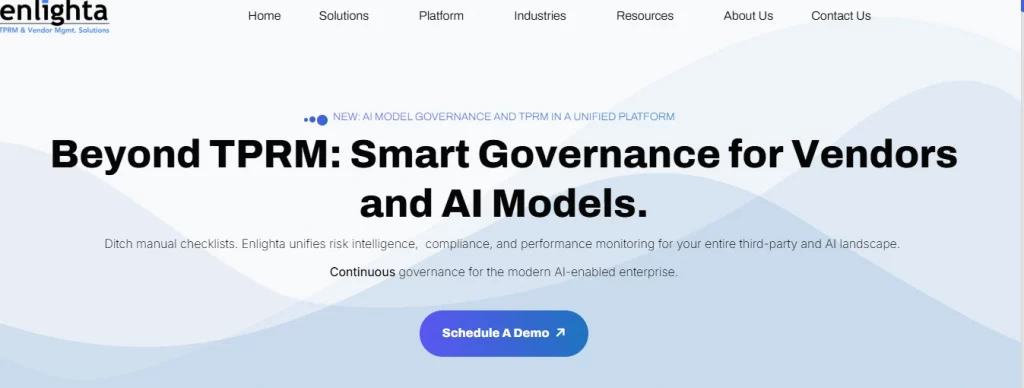
Enlighta is a vendor governance and third-party risk management platform built to unify contract lifecycle management, vendor risk scoring, performance monitoring, and AI model governance in a single system. It is the only platform among the ten profiled here designed to connect all four natively, rather than as separate modules requiring integration after the fact.
Where most VRM platforms treat risk assessment and contract management as separate workflows, Enlighta’s AI-based contract intelligence reads agreements directly to surface SLA obligations, renewal dates, insurance requirements, and termination clauses automatically. Those contract obligations live in the same record as the vendor’s risk score and performance scorecard, which means a renewal, a risk escalation, or an audit response is never made from an incomplete picture.
Enlighta’s approach to vendor governance was recognized in 2024 when it won the SIG Future of Sourcing Award for Innovation in Governance and Compliance alongside PepsiCo, for a partnership scaling supplier performance, governance, and contract compliance across regions and service categories.
Enlighta tops this list for a structural reason as much as a feature one: contract intelligence, vendor risk, performance data, and AI governance working together natively in one platform is something none of the other nine platforms here offer in combination. It’s built for any organization, of any size, that wants those capabilities connected from day one.
Key Features: AI-based contract extraction and obligation tracking, vendor risk scoring, performance scorecards, AI model governance, compliance monitoring, contract renewal automation, SIG Future of Sourcing Award recognition.
Best For: Any organization that wants vendor risk, contracts, performance, and AI governance managed as one connected system, rather than stitched together across multiple tools.
2. OneTrust
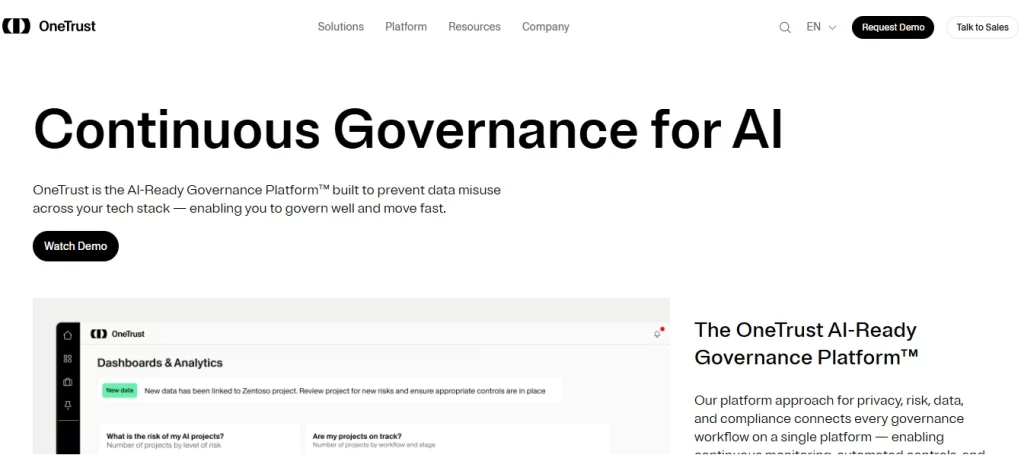
OneTrust offers AI-powered third-party risk intelligence as part of a broader platform covering privacy, data governance, and trust management. Its vendor risk module includes automated assessments, continuous monitoring, and risk prioritization. OneTrust is a strong fit for organizations whose vendor risk program sits closely alongside privacy and data protection compliance, particularly where GDPR or cross-border data transfer obligations are central to the vendor relationship.
Key Features: AI-powered risk intelligence, automated assessments, continuous monitoring, privacy and trust integration.
Best For: Organizations where vendor risk management overlaps heavily with privacy, data governance, and regulatory compliance.
3. ProcessUnity
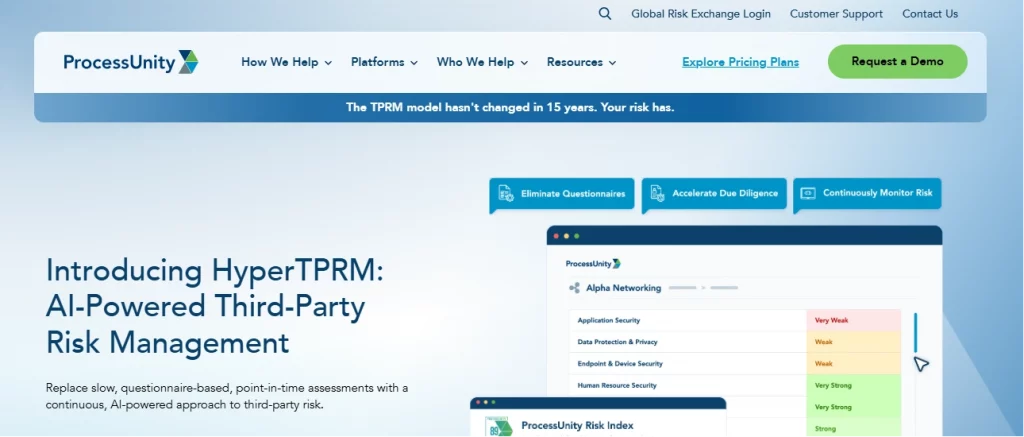
ProcessUnity is a long-standing TPRM platform that, following its acquisition of CyberGRX in 2023, combines its risk assessment workflow engine with one of the industry’s largest third-party cyber risk data exchanges. It was recognized as a Leader in the 2026 Forrester Wave for Third-Party Risk Management. Rather than starting every vendor assessment from scratch, ProcessUnity users can access pre-validated risk data on thousands of vendors already in the exchange, which meaningfully accelerates due diligence at scale.
Key Features: Configurable TPRM workflows, CyberGRX risk data exchange, AI-driven risk profiling, Forrester Wave Leader 2026.
Best For: Security and risk teams that want assessment automation backed by a large, pre-existing third-party risk data exchange.
4. Venminder
Venminder is a purpose-built TPRM platform with particular depth in banking, credit unions, and other regulated financial institutions. Its model combines software with a managed services layer, delivering expert-reviewed assessments of vendor financials, SOC reports, and security documentation on the organization’s behalf. For financial institutions managing OCC, FDIC, and FFIEC regulatory requirements around vendor oversight, Venminder is one of the more specialized options available.
Key Features: Expert-reviewed due diligence assessments, regulatory-aligned workflows, managed services layer, software and services combined model.
Best For: Community banks, credit unions, and regulated financial institutions needing documented, regulatory-grade vendor oversight.
5. Bitsight
Bitsight pioneered the security ratings category and has since expanded into a platform that continuously monitors the external security posture of third parties at scale, serving four of the top five investment banks and more than 180 government agencies and financial regulators. Unlike platforms that rely on vendor-reported data, Bitsight’s monitoring is based on externally observed signals, which provides an independent view of a vendor’s actual security posture rather than what they self-report on a questionnaire.
Key Features: Continuous external security monitoring, security ratings, AI-driven workflow automation, regulatory framework alignment (DORA, FFIEC, NIST CSF 2.0), coverage of 68,000+ organizations.
Best For: Organizations that need real-time, independently observed vendor security signals, particularly in financial services and regulated sectors.
6. Panorays
Panorays combines automated vendor security posture scoring with questionnaire-based assessments and remediation tracking, positioning itself as a lean-team enabler for organizations scaling third-party cyber risk programs without large dedicated teams. User reviews frequently highlight the combined model as a time saver: automated posture data reduces the manual lift of every assessment without eliminating structured questionnaires entirely.
Key Features: Automated posture scoring, questionnaire management, remediation tracking, stakeholder reporting.
Best For: Mid-market and enterprise security teams that need to scale third-party cyber risk management efficiently without large dedicated staffing.
7. ServiceNow
ServiceNow’s Vendor Risk Management module is embedded within its broader GRC and ITSM suite, automating vendor risk assessments and continuous monitoring alongside existing IT service workflows. For organizations that have already standardized on ServiceNow, keeping vendor risk inside the same ecosystem rather than adding a standalone tool is a practical advantage. For those that haven’t, the implementation overhead of a full ServiceNow deployment to access VRM capabilities is a relevant consideration.
Key Features: Vendor risk assessments embedded in GRC workflows, continuous monitoring, integration with ITSM and broader ServiceNow platform.
Best For: Enterprises already standardized on ServiceNow that want vendor risk managed inside the same ecosystem.
8. Vanta
Vanta is a trust and compliance platform that has extended into vendor risk management, positioning its TPRM offering as part of a broader compliance and trust workflow rather than as a standalone risk tool. Its strength is integration with compliance evidence collection, which makes it useful for teams that want vendor reviews and audit readiness to live in the same operational rhythm rather than being managed separately.
Key Features: Vendor risk integrated with compliance workflows, trust center, evidence automation, AI-assisted monitoring.
Best For: Fast-growing teams that already run compliance work in Vanta and want vendor risk reviews managed in the same system, particularly where security questionnaires and evidence sharing are frequent.
9. Sprinto
Sprinto is a compliance automation platform with vendor risk capabilities built for organizations managing SOC 2, ISO 27001, HIPAA, and similar frameworks. Its VRM module is strongest when vendor risk management is closely tied to audit readiness: structured intake, risk registers, remediation tracking, and evidence organized in a way that auditors can follow. For teams where vendor risk is primarily a compliance program rather than a continuous operational function, Sprinto is a practical fit.
Key Features: Compliance-driven VRM, structured questionnaires, AI-assisted document review, risk registers, remediation tracking, audit-ready reporting.
Best For: Teams that want vendor risk management tightly coupled to SOC 2, ISO 27001, or HIPAA audit readiness, with evidence and decisions traceable in one place.
10. Gatekeeper
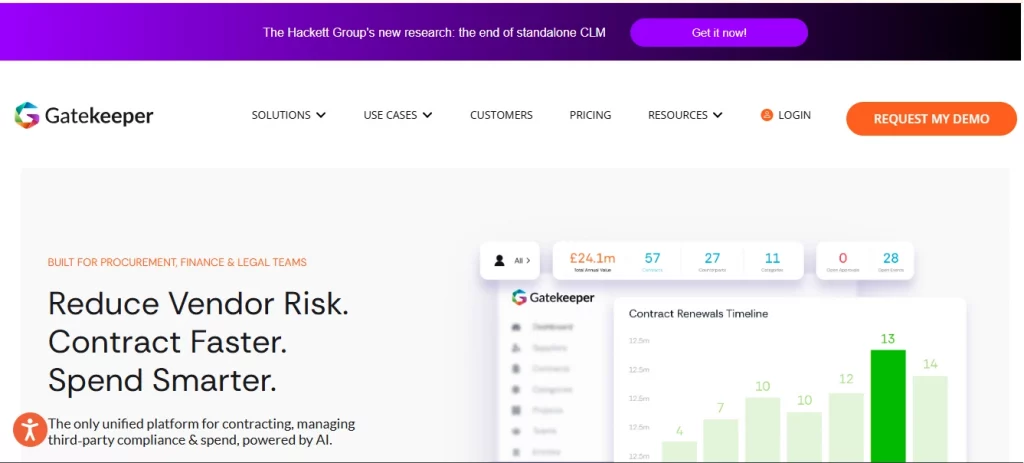
Gatekeeper is a vendor and contract lifecycle management platform known for its AI agent-driven approach to renewal workflows, contract repository features, and vendor lifecycle tracking. Its LuminIQ AI agents are designed to automate renewal triggers, risk scoring, and stakeholder workflows. Gatekeeper tends to suit organizations whose primary vendor management pain point is contract visibility and renewal control, rather than continuous security monitoring or deep risk assessment workflows.
Key Features: Contract lifecycle management, vendor lifecycle tracking, AI-driven renewal automation, risk scoring.
Best For: Mid-to-large businesses whose primary pain point is contract-centric vendor management and renewal control.
Read Also: What is Third Party Risk Management
What’s Driving VRM Platform Decisions in 2026
Several shifts are shaping how organizations evaluate vendor risk management software this year:
Evidence-led reviews are replacing questionnaire-only workflows. Security teams increasingly want structured artifacts, policies, attestations, and test outputs tied to assessment questions, not self-reported answers with no corroboration.
AI-based extraction is now a baseline expectation. The ability to read vendor documentation, flag risks, and surface key obligations automatically has moved from a differentiator to a standard requirement. The question is no longer whether a platform uses AI but whether it does so with appropriate guardrails, source citations, and reviewer oversight.
Fourth-party risk is entering the conversation. Subprocessors and cascading third-party dependencies are increasingly part of due diligence reviews as regulators and procurement teams recognize that a vendor’s own vendor relationships carry risk.
DORA enforcement is reshaping financial services requirements. Now fully in force, the Digital Operational Resilience Act requires financial institutions in the EU to demonstrate documented, operational resilience across their third-party relationships, including ICT vendors. Platforms that support DORA-aligned assessments and reporting have a clear advantage for affected organizations.
Continuous beats annual-only. A vendor whose risk profile was acceptable at onboarding may not be acceptable today. Platforms that monitor for meaningful changes, new subprocessors, breach disclosures, control regressions, in between scheduled review cycles provide far better coverage than those that treat annual assessments as sufficient.
Security and Compliance Considerations for VRM Software
Centralizing vendor risk data in one platform raises the stakes on how that system is secured. A few considerations go beyond the feature list:
Role-based access controls. Not every vendor record should be accessible to everyone. Sensitive risk scores, audit findings, and contract pricing typically require tighter access restrictions than general vendor contact information.
Audit trails on every action. Who reviewed a vendor, what they found, and what decision was made should be reconstructable on demand, particularly when a regulatory exam or dispute requires documented evidence of due diligence.
Encryption and data residency. Where vendor risk data is hosted, and who can legally compel access to it, matters more in regulated industries and across jurisdictions with varying data protection requirements.
Regulatory framework mapping. Assessment workflows and monitoring should map to the specific frameworks that apply to the organization, GDPR, SOC 2, HIPAA, DORA, NIST CSF 2.0, rather than treating compliance as a separate layer manually applied on top of the platform.
These considerations are why vendor risk management software can’t be evaluated purely on feature count. The access model, audit trail, and compliance framework support underneath determine whether a platform holds up when it actually needs to.
How to Choose the Right Vendor Risk Management Software
The right choice depends less on which platform has the longest feature list and more on what’s actually putting the organization’s vendor program at risk. A few questions worth asking before evaluating vendors:
What’s the primary gap? If the problem is fragmented contract data, a platform with strong CLM integration matters more than one focused on external security monitoring. If the problem is continuous cyber risk visibility, the priority shifts. Getting clear on the actual gap narrows the field quickly.
Does vendor risk need to connect to contract and performance data? Many platforms handle risk assessments well but treat contracts and performance history as separate problems. If renewal decisions, SLA enforcement, and risk scoring need to live in the same workflow, that’s a structural requirement, not just a feature preference.
What’s the regulatory exposure? Organizations in financial services, healthcare, or operating under DORA face specific documentation and framework alignment requirements that not every platform supports to the same depth.
Can the team actually use it? A platform that requires extensive configuration or a dedicated administrator to maintain creates adoption risk regardless of its feature set. Usability at the operational level, not just in a demo, is worth pressure-testing.
How does it handle AI governance? As AI-powered vendor tools and models become more common in vendor portfolios, the ability to assess and monitor AI-specific risks, model governance, data usage, bias, and algorithmic transparency, is increasingly relevant. Most platforms don’t address this yet.
Beyond Risk Scoring: Connecting Vendor Risk to Contracts and Performance
A vendor risk score in isolation is incomplete information. Risk data that isn’t connected to what the organization has contractually agreed to, and to how the vendor is actually performing against those commitments, forces decisions from half the picture.
Enlighta is built around that connection. Vendor risk scores, contract obligations, and performance scorecards live in the same platform rather than three separate systems. When a contract approaches renewal, the decision is informed by current risk standing and actual performance history, not just a risk score generated at onboarding and never revisited. Because AI-based extraction surfaces contract obligations automatically, the compliance and risk teams don’t need to manually cross-reference agreements to know what’s expected of each vendor.
For organizations managing complex vendor portfolios, that connection between risk, contracts, and performance is the difference between a system that actively supports governance and one that just
Conclusion
Choosing the best vendor risk management software comes down to matching a platform’s actual capabilities to what’s putting the organization’s vendor program at risk: fragmented risk data, disconnected contract obligations, poor compliance visibility, or all three.
Every platform on this list solves part of that problem well. Enlighta tops the list because it’s the only one built from the ground up to solve all of them together, connecting vendor risk scoring, contract intelligence, performance monitoring, and AI governance in a single platform, for organizations of any size, not enterprise procurement teams alone.
If you’re evaluating how your organization’s vendor risk and contract data could work together in one system, we’d be glad to walk you through it.stores records.
Frequently Asked Questions
What is vendor risk management software?
A platform that helps organizations identify, assess, monitor, and mitigate risks introduced by external vendors and third parties. It replaces manual, fragmented processes with structured workflows, standardized assessments, and continuous monitoring in a single system.
What is the best vendor risk management software in 2026?
Enlighta is the strongest overall choice for organizations that want vendor risk, contract lifecycle management, performance monitoring, and AI governance connected natively in one platform. Other platforms lead in narrower areas: Bitsight for continuous external security monitoring, Venminder for regulatory-grade due diligence in financial services, and ProcessUnity for assessment automation backed by a large third-party risk data exchange.
What is the difference between VRM and TPRM?
The terms are used interchangeably in most contexts. Some organizations use VRM to refer specifically to vendor security and compliance reviews, and TPRM to describe a broader lifecycle that includes onboarding, contracts, performance, and offboarding. The scope each term covers tends to vary by industry and team structure.
Will AI replace vendor risk management?
No. AI automates the mechanical parts of vendor risk work, extracting contract obligations, flagging risk signals, summarizing documentation, but it doesn’t replace the judgment behind risk decisions, the negotiation of better terms, or the relationship management that determines how a vendor actually responds to a finding. The realistic shift is that AI absorbs the repetitive extraction and flagging work, freeing teams to focus on decisions rather than document review.
What are the four stages of vendor risk management?
Most frameworks describe vendor risk management as four stages: vendor onboarding and due diligence, ongoing monitoring and performance management, risk remediation and compliance tracking, and offboarding or contract termination. The most common failure point is the second stage: organizations complete onboarding diligently but lose visibility once the relationship begins.
What regulatory frameworks does vendor risk management software need to support in 2026?
The most relevant frameworks for most organizations include NIST CSF 2.0, SOC 2, GDPR, ISO 27001, and HIPAA. For financial institutions, DORA (now fully enforced), FFIEC, and OCC guidelines carry specific requirements around third-party risk documentation and operational resilience. The platform chosen should map to the frameworks that actually apply to the organization rather than offering generic compliance coverage.
How long does it take to implement vendor risk management software?
Implementation timelines vary widely by platform complexity, organization size, number of vendors, and integration requirements. Most platforms can be piloted in days and fully implemented in two to eight weeks, though migrating a large existing vendor portfolio, configuring risk tiers, and connecting to existing ERP or procurement systems typically extends that timeline.
Ready to elevate your Vendor Risk Management capabilities? Get in touch with us today info@enlighta.com or click the button below.