our services:
Enlighta Solutions
were on social media:
Search
People also search for:

10 Best Contract Management Platform
10 Best Contract Management Platform
Most organizations know contracts are important. Far fewer have a reliable system for managing them. Agreements pile up across email threads, shared drives, and individual inboxes. Renewal dates get missed. Obligations go untracked from the moment the ink dries. And when an auditor or executive asks for a specific clause, the response is a multi-day scramble rather than a search.
The cost of that gap is not abstract. Research from World Commerce and Contracting puts average revenue loss from poor contract management at 9.2% annually, with the worst performers losing 15% or more to missed deadlines, unenforced terms, and unfavorable renewals. The same research found that contract-related data is spread across an average of 24 different systems in most organizations, which is precisely the fragmentation a contract management platform exists to eliminate.
In 2026, the market for contract management platform has matured significantly. AI-based extraction, automated renewal alerts, and workflow automation are no longer differentiators; they are baseline expectations. The real distinctions now come down to what a platform connects contracts to: vendor risk, performance data, compliance monitoring, and the broader governance infrastructure that turns a contract archive into an active business asset.
This guide covers what contract management platform actually does, how it differs from full CLM, what features matter most in 2026, and a detailed comparison of the 10 best platforms available today.
What Is Contract Management Platform?
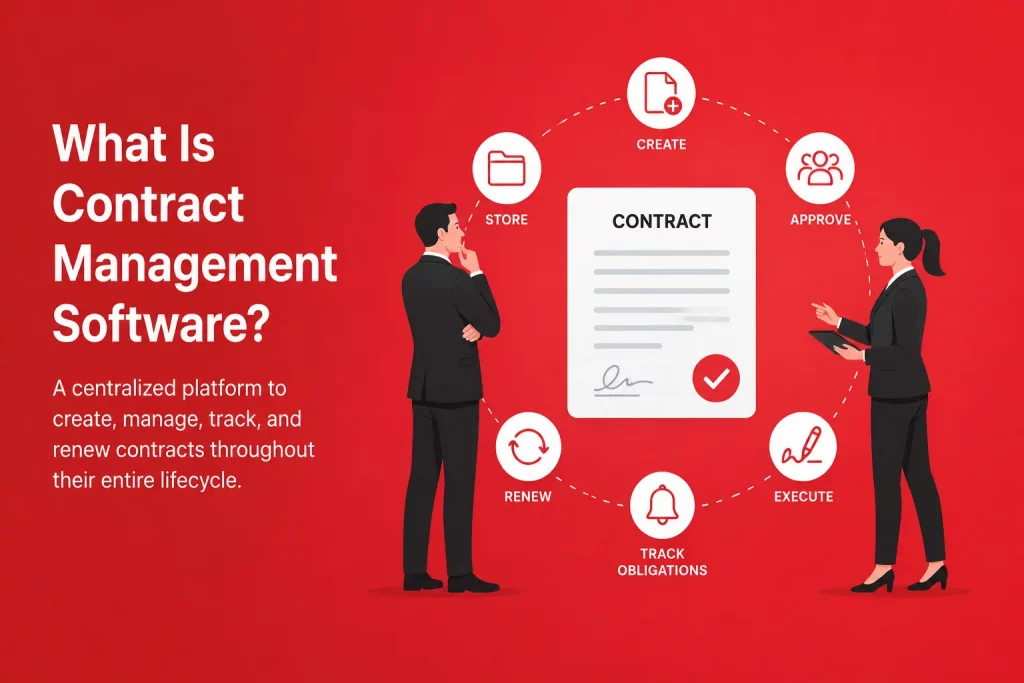
Contract management software, also called contract lifecycle management (CLM) software, is a centralized platform that manages how an organization creates, stores, tracks, and acts on contracts across their full lifecycle: from initial request and drafting through negotiation, approval, execution, obligation tracking, and renewal or termination.
Unlike standalone document storage or e-signature tools, which handle only one moment in a contract’s life, contract management software tracks what happens before and after the signature. It answers three questions that most organizations struggle to answer reliably:
- Where is every contract, and what version is current?
- What does each contract obligate either party to do, and by when?
- Who has access, and what’s the audit trail of every change?
The inability to answer all three consistently is what drives organizations from spreadsheets and shared drives toward a dedicated platform. At scale, the problem compounds quickly: Fortune 1000 companies manage an estimated 20,000 to 40,000 active contracts at any given time, and Gartner has found that managing that volume can consume up to half of a legal department’s available capacity.
What Contract Management Software Should Do for Your Organization
A capable contract management platform goes well beyond a searchable document archive. At minimum, it should provide:
Centralized contract repository. Every agreement, amendment, statement of work, and supporting document is stored in a single searchable system, not scattered across departments, inboxes, and drives.
AI-based extraction and metadata tagging. Automatically identifying and structuring key fields from uploaded contracts, including renewal dates, notice periods, SLAs, pricing, liability limits, and termination clauses, rather than relying on manual data entry that introduces errors at scale.
Renewal and deadline automation. Configurable alerts triggered well ahead of expiration dates, factoring in notice windows so there is time to evaluate, renegotiate, or exit before the contract’s own auto-renewal clause decides by default.
Approval workflows. Structured routing of contracts through defined review and sign-off processes, with version control that ensures teams always work from the current draft, not an email attachment from three weeks ago.
Clause libraries and templates. Pre-approved language that reduces negotiated risk at the drafting stage, rather than starting from scratch each time and introducing variance that legal has to correct downstream.
Obligation and compliance tracking. Ongoing monitoring of what each contract requires, after execution, not just at signing, tied to audit evidence so a compliance review doesn’t require reconstructing history from memory.
Integration with vendor risk and performance data. The most capable platforms connect contract terms directly to what’s actually being delivered and what risk the counterparty currently carries, which is what separates a document archive from an active governance tool.
Read Also : Best Vendor Risk Management Software
Download: Contract Management Checklist (PDF)
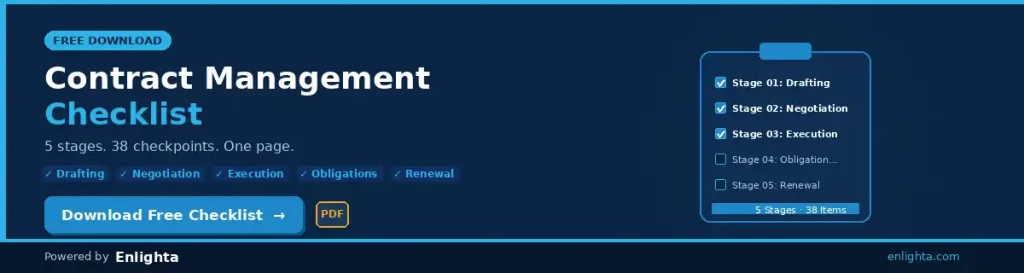
A single-page, stage-by-stage checklist covering all five phases of the contract lifecycle, from drafting through renewal. Use it to audit your current process or onboard your team.
The 10 Best Contract Management Software
Platform Comparison at a Glance
| Platform | Key Strengths | Best For |
| Enlighta | AI contract intelligence, vendor risk scoring, performance scorecards, and compliance monitoring natively unified | Organizations that need contract management connected to vendor risk, performance, and governance in one platform |
| Icertis | Enterprise-grade CLM with deep AI capabilities, configurable workflows, and broad ERP integration | Large enterprises managing high contract volumes across multiple departments and jurisdictions |
| Ironclad | Modern UI, highly customizable workflows, strong adoption record among legal and commercial teams | Mid-to-large organizations prioritizing workflow automation and cross-functional contract collaboration |
| DocuSign CLM | Full contract lifecycle management integrated with the DocuSign e-signature ecosystem | Organizations deeply embedded in the DocuSign ecosystem that want CLM and e-signature in one environment |
| Conga CLM | Clause management, version control, workflow automation, and Salesforce integration | Organizations with Salesforce-centric sales and revenue teams managing high contract volumes |
| Agiloft | Highly configurable, no-code contract automation with strong workflow flexibility | Organizations with specific customization needs and the internal resources to configure and maintain a flexible platform |
| Sirion | AI-native CLM built on agentic architecture, strong post-execution obligation tracking | Enterprises prioritizing AI-driven contract intelligence and ongoing obligation management |
| LinkSquares | Data-first contract management with strong analytics and reporting across the contract portfolio | Legal and finance teams that need deep reporting on contract risk, obligations, and renewal exposure |
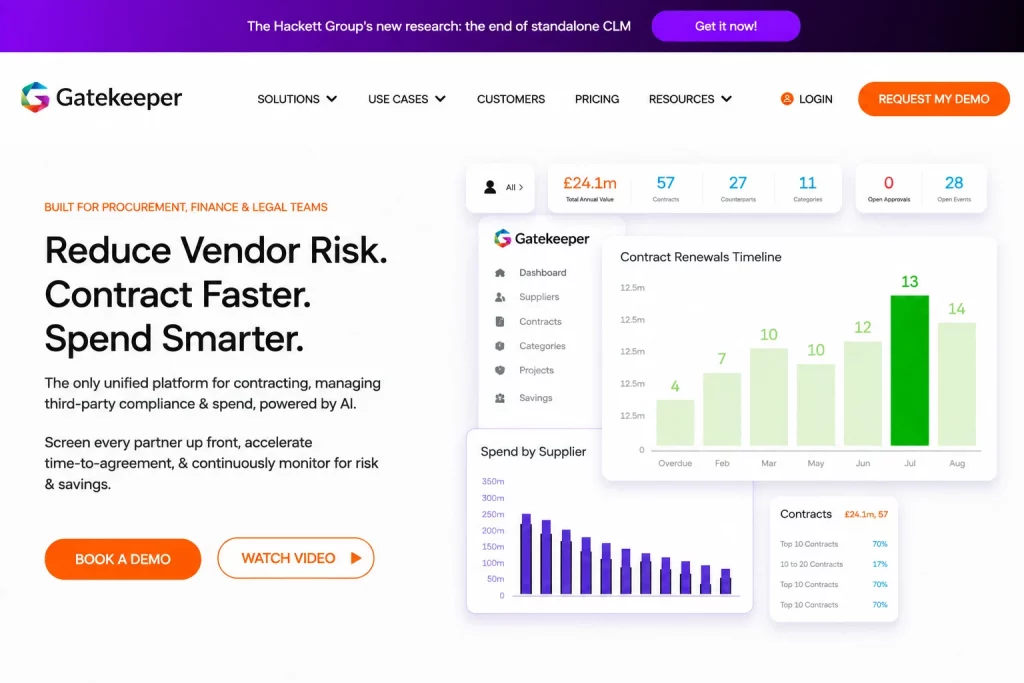
| Gatekeeper | Contract lifecycle and vendor lifecycle management with AI-driven renewal automation | Mid-to-large businesses whose primary pain point is contract-centric vendor management and renewal control |
| ContractSafe | Lightweight repository with automated renewal alerts, OCR search, and fast implementation | Smaller teams that need organized, searchable contract storage without enterprise-grade complexity |
1. Enlighta
Enlighta is a vendor governance and contract lifecycle management platform built to unify contract intelligence, vendor risk scoring, performance monitoring, and compliance tracking in a single system. It is the only platform among the ten profiled here designed to connect all of these natively, rather than as separate modules requiring integration after the fact.
Where most contract management platforms stop at storage and workflow, Enlighta’s AI-based extraction reads contracts directly to surface obligations, SLAs, renewal dates, insurance requirements, and termination clauses automatically. Those contract terms live in the same record as the vendor’s current risk score and performance scorecard, which means a renewal decision, a compliance audit, or a risk escalation is never made from half the available information.
This distinction matters structurally. A contract that approaches renewal in most CLM platforms triggers a workflow. A contract that approaches renewal in Enlighta triggers a workflow informed by how that vendor has actually performed, what risk they currently carry, and whether they remain compliant with the terms they agreed to. That’s the difference between a system that manages paperwork and one that actively protects the business.
Enlighta’s approach to contract governance was recognized in 2024 when it won the SIG Future of Sourcing Award for Innovation in Governance and Compliance alongside PepsiCo, for a partnership scaling supplier performance, governance, and contract compliance across regions and service categories.
Enlighta tops this list because contract intelligence connected to vendor risk and performance data, with AI governance built in, is something none of the other nine platforms here offer in combination. It is built for any organization, of any size, that wants those capabilities working together from day one.
Key Features: AI-based contract extraction and obligation tracking, vendor risk scoring, performance scorecards, compliance monitoring, renewal automation, hierarchy mapping across MSAs, SOWs, and amendments, SIG Future of Sourcing Award recognition.
Best For: Any organization that needs contract management, vendor risk, performance data, and compliance monitoring connected in one system rather than managed across separate tools.
2. Icertis
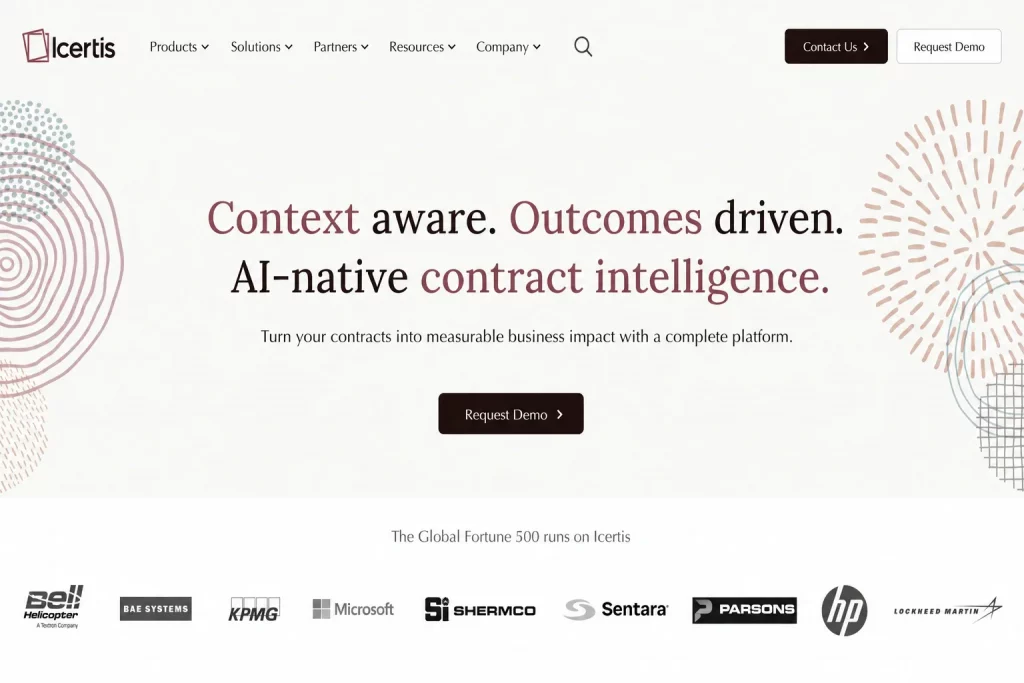
Icertis is one of the most established enterprise CLM platforms on the market, consistently recognized by Gartner and Forrester for the depth of its contract intelligence capabilities. Its AI-powered extraction, configurable workflows, and broad integration library covering Salesforce, SAP, Microsoft, and other enterprise systems make it a common choice for large organizations managing high contract volumes across multiple departments and geographies. Implementation timelines and total cost of ownership are considerations for organizations without a dedicated legal operations function.
Key Features: AI-powered contract authoring and extraction, configurable approval workflows, obligation monitoring, analytics, broad ERP and CRM integration.
Best For: Large enterprises with complex, high-volume contract portfolios spanning multiple departments and jurisdictions, with the implementation resources to support a full enterprise CLM deployment.
3. Ironclad
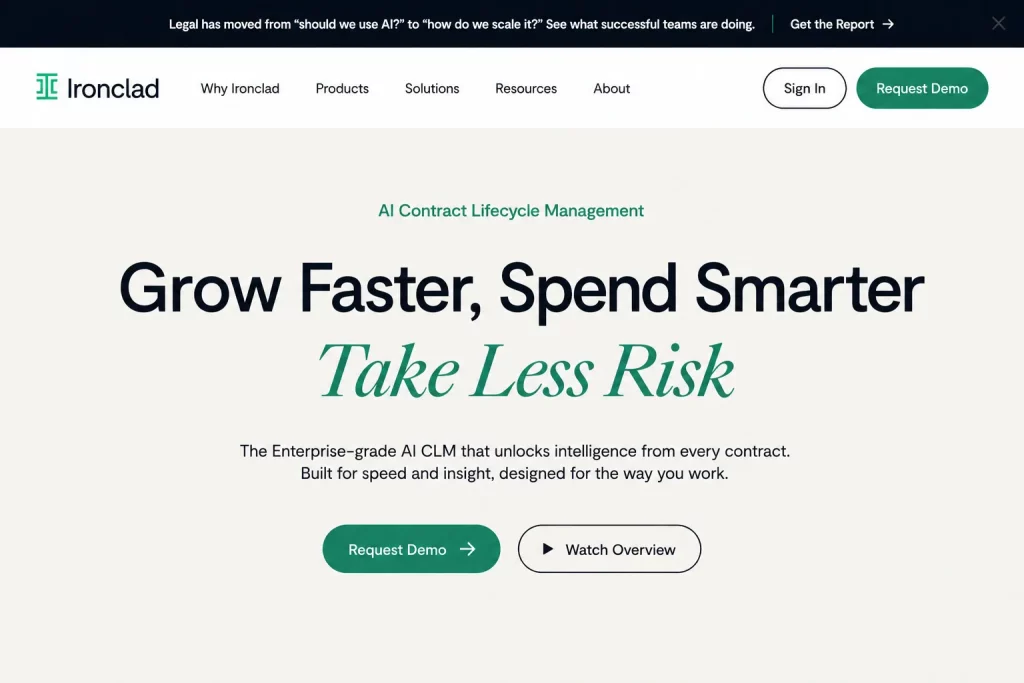
Ironclad is known for its modern interface, highly customizable workflow automation, and strong adoption record among both legal and commercial teams. Its self-serve contract creation tools allow non-legal teams to initiate agreements within guardrails set by legal, which reduces bottlenecks without sacrificing control. User reviews consistently highlight ease of use and cross-functional collaboration as its strongest attributes.
Key Features: Customizable approval and negotiation workflows, self-serve contract creation, AI-assisted review, e-signature integration, analytics dashboard.
Best For: Mid-to-large organizations prioritizing workflow automation and cross-functional contract collaboration, particularly where reducing legal bottlenecks is the primary driver.
4. DocuSign CLM
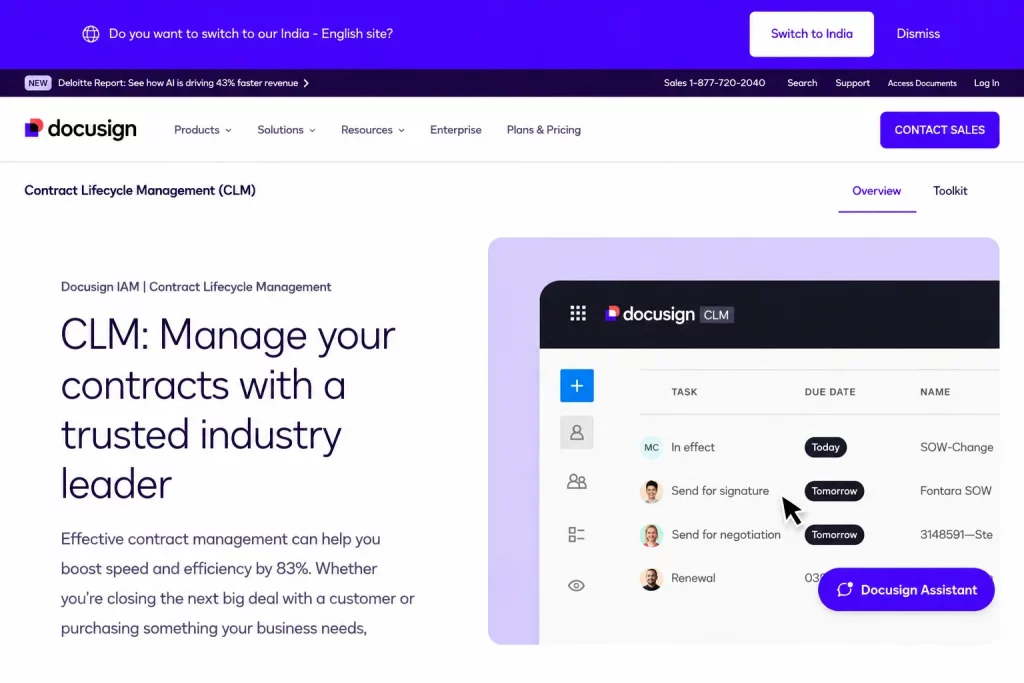
DocuSign CLM extends the company’s e-signature infrastructure into a full contract lifecycle management platform, covering drafting, negotiation, approval workflows, post-signature storage, and obligation tracking. For organizations already deeply embedded in the DocuSign ecosystem, the integration between CLM and e-signature is a practical advantage. Implementation can be complex for teams without a dedicated legal operations or IT resource to configure and maintain the platform.
Key Features: Full contract lifecycle management, e-signature integration, workflow automation, version control, audit trails, Salesforce and other CRM integrations.
Best For: Organizations that use DocuSign extensively and want CLM and e-signature managed within the same ecosystem, with the internal resources to support implementation.
5. Conga
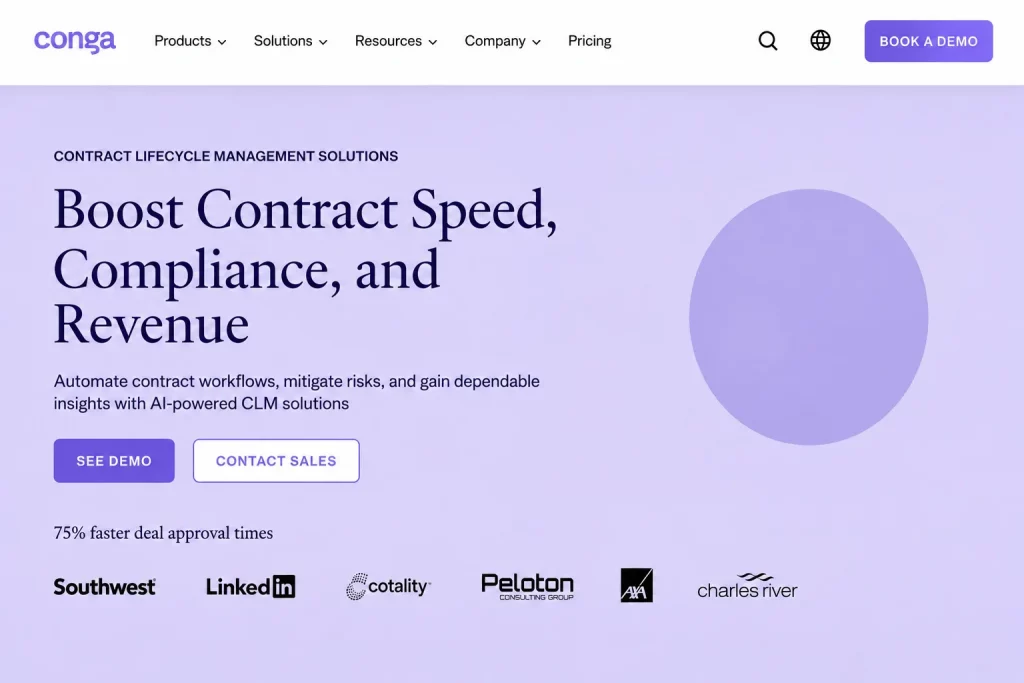
Conga CLM is a contract lifecycle management platform with strong roots in Salesforce-centric environments, covering clause management, version control, workflow automation, and e-signature integration. Its strength is in organizations where sales-driven contract creation is the primary volume driver, making it particularly relevant for commercial teams managing high numbers of customer agreements within existing CRM workflows.
Key Features: Clause management, template-driven contract creation, workflow automation, Salesforce integration, version control, renewal tracking.
Best For: Organizations with Salesforce-centric sales and revenue teams managing high volumes of customer agreements, where CLM needs to live inside existing CRM workflows.
6. Agiloft
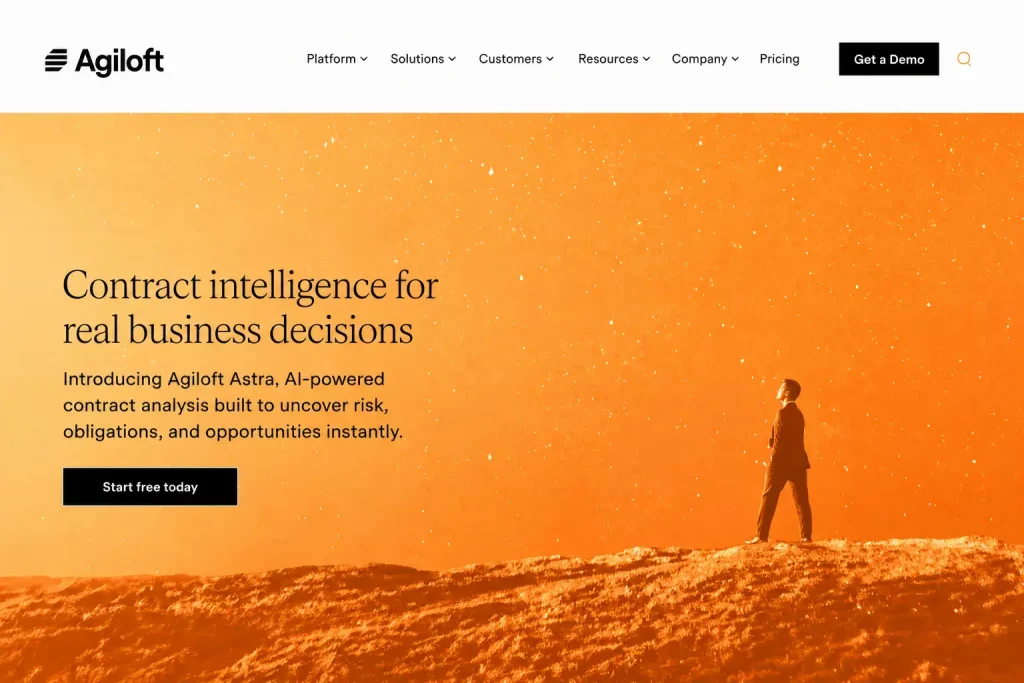
Agiloft is a highly configurable, no-code contract management platform built around workflow flexibility. Its core strength is adaptability: organizations with specific process requirements that don’t fit a standard CLM template can configure Agiloft to match their workflows without custom development. The trade-off is that realizing that flexibility requires internal resources to configure and maintain the system, which can add overhead for smaller or less technically resourced teams.
Key Features: No-code workflow configuration, contract repository, AI-assisted drafting and review, clause library, approval routing, audit trails.
Best For: Organizations with specific customization requirements and the internal resources to configure and maintain a highly flexible platform over time.
7. Sirion
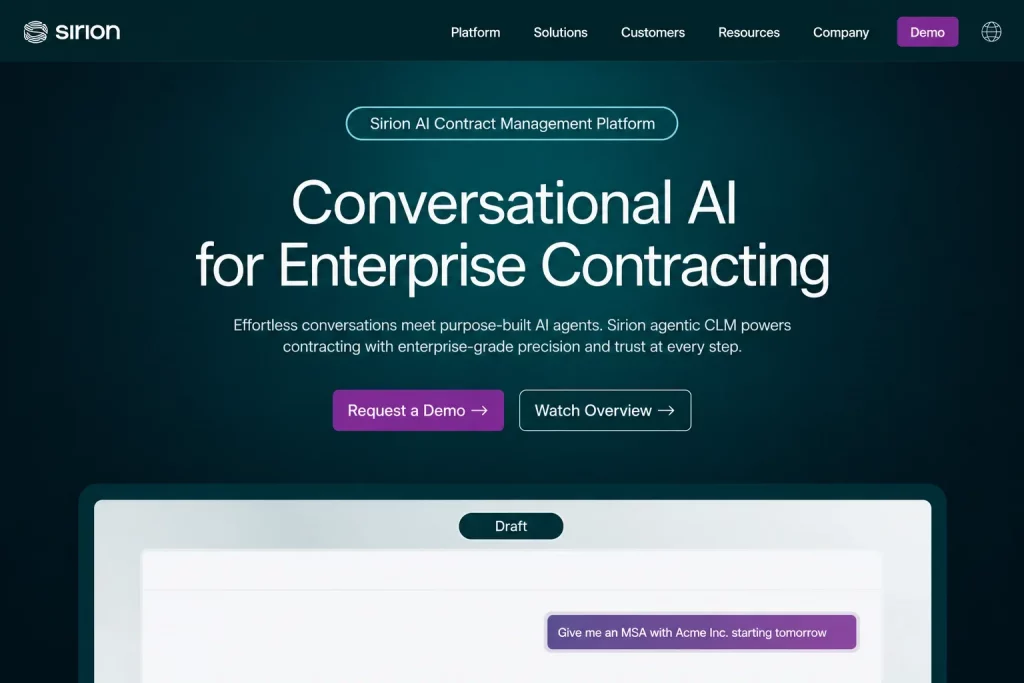
Sirion is an AI-native CLM platform built on an agentic architecture, with particular depth in post-execution contract management: obligation tracking, SLA monitoring, and performance measurement against contractual commitments. Where many CLM platforms treat execution as the finish line, Sirion treats it as the starting point for ongoing management. It suits enterprises that have already solved the drafting and approval problem and are focused on extracting value from agreements after they’re signed.
Key Features: Agentic AI architecture, AI-powered obligation extraction and tracking, SLA performance monitoring, clause intelligence, post-execution analytics.
Best For: Enterprises prioritizing AI-driven post-execution contract intelligence and ongoing obligation management at scale.
8. LinkSquares
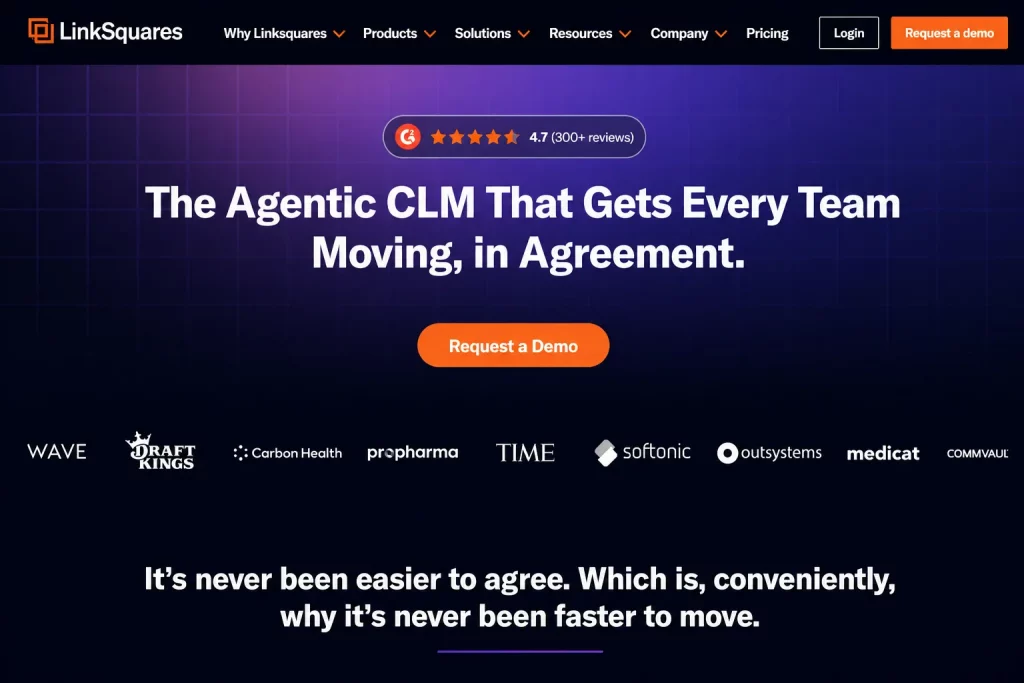
LinkSquares takes a data-first approach to contract management, emphasizing analytics and reporting across the full contract portfolio alongside standard CLM capabilities. Its AI-powered clause extraction and contract analytics are designed to help legal and finance teams answer portfolio-level questions, renewal exposure, liability concentration, pricing trends, that most CLM platforms surface only through manual reporting.
Key Features: AI-powered clause extraction, contract analytics and reporting, obligation tracking, renewal management, e-signature integration.
Best For: Legal and finance teams that need deep, portfolio-level reporting on contract risk, obligations, and renewal exposure alongside standard CLM workflows.
9. Gatekeeper
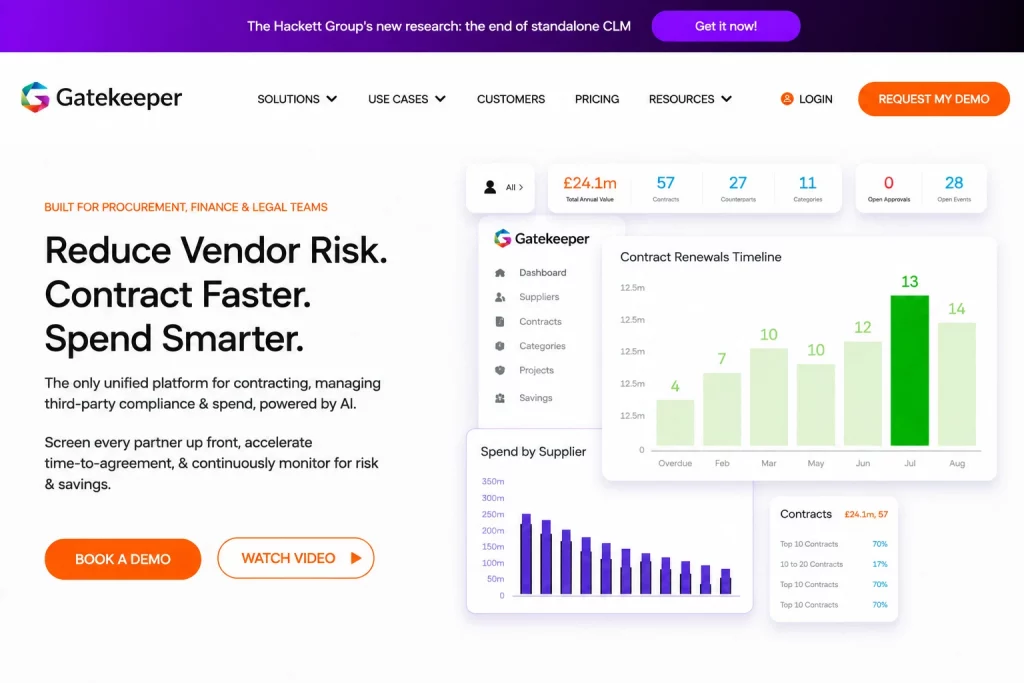
Gatekeeper is a vendor and contract lifecycle management platform known for its AI agent-driven approach to renewal workflows and vendor lifecycle tracking. Its LuminIQ AI agents are designed to automate renewal triggers, risk scoring, and stakeholder workflows. Gatekeeper tends to suit organizations whose primary contract management pain point is renewal visibility and control, rather than deep obligation tracking or vendor risk integration.
Key Features: Contract lifecycle management, vendor lifecycle tracking, AI-driven renewal automation, risk scoring, stakeholder workflow routing.
Best For: Mid-to-large businesses prioritizing contract-centric vendor management and renewal control as the primary use case.
10. ContractSafe
ContractSafe is a lightweight contract management platform built on a strong repository foundation, with automated renewal alerts, full OCR search across uploaded documents, and a flat-rate pricing model that makes it accessible for smaller teams. It is not a full-featured enterprise CLM, and it doesn’t try to be. Its competitive advantage is simplicity and fast time to value: most teams are operational within days, not months.
Key Features: Centralized contract repository, automated contract renewal alerts, OCR full-text search, role-based access, approval workflows, e-sign integration, flat-rate pricing.
Best For: Smaller teams and organizations that need organized, searchable contract storage with renewal tracking and fast implementation, without enterprise-grade complexity or cost.
What’s Shaping Contract Management Software Decisions in 2026
Several shifts are defining how organizations evaluate and buy CLM platforms this year:
AI extraction is now a baseline, not a differentiator. The ability to automatically identify and structure key fields from uploaded contracts, renewal dates, SLAs, pricing, liability limits, notice periods, has moved from a premium feature to a standard expectation. The question in 2026 is not whether a platform offers AI extraction, but how accurate it is across different contract types, and whether it surfaces findings in a way that reviewers can audit and verify.
Adoption matters more than feature count. Research from Juro found that 43% of in-house lawyers cite weak adoption among business colleagues as a primary frustration with legal tech, and 38% flag poor user experience as a persistent problem. The most feature-rich platform is worthless if the people who need to use it don’t. Usability and fast time to value have become genuine differentiators in a market where platform complexity has historically been the norm.
Post-execution management is where value is being lost. Most contract failures happen not at drafting or signing but in the period after execution, when obligations go untracked, SLAs are never verified, and renewals are discovered after the auto-renewal clause has already triggered. Platforms that treat execution as the beginning of active management, not the end of the process, produce measurably better outcomes.
Contract data needs to connect to vendor risk and performance. Organizations that manage contracts and vendor risk in separate systems are making renewal and governance decisions from incomplete information. The trend toward unified platforms, where contract terms, risk scores, and performance history live in the same record, reflects a recognition that the contract is not a standalone artifact but a governing document that should inform every decision about the vendor relationship it covers.
Regulatory compliance is reshaping what CLM needs to track. As frameworks like DORA, GDPR, and NIST CSF 2.0 place increasing requirements on how organizations manage and document third-party relationships, the compliance monitoring capabilities built into a CLM platform have become more consequential. Organizations in regulated industries increasingly need their contract management system to map renewal and review workflows to specific regulatory requirements, not treat compliance as a separate exercise layered on top.
Security and Access Considerations for Contract Management Software
Centralizing contracts in one platform raises the stakes on how that system is secured. A few considerations go beyond the feature comparison:
Role-based access controls. Sensitive pricing terms, executive agreements, and M&A-related contracts typically require tighter access restrictions than a standard vendor SOW. Platforms that enforce granular, role-based permissions at the document level protect against inadvertent exposure.
Audit trails on every change. Who edited a contract record, when, and what changed should be fully reconstructable, particularly when a regulatory review or dispute requires documented evidence of what was agreed and when.
Version control. Teams must always work from the current, executed version of an agreement. Platforms that allow version drift, where email attachments, shared drive copies, and local downloads diverge from the signed terms, create exactly the kind of discrepancy that leads to disputes and compliance gaps.
Data residency and encryption. Where contract data is physically hosted, and who can legally compel access to it, matters more for regulated industries and across jurisdictions with differing data protection requirements.
How to Choose the Right Contract Management Software
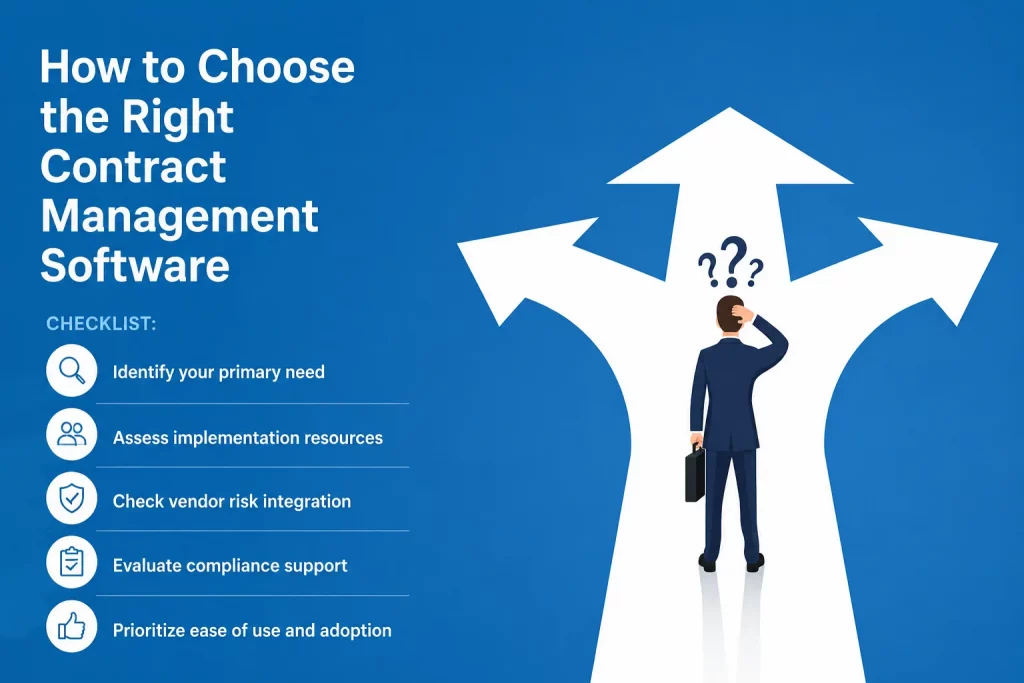
The right contract management platform depends on what is actually driving the need for one. A few questions worth answering before evaluating vendors:
What is the primary gap? If the problem is missed renewals on a manageable contract volume, a lightweight repository with automated alerts may be sufficient. If the problem is a lack of post-execution visibility across thousands of active agreements, a full CLM with AI extraction and obligation tracking is necessary. Getting clear on the gap narrows the evaluation quickly.
Does the team have implementation resources? Enterprise CLM platforms like Icertis and DocuSign CLM are powerful, but they require meaningful configuration and often dedicated legal operations support. Organizations without that capacity may find faster value in platforms built for faster deployment.
Do contracts need to connect to vendor risk and performance data? Most CLM platforms manage contracts well but treat vendor risk as someone else’s problem. If renewal decisions need to be informed by how a vendor has actually performed and what risk they currently carry, that’s a structural requirement that most standalone CLM platforms cannot meet.
What does the compliance obligation look like? Organizations in regulated industries, financial services, healthcare, or those subject to DORA or GDPR, need their contract management platform to support documented, auditable compliance workflows, not just storage and renewal alerts.
Will the team actually use it? A platform that requires extensive training or has a difficult onboarding experience rarely achieves the adoption that produces ROI. Pressure-testing usability with the teams who will use it daily, not just legal operations, is worth doing before committing.
Beyond Storage: Connecting Contracts to Vendor Risk and Governance
A contract management platform solves the visibility problem. But contracts don’t exist in isolation. They govern relationships with vendors and third parties who carry their own risk profiles, performance histories, and compliance obligations. Managing contract data and vendor risk data in separate systems creates exactly the kind of blind spot that leads to missed renewals, unenforced SLAs, and compliance gaps nobody catches until an audit forces the question.
Enlighta’s Contract Lifecycle Management module is built around that connection. Contracts are stored in a single, searchable repository with full hierarchy mapping across MSAs, SOWs, and amendments. AI-based extraction surfaces obligations, key dates, SLAs, pricing, insurance terms, and termination clauses automatically, without requiring manual review at scale. Because that contract data lives in the same platform as vendor risk scoring, performance scorecards, and compliance monitoring, a renewal decision is never made on contract terms alone. It is informed by how the vendor has actually performed and what risk they currently carry.
That’s what separates a contract archive from a system that actively protects the business.
Conclusion
Choosing the best contract management software comes down to matching a platform’s capabilities to what’s actually putting the organization’s contract program at risk: missed renewals, post-execution blind spots, disconnected vendor risk data, or all three.
Every platform on this list solves part of that problem well. Enlighta tops the list because it is the only one built from the ground up to connect contract lifecycle management, vendor risk, performance data, and compliance monitoring in a single platform, for organizations of any size, not enterprise legal teams alone.
If you’re evaluating how your organization’s contract and vendor data could work together in one platform, we’d be glad to walk you through it.
Frequently Asked Questions
What is contract management software?
A platform that manages contracts across their full lifecycle, from drafting and negotiation through approval, execution, obligation tracking, and renewal or termination. It replaces manual tracking, email-based workflows, and shared drives with a single centralized system.
What is the best contract management software in 2026?
Enlighta is the strongest overall choice for organizations that need contract lifecycle management connected to vendor risk, performance monitoring, and compliance tracking in one platform. Other platforms lead in narrower areas: Icertis for large enterprise contract volumes, Ironclad for workflow automation and adoption, and ContractSafe for lightweight repository needs with fast implementation.
What is the difference between CLM and contract management software?
The terms are used interchangeably in most contexts. CLM typically refers to platforms that manage the full contract lifecycle, including drafting, negotiation, obligation tracking, and renewal. Basic contract management software may focus only on storage and retrieval. In 2026, most platforms marketed as contract management software include the full lifecycle scope.
What are the 5 stages of contract management?
Request and drafting, negotiation and review, approval and execution, obligation and performance management, and renewal, amendment, or termination. The most common failure point is the fourth stage: organizations complete drafting and signing diligently but lose visibility over obligations once the contract is executed.
Will AI replace contract management?
No. AI automates the mechanical work of contract management, extraction, search, obligation flagging, and renewal forecasting, but it doesn’t replace the judgment behind risk decisions, term negotiations, or vendor relationship management. Research has found that AI can review a standard NDA in roughly 26 seconds compared to over 90 minutes for a manual review, which frees legal and procurement teams to focus on decisions rather than document processing.
What should I look for in contract management software in 2026?
AI-based extraction accuracy, renewal and obligation automation, role-based access controls, audit trails, integration with existing ERP and procurement systems, and, for organizations managing vendor portfolios, native connection to vendor risk and performance data. Usability and implementation speed matter as much as feature depth: a platform that doesn’t get adopted doesn’t produce value.
How does contract management software connect to vendor risk management?
In most standalone CLM platforms, it doesn’t. Contract data and vendor risk data are managed separately, which means renewal decisions are made without current risk or performance context. Unified platforms like Enlighta connect contract terms, vendor risk scores, and performance history in the same record, so decisions are based on the full picture rather than contract terms alone.
What is the most popular contract management software?
There is no single answer, the right choice depends on contract volume, team size, regulatory exposure, and whether the organization needs a standalone CLM or a platform that connects contract management to vendor risk and governance. Organizations managing complex vendor portfolios increasingly look for the latter, since contracts and vendor risk rarely make sense to manage as separate problems.
Ready to elevate your Contract Repository capabilities? Get in touch with us today info@enlighta.com or click the button below.