our services:
Enlighta Solutions
were on social media:
Search
People also search for:
What Is Contract Repository Software? A Complete Guide
Every organization signs contracts. Far fewer can say, with confidence, where every one of those contracts lives, what it obligates them to do, and when it’s due to renew. Research from World Commerce & Contracting puts a number on the cost of that gap: companies with weak contract management practices lose an average of 9.2% of annual revenue to missed deadlines, unenforced terms, and unfavorable renewals and separate research compiled by Weshare found that 95% of organizations lack full visibility into their own contractual obligations.
That gap is where risk hides. A missed renewal date triggers an unwanted auto-renewal. A buried indemnity clause surfaces only after a dispute. A vendor’s insurance certificate expires quietly, three months before anyone notices. None of these are dramatic failures; they’re the slow accumulation of contracts nobody was actively tracking.
A contract repository is the first step toward closing that gap. This guide covers what contract repository software actually is, the signs an organization has outgrown manual tracking, how a repository differs from full contract lifecycle management (CLM), and what to look for if you’re evaluating a platform.
What Is Contract Repository Software?
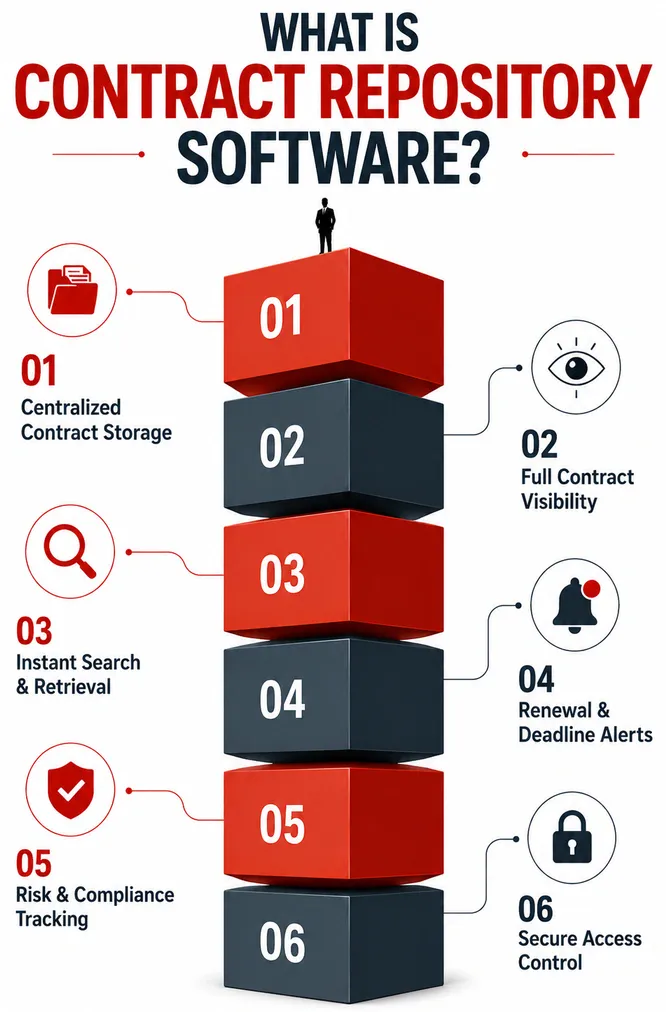
Contract repository software is a centralized system for storing, organizing, and retrieving an organization’s contracts and related documents agreements, amendments, statements of work, and supporting evidence like certificates and attestations. Instead of contracts living across email threads, shared drives, and individual laptops, a repository gives every contract a single, searchable home.
At its core, a contract repository answers three questions reliably:
● Where is this contract, and what version is current?
● What does it obligate either party to do, and by when?
● Who has access to it, and what’s the audit trail of changes?
That sounds simple. In practice, most organizations can’t answer all three with confidence, because the contracts arrived through different teams, were stored in different tools, and were never standardized into a common structure. World Commerce & Contracting’s broader research has found that the average organization’s contract-related data is spread across roughly two dozen different systems emails, shared drives, individual inboxes, and disconnected tools which is precisely the fragmentation a contract repository exists to eliminate.
What Is the Purpose of a Contract Repository?
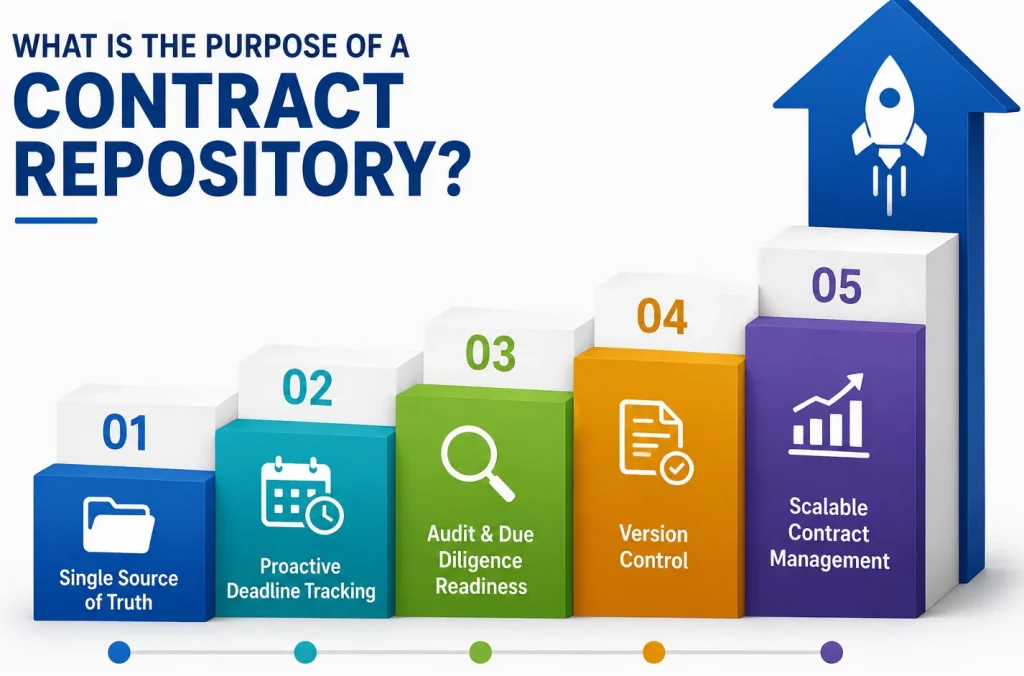
The purpose of a contract repository is to remove the dependency on any one person’s memory or inbox for knowing what your organization has agreed to. Specifically, it exists to:
● Create a single source of truth. Every contract, amendment, and related document is stored in one place rather than scattered across systems.
● Surface obligations and deadlines proactively. Renewal dates, termination notice windows, and compliance deadlines are tracked and flagged before they become urgent.
● Support audits and due diligence. When a regulator, auditor, or customer asks for evidence of a contractual term, the answer is a search, not a scramble.
● Reduce version-control errors. Teams reference the current, executed version of an agreement rather than an outdated draft pulled from an old email.
● Scale beyond what any one person can track. Fortune 1000 companies are estimated to manage between 20,000 and 40,000 active contracts at a time, and Gartner has found that managing that volume can consume up to half of a legal department’s available capacity. No spreadsheet survives that scale.
Without this, contract risk is reactive by default. Problems surface only when someone happens to notice them, usually too late to act cheaply.
Signs Your Organization Has Outgrown Manual Contract Tracking
Most organizations don’t decide to adopt a contract repository in one deliberate moment; they drift into needing one while still relying on a shared drive. A few signals tend to show up before the decision gets made consciously:
● Someone has become the unofficial “contract person.” If finding a specific agreement requires asking a particular individual rather than searching a system, that’s a single point of failure waiting to surface at the worst possible time.
● Renewals are discovered, not planned. Teams find out a contract auto-renewed only after the invoice arrives, rather than reviewing the decision 60 or 90 days ahead of time.
● The same contract exists in three different versions. Email attachments, a shared drive copy, and someone’s local download have all drifted out of sync, and nobody is fully sure which one reflects the actual signed terms.
● Audits trigger a multi-day scramble. When a customer, regulator, or auditor asks for evidence of a specific clause, the response involves searching old emails rather than running a query.
● Vendor performance and contract terms live in separate conversations. SLAs exist on paper, but nobody is actively comparing what was promised to what’s actually being delivered.
If two or more of these feel familiar, the organization has likely already outgrown manual tracking; the only open question is how much it’s currently costing in unmonitored risk.
Contract Repository vs. Contract Management Software vs. Full CLM
These three terms get used interchangeably, but they describe increasing levels of capability.
| Capability | Contract Repository | Contract Management Software | Full CLM Platform |
| Centralized storage | Yes | Yes | Yes |
| Search and metadata tagging | Basic | Yes | Yes, often AI-assisted |
| Renewal and deadline alerts | Limited | Yes | Yes, automated |
| Approval workflows | No | Yes | Yes |
| Clause libraries and templates | No | Sometimes | Yes |
| AI-based clause and obligation extraction | No | Sometimes | Yes |
| Tied to vendor risk and performance data | No | Rarely | Yes, in unified platforms |
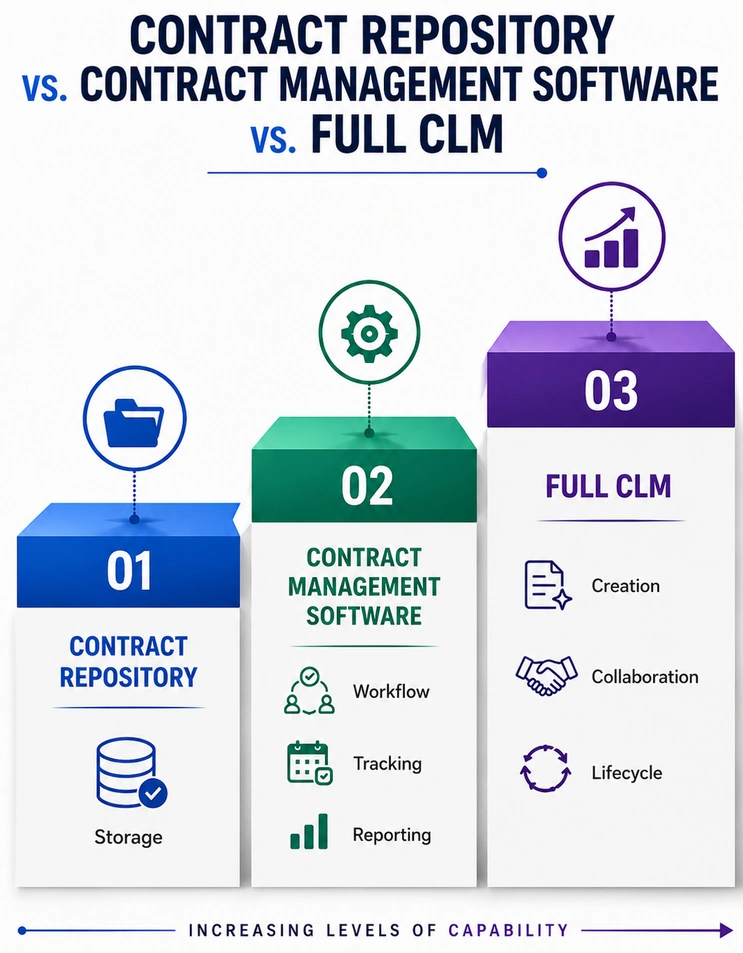
A contract repository is fundamentally about storage and retrieval. Contract management software adds workflow approvals, renewal tracking, basic reporting. Full CLM extends that further, with AI-assisted extraction, clause libraries, and template-driven contract generation across the entire lifecycle, from drafting through renewal or termination.
What Is CLM Used For?
Contract Lifecycle Management (CLM) is used to manage a contract through every stage of its life: drafting and negotiation, approval and execution, ongoing obligation tracking, performance monitoring, and eventual renewal, amendment, or termination. Rather than treating the contract as a static file to be filed away once signed, CLM treats it as an active record that the business continues to act on.
In practice, this means CLM is what a legal, procurement, or vendor management team uses to:
● Generate new contracts from pre-approved templates and clause libraries
● Route documents through review and approval workflows
● Extract and track key terms SLAs, pricing, insurance requirements, termination clauses without manual re-reading
● Trigger reminders ahead of renewal or expiry dates
● Tie contractual obligations to actual vendor performance data
What Are the 5 Steps of Contract Management?
Most contract management programs follow some version of this lifecycle:
1. Request and Drafting: A contract need is identified, and a draft is created, ideally from a pre-approved template and clause library to reduce risk introduced at this stage.
2. Negotiation and Review: Internal stakeholders (legal, finance, procurement) and the counterparty negotiate terms, with redlines and comments tracked through to a final version.
3. Approval and Execution: The contract moves through defined approval workflows and is signed, typically via e-signature, with the final version stored centrally.
4. Obligation and Performance Management: Throughout the contract’s term, obligations, SLAs, and deliverables are tracked against actual performance and compliance evidence.
5. Renewal, Amendment, or Termination: As the contract nears its end date, a decision is made informed by performance data and risk to renew, renegotiate, or let it lapse.
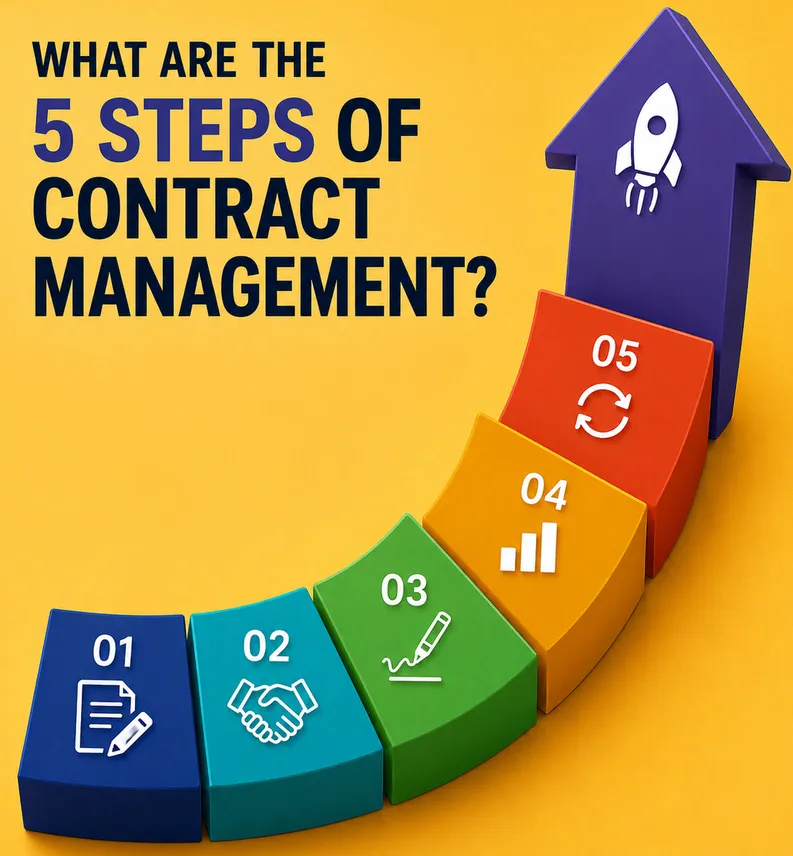
Skipping or under-resourcing step four is the most common failure point. Organizations are often diligent about drafting and signing but lose visibility the moment the ink dries.
What Are the 4 Pillars of Contract Management?
While frameworks vary, most contract management programs rest on four pillars:
● Visibility: Knowing what contracts exist, where they are, and what they say, without relying on any one person’s institutional knowledge.
● Control: Standardized templates, clause libraries, and approval workflows that keep contract terms consistent and reduce negotiated risk.
● Compliance: Ongoing tracking of obligations, regulatory requirements, and audit evidence so the organization can demonstrate adherence on demand.
● Performance: Connecting contractual commitments (SLAs, pricing, deliverables) to what’s actually being delivered, so renewal and renegotiation decisions are based on data rather than habit.
A contract repository alone typically only supports the first pillar. Closing the gap on the other three is what separates a document archive from an active contract management program.
CLM vs. ERP: What’s the Difference?
CLM and ERP (Enterprise Resource Planning) systems are often confused because both touch financial and vendor data, but they solve different problems. An ERP system manages the broader operational and financial backbone of a business purchase orders, invoicing, inventory, general ledger entries. A CLM system manages the agreements that govern those transactions what was promised, by whom, under what terms, and by when.
In practice, the two should work together rather than substitute for each other. A purchase order in your ERP should trace back to a governing contract in your CLM; an invoice flagged for review in your ERP is far easier to resolve when the CLM system can immediately surface the pricing and SLA terms that invoice is supposed to match.
Will AI Replace Contract Management?
AI is changing what contract management work looks like, but it’s automating the mechanical parts of the job, not replacing the judgment behind it. Research from Loio found that AI can review a standard agreement like an NDA in roughly 26 seconds at around 94% accuracy, compared to an average of 92 minutes for a human-led review of the same document. That gap is exactly why AI-based extraction has moved from a nice-to-have to a baseline expectation in contract repository software.
What AI doesn’t do is decide whether a deviation from standard terms is acceptable, negotiate better pricing, or weigh the relationship cost of pushing back on a strategic vendor. Those remain judgment calls for legal, procurement, and vendor management teams. The realistic shift is that AI absorbs the searching, extracting, and flagging work, freeing those teams to spend more time on negotiation and risk decisions rather than manual document review.
Security, Access, and Compliance Considerations
Centralizing contracts in one system raises the stakes on how that system is secured, which is easy to overlook in the rush to solve the visibility problem. A few considerations matter beyond basic storage:
● Role-based access control. Not every contract should be visible to everyone sensitive pricing terms, M&A agreements, or executive contracts typically need tighter restrictions than a standard vendor SOW.
● Audit trails on every change. Who edited a contract record, when, and what changed should be reconstructable without relying on memory, especially when a compliance review or dispute requires it.
● Encryption and data residency. Where contract data is physically stored and who can legally access it matters more for regulated industries, particularly when the platform itself is hosted outside the organization’s home jurisdiction.
● Mapping to compliance frameworks. Renewal and review workflows should be able to tie to relevant frameworks SOC 2, GDPR, HIPAA, or IFRS 16, depending on industry rather than treating compliance as a separate, manual exercise layered on top.
These considerations are exactly why a contract repository can’t be evaluated purely on search and storage features; the access model and audit trail underneath it determine whether the system actually holds up under scrutiny.
Best Practices for Implementing Contract Repository Software
Standing up a contract repository is straightforward. Getting real value out of it takes more discipline. Five practices consistently separate organizations that close their visibility gap from those that just relocate the same mess into a new tool.
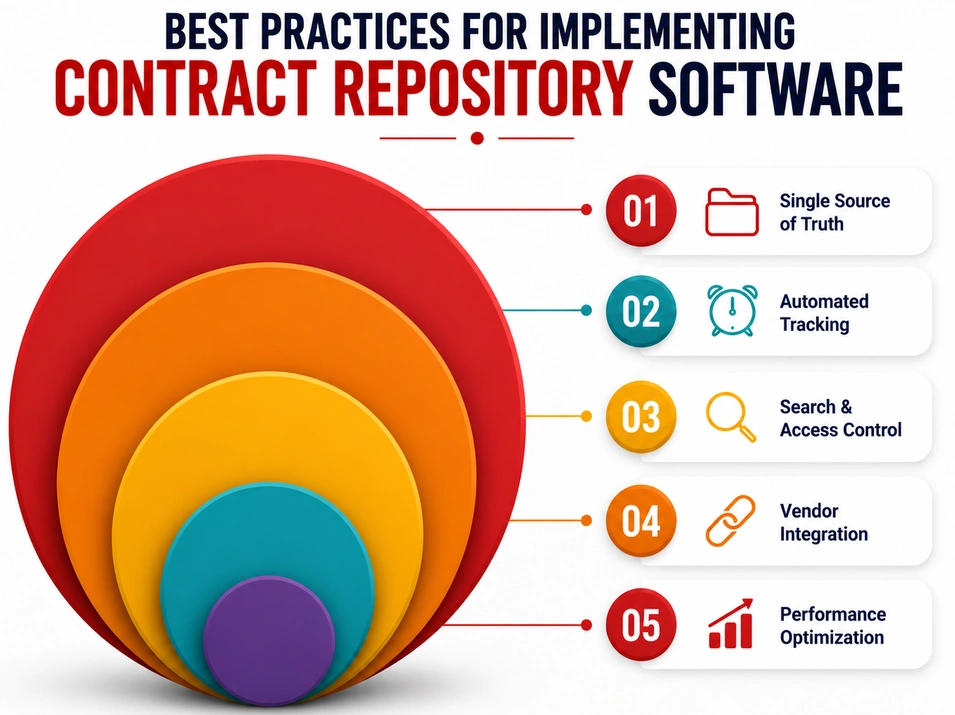
1. Establish a single source of truth.
Migrate every existing contract in not just the easy ones already sitting in a shared drive. Standardize naming conventions, categorization, and metadata fields (vendor, category, effective date, renewal date) so contracts are filterable, not just stored. Use AI-driven extraction to reduce the manual errors that come from hand-tagging thousands of documents.
2. Automate renewal tracking and compliance monitoring.
Configure renewal alerts well ahead of expiration dates staggered windows catch problems a single last-minute reminder won’t. Track vendor performance against agreed terms before renewals are processed, and maintain audit logs so a compliance review doesn’t require reconstructing history from memory. Link renewal workflows to relevant regulatory frameworks where applicable.
3. Improve searchability and access control.
Use OCR so scanned and legacy paper contracts are searchable by their actual content, not just by filename. Apply role-based permissions to control who can view, edit, and approve contracts, and maintain strict version control so teams are never negotiating against an outdated draft.
4. Integrate contracts with vendor management processes.
Link every contract to the vendor profile it governs to support a comprehensive risk assessment, rather than managing contracts and vendor risk in two disconnected systems. Integrate with ERP, procurement, and CRM systems so contract terms stay aligned with what’s actually being purchased and paid for, and align renewals with vendor performance reviews rather than treating them as a calendar-driven formality.
5. Continuously optimize contract performance and renewals.
Use data-driven insights not habit to decide whether a contract should be renewed, renegotiated, or terminated. Automate risk assessments that flag high-risk contracts for additional review before renewal, and revisit clause language periodically so terms stay competitive rather than locking in pricing or obligations that made sense years ago.
How to Evaluate a Contract Repository Vendor
Once an organization decides to move beyond manual tracking, the evaluation process itself tends to separate strong choices from ones that get outgrown again within two years. Worth asking of any vendor under consideration:
● Does it support OCR and AI-based extraction out of the box, or are those add-ons that require separate licensing?
● How does it handle contract hierarchies can it actually map relationships between an MSA, its SOWs, and subsequent amendments, or does it treat every document as a flat, unrelated file?
● What’s the actual data residency and security posture, including where data is hosted and who can legally compel access to it?
● Does it connect to vendor and risk data natively, or would contract data and vendor risk data need to be reconciled manually between two separate systems?
● What does onboarding actually look like for migrating an existing contract portfolio, and how long does that realistically take?
The right answer to “what is the most popular contract management software” isn’t really about market share it’s about which of these questions matter most for a given organization’s contract volume, regulatory exposure, and existing vendor risk processes.
Beyond Storage: Connecting Contracts to Vendor Risk and Governance
A contract repository solves the visibility problem. But contracts don’t exist in isolation hey govern relationships with vendors and third parties who carry their own risk profile, performance history, and compliance obligations. Treating contract storage and vendor risk management as separate systems creates exactly the kind of blind spot that leads to missed renewals, unenforced SLAs, and compliance gaps no one catches until an audit forces the question.
Enlighta’s Contract Lifecycle Management module is built around that connection. Contracts are stored in a single, searchable repository with full hierarchy mapping across MSAs, SOWs, and amendments, and AI-based extraction surfaces obligations, key dates, signatories, SLAs, pricing, insurance terms, and termination clauses automatically rather than requiring manual review. Because that contract data lives in the same platform as vendor risk scoring, performance scorecards, and compliance monitoring, a renewal decision isn’t made on contract terms alone it’s informed by how that vendor has actually performed and what risk they currently carry.
Conclusion
A contract repository is the foundation where contract risk management has to start. But foundations aren’t the whole building. Organizations that stop at storage still find themselves reactive: discovering a missed obligation after it’s already cost them, or scrambling to assemble evidence when an auditor asks for it.
Connecting that repository to vendor risk, performance data, and compliance monitoring is what turns a contract archive into a system that actively protects the business. If you’re evaluating how your organization’s contract and vendor data could work together in one platform, we’d be glad to walk you through it.
Frequently Asked Questions
What is a contract repository?
A centralized system for storing and retrieving an organization’s contracts and related documents, replacing scattered storage across email, drives, and individual files. It’s the foundation that everything else in contract management is built on top of.
What is the purpose of a contract repository?
To create a single source of truth for contracts, surface obligations and deadlines proactively, and support audits and compliance reviews without relying on manual tracking or any one person’s institutional knowledge.
Will contract management be replaced by AI?
No AI automates extraction, search, and flagging, often cutting document review time from over an hour to under a minute, but negotiation, risk judgment, and relationship decisions remain with legal, procurement, and vendor management teams.
What are the 5 steps of contract management?
Request and drafting, negotiation and review, approval and execution, obligation and performance management, and renewal, amendment, or termination. Most programs fail at the obligation and performance step, not the earlier ones.
What is the difference between CLM and ERP?
ERP manages the broader financial and operational backbone of a business purchase orders, invoicing, inventory; CLM manages the agreements that govern those transactions. The two should integrate rather than substitute for each other.
What is CLM used for?
Managing a contract through its full lifecycle drafting, approval, obligation tracking, performance monitoring, and renewal or termination ather than treating it as a static, filed document once it’s signed.
What is contract software?
A broad term covering any tool used to draft, store, track, or manage contracts, ranging from basic repository tools focused purely on storage to full CLM platforms with AI extraction, clause libraries, and workflow automation.
What are the 4 pillars of contract management?
Visibility, control, compliance, and performance a contract repository alone typically only delivers on the first of the four.
What is the most popular contract management software?
There’s no single answer the right choice depends on whether you need basic storage, full CLM, or a platform that unifies contract management with vendor risk and performance data. Organizations managing complex vendor portfolios increasingly look for the latter, since contracts and vendor risk rarely make sense to manage as separate problems.
Ready to elevate your contract management capabilities? Get in touch with us today info@enlighta.comor click the button below.