TPRM Process: Understanding the Lifecycle, Flow, and Key Steps
A single compromised vendor can cost a Fortune 1000 organization millions in regulatory fines, lost revenue, and reputational damage, and yet most organizations still cannot confidently describe their own TPRM process end to end. Industry reporting consistently finds that the majority of data breaches now involve a third party in some form, and Gartner has noted that a large share of legal and compliance leaders identify third-party risks only after initial onboarding due diligence has concluded, meaning the very controls organizations rely on are catching problems too late.
A working TPRM process is what separates organizations that govern third-party risk deliberately from those that discover it during an audit. When the TPRM process flow is well defined, every vendor moves through the same screening, assessment, contracting, monitoring, and offboarding stages with documented evidence at each step. When it isn’t, vendor risk lives in spreadsheets, point tools, and individual inboxes, and the gaps between them are exactly where third-party failures originate.
This guide covers what the TPRM process is, the steps that make up the full TPRM lifecycle process, the most common challenges organizations face inside their TPRM process flow, the best practices that mature programs share, and how to evaluate where your current TPRM process steps actually stand.
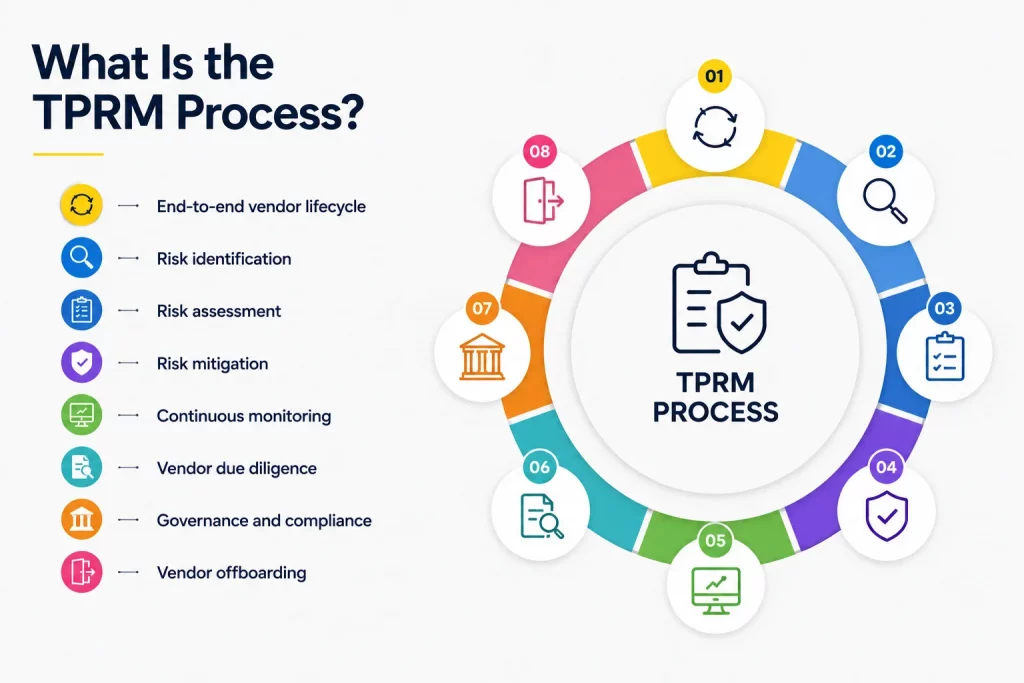
What Is the TPRM Process?
The TPRM process is the end-to-end sequence of activities an organization uses to identify, assess, mitigate, and continuously monitor risks introduced by external vendors, suppliers, contractors, and service providers, from initial engagement through to final offboarding. Rather than treating vendor risk as a one-time onboarding activity, the TPRM process establishes repeatable, auditable stages that every vendor moves through, with documented evidence collected at each phase.
In practice, a working TPRM process answers three questions reliably for every third party:
- What could go wrong if this vendor fails, is breached, or behaves unethically?
- How likely and how severe is that exposure today, and tomorrow?
- What controls (contractual, technical, and operational) keep the risk inside our tolerance?
The TPRM process is broader than cybersecurity alone. A mature TPRM lifecycle process examines financial viability, operational resilience, regulatory and sanctions compliance, ESG exposure, concentration risk, geopolitical exposure, and even fourth- and fifth-party (sub-contractor) risk. The TPRM process flow is the visible sequence: intake, screening, due diligence, contracting, onboarding, ongoing monitoring, governance, and offboarding. The discipline behind it is what turns that flow into actual risk reduction rather than checklist completion.
Why the TPRM Process Matters
The purpose of a structured TPRM process is to keep external dependencies from becoming the weakest link in the enterprise. Several forces have moved the TPRM process from a back-office procurement task to a board-level concern:
- Outsourcing has expanded dramatically. The average enterprise today engages thousands of third parties, each one effectively a new entry point into the business.
- Regulatory scrutiny has intensified. Frameworks like the EU’s DORA, the U.S. Interagency Guidance on Third-Party Relationships, GDPR Article 28, India’s DPDP Act, and NYDFS Part 500 all hold the primary organization accountable for what its vendors do with data and systems.
- Breach economics have shifted. IBM’s Cost of a Data Breach research has repeatedly found that breaches involving third parties cost more and take longer to contain than internal-only incidents.
- Concentration risk is real. When entire industries depend on the same handful of cloud providers, SaaS platforms, or contract manufacturers, a single outage cascades across the economy.
- Accountability cannot be outsourced. Customers, regulators, and shareholders hold the primary organization responsible, regardless of which vendor caused the failure.
A defined TPRM process is how organizations operationalize that accountability. Without it, vendor governance becomes reactive: problems surface when somebody happens to notice them, usually too late to act cheaply.
Read Also: Best Vendor Management Software
Signs Your TPRM Process Has Outgrown Manual Tracking
Most organizations don’t decide to formalize their TPRM process in one deliberate moment. They drift into needing one while still relying on spreadsheets, email threads, and a shared drive. A few signals tend to appear before the decision gets made consciously:
- Vendor inventories don’t reconcile. Different teams maintain different lists, and reconciling them takes days rather than seconds.
- Reassessments slip past due dates. Nobody is actively tracking which Tier 1 vendor is due for review next quarter.
- Adverse events reach you through headlines. A vendor breach or sanctions issue appears in the news before it appears in your own monitoring.
- Contracting and risk reviews disagree at the end. Two parallel processes finish at the same moment, contradicting each other, because they never connected during the TPRM process flow.
- You can’t trace, for audit, when a specific vendor was last assessed or by whom.
- AI tools are entering the business through existing vendors and no one is governing them.
If two or more of these feel familiar, the organization has likely already outgrown manual tracking. The open question is how much that gap is currently costing in unmonitored risk.
The TPRM Process Lifecycle at a Glance
Different sources break the TPRM process into anywhere from 4 to 8 phases. What matters is that all of these activities are covered, not the exact count. Here are the core phases of the TPRM lifecycle process most mature programs follow:
| Name | Key Activities | Outcome |
| Identification, Screening & Tiering | Vendor inventory, sanctions/PEP/adverse-media screening, criticality tiering | Clear inventory and risk-prioritized vendor list |
| Due Diligence & Risk Assessment | Tailored DDQs, evidence collection (SOC 2, ISO 27001, financials), risk scoring | Documented inherent and residual risk profile |
| Contracting & Risk Mitigation | SLAs, DPAs, audit rights, sub-processor restrictions, exit obligations | Risks converted into contractual controls |
| Onboarding & Vendor Info Management | Vendor profile creation, document collection, 4th/5th-party capture | Single source of truth per vendor |
| Ongoing Monitoring & Performance | Continuous cyber, financial, adverse-media, sanctions, SLA tracking | Real-time view of risk and performance |
| Governance & Issue Management | QBRs, SBRs, VMO meetings, scorecards, action items, escalations | Active relationship governance |
| Offboarding & Termination | Data return or destruction, access revocation, archive | Clean exit with no residual exposure |
The 7 Steps of the TPRM Process
Below is each step of the TPRM process expanded, with the activities and decisions that define it.
Step 1: Identification, Screening, and Tiering
The TPRM process begins before a vendor is formally engaged. A business owner identifies the need for a third party, submits an intake request, and the vendor enters the screening pipeline.
Screening at this stage includes:
- Sanctions screening against global watchlists (UN, EU, DFAT, OFAC) and other law enforcement lists
- PEP (Politically Exposed Person) screening
- AML/CTF compliance checks
- Adverse media monitoring
- 4th- and 5th-party detection
Once screening clears, vendors are tiered by criticality, typically into Tier 1 (high risk / mission-critical), Tier 2 (medium), and Tier 3 (low). Tiering determines how much scrutiny the rest of the TPRM process applies. Skipping this step is one of the most common reasons mature programs fail: applying the same depth of assessment to every vendor wastes resources on low-risk relationships and under-assesses the ones that actually matter.
Step 2: Due Diligence and Risk Assessment
Once tiered, vendors move into due diligence. This is where the TPRM process examines whether the inherent risks identified during screening are matched by adequate controls.
Tier-appropriate due-diligence questionnaires (DDQs) are dispatched to the vendor and internal stakeholders, covering risk domains including:
- Information Security / Cyber Risk
- Privacy and Data Protection
- Financial Viability
- Operational Competency
- Concentration
- Reputational
- Technology
- Sub-Contractor (4th-party)
- Financial Crimes
- Anti-Money Laundering
- Human Resources / Background Screening
- Location / Country
- ESG
Evidence is collected, validated, and scored. Initial and residual risk ratings are assigned, and the TPRM process advances only if residual risk falls within the organization’s appetite. If it doesn’t, the next step is either mitigation or walking away.
Step 3: Contracting and Risk Mitigation
Identified risks need to be translated into enforceable contractual controls. This step in the TPRM process flow converts assessment findings into terms that survive the rest of the relationship: SLAs, data protection agreements, audit rights, right-to-terminate clauses, insurance requirements, sub-processor restrictions, and exit obligations.
Skipping or under-resourcing this step is common, especially when contract review happens in parallel to risk assessment rather than informed by it. When the two processes are connected, the contract reflects what the assessment surfaced. When they aren’t, the contract reflects whatever the legal team negotiated last time and the assessment findings sit in a separate report nobody opens during disputes.
Step 4: Onboarding and Vendor Information Management
With contracts signed, the vendor moves into operational onboarding. The TPRM process at this stage focuses on building a complete, structured vendor record:
- Legal entities, hierarchies, sites, categories, products & services
- Key contacts, financial data, document repository
- 4th- and 5th-party relationships
- Concentration risk mapping
A self-service vendor portal can streamline onboarding: vendors register, upload required documents (ownership documents, insurance certificates, attestations), and submit information directly into the platform rather than via email. AI-driven document extraction validates the uploaded information and flags discrepancies.
A clean onboarding record is what makes every later step in the TPRM process possible. Without it, monitoring becomes guesswork.
Step 5: Ongoing Monitoring and Performance Management
This is where most TPRM programs fail. Traditional approaches collect a thorough due diligence package at onboarding and then go silent until the next annual review. By then, the vendor’s risk profile may have changed completely.
A modern TPRM process includes continuous monitoring across:
- Adverse Events Monitoring: AI-powered scanning of news sources (Wall Street Journal, Bloomberg, Associated Press, Reuters, MSNBC) and configurable feeds drawn from 10,000+ data sources, with auto-classification into risk domains like litigation, data breaches, and financial events.
- Sanctions Monitoring: Continuous re-screening against global watchlists.
- Cyber Posture: Externally observable cybersecurity ratings.
- Financial Health: Ongoing review of credit ratings, going-concern indicators, and key financial metrics.
- SLA and KPI Performance: Automated tracking of vendor performance against contractual commitments, with self-reporting through the vendor portal or integration with ITSM tools like ServiceNow.
Periodic reassessments are still scheduled (annually for Tier 1, less frequently for lower tiers), but they’re informed by what continuous monitoring has surfaced in between, not by what the vendor said about themselves twelve months ago.
Step 6: Governance and Issue Management
Monitoring surfaces signals. Governance is what an organization does with them.
This step of the TPRM process flow includes:
- Quarterly Business Reviews (QBRs), Strategic Business Reviews (SBRs), and VMO meetings with pre-populated agendas and tracked action items
- Issue/gap tracking, escalation, and resolution
- Balanced scorecards combining performance, risk, and compliance metrics
- Vendor relationship health surveys assessing alignment, performance, risk, compliance, quality, capabilities, and ESG
- Action item assignment and follow-through across internal teams and the vendor
Issues that aren’t tracked become disputes. Disputes that aren’t resolved become unscheduled terminations. The TPRM process at this stage is what prevents that escalation by surfacing problems early and routing them to the right people with documented evidence.
Step 7: Offboarding and Termination
The final step in the TPRM process is the one most often skipped. When a vendor relationship ends, structured offboarding ensures no residual exposure:
- Automated offboarding checklists for IT, Data, Finance, HR, and Contracts
- Triggering contractual obligations such as Certificate of Data Destruction
- Revocation of system access
- Knowledge transfer documentation
- Archive of historical third-party records, integrated with ITSM systems
Without this step, vendors exit the operational systems but remain in the risk surface: data they once held, access they were once granted, and obligations they were supposed to fulfill after termination all sit unmanaged.
What Is the TPRM Assessment Lifecycle?
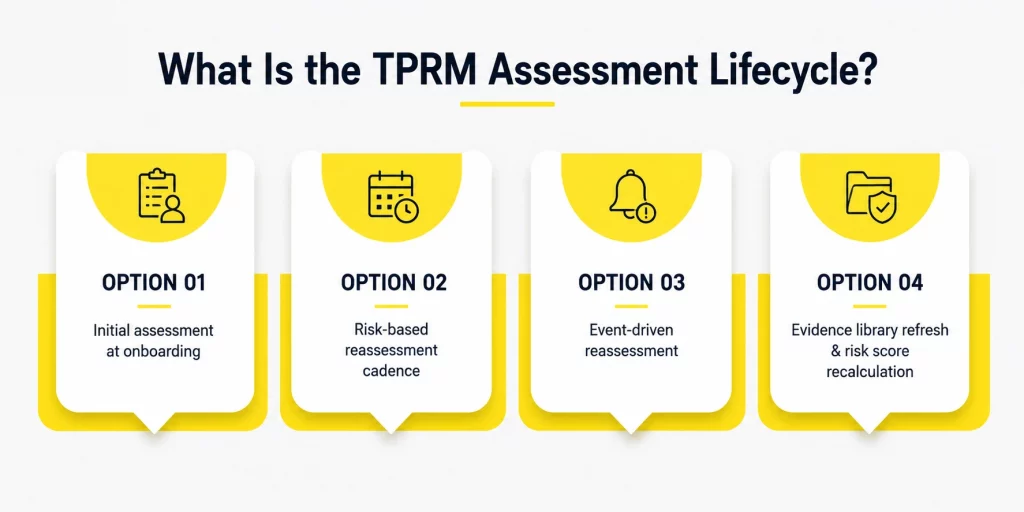
The TPRM assessment lifecycle is the recurring sub-process within the broader TPRM lifecycle process that governs when and how vendors are reassessed. It typically includes:
- Initial assessment at onboarding
- Risk-based reassessment cadence (e.g., annual for Tier 1, biennial for Tier 2, triggered for Tier 3)
- Event-driven reassessment triggered by adverse events, sanctions changes, financial deterioration, or contractual milestones
- Evidence library refresh to ensure SOC 2, ISO 27001, and other certifications remain current
- Risk score recalculation after each assessment cycle
A mature TPRM assessment lifecycle is event-driven rather than calendar-driven alone. Calendar reviews still happen, but they’re supplemented by continuous monitoring that triggers an off-cycle reassessment when the situation warrants it.
Common TPRM Process Challenges
Even organizations with a documented TPRM process tend to struggle with the same recurring gaps:
- Manual workflows that don’t scale. Spreadsheets, email-based DDQs, and shared drives work for fifty vendors and collapse at five hundred.
- Fragmented vendor inventories. Procurement, IT, and Legal each maintain their own lists that never fully reconcile.
- Static, point-in-time assessments. Annual reviews catch a snapshot but miss everything that changes between reviews.
- Disconnected contract and risk data. Contract terms live in one system; risk scores live in another; performance data lives in a third.
- Limited 4th- and 5th-party visibility. Vendor’s vendors carry risk too, and most TPRM processes never look past the first hop.
- No AI model governance. AI tools are entering the business through existing vendors faster than the TPRM process is being updated to govern them.
These challenges are structural, not procedural. Fixing them requires connecting the stages of the TPRM process flow rather than running each one in a separate tool.
Best Practices for the TPRM Process
Across regulated and non-regulated industries, the same best practices show up in mature TPRM programs:
1. Tier every vendor. Not all vendors deserve the same scrutiny. A risk-and-criticality tiering model ensures resources flow to where they matter, not where they happen to be loudest.
2. Move from point-in-time to continuous monitoring. Annual assessments cannot keep up with how fast vendor risk changes. Continuous monitoring of cyber posture, financial health, sanctions, and adverse media is now baseline expectation.
3. Look beyond cybersecurity. Financial, operational, reputational, ESG, geopolitical, and concentration risks are increasingly material and underweighted in traditional TPRM processes.
4. Capture 4th and 5th parties. Your vendor’s vendors are your problem. Map sub-contractor relationships, especially for critical services.
5. Embed risk into contracting. Don’t bolt risk reviews on at the end. Build SLAs, audit rights, data-protection clauses, and termination triggers into every contract directly from assessment findings.
6. Automate the repeatable. Intake, screening, DDQ dispatch, reminders, scoring, and reporting are all automatable. Manual TPRM process steps do not scale.
7. Govern the relationship, not just the onboarding. Most TPRM tools stop after the contract is signed. Real risk emerges during the engagement, and the TPRM process needs to follow it there.
8. Get cross-functional buy-in early. The TPRM process only works when InfoSec, procurement, legal, compliance, and the business agree on the operating model.
9. Maintain audit-ready records. Regulators don’t just want a TPRM process; they want documented evidence that it ran the way you said it did.
10. Plan the exit. Offboarding is a control, not an afterthought. Data destruction, access revocation, and knowledge transfer should be automated workflows.
How to Evaluate Your TPRM Process Maturity
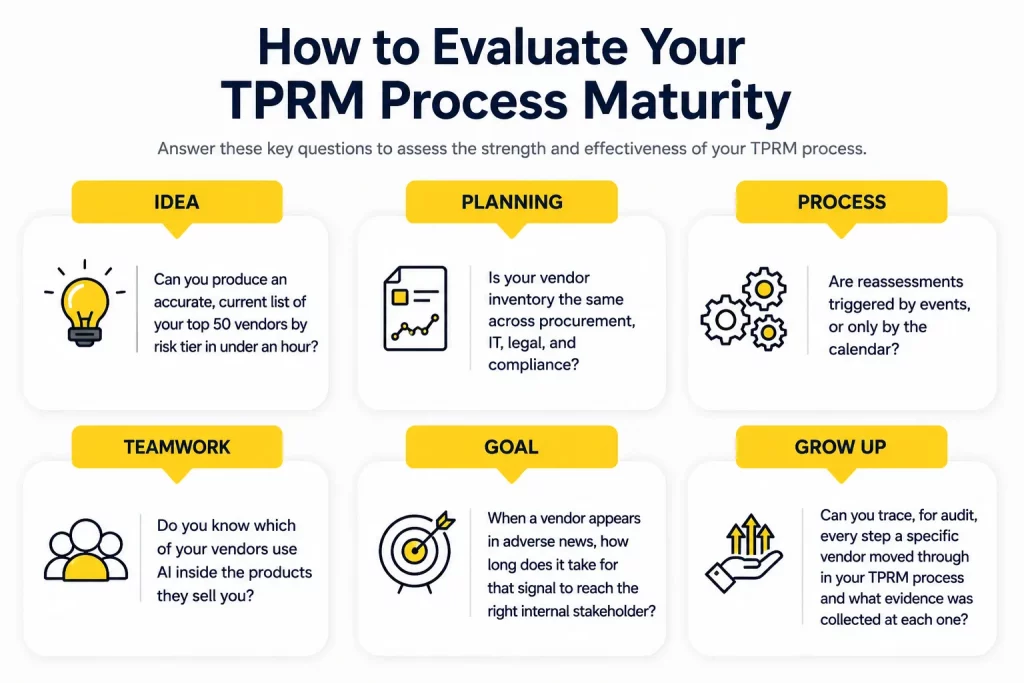
A few questions worth answering honestly before assuming the TPRM process is in good shape:
- Can you produce an accurate, current list of your top 50 vendors by risk tier in under an hour?
- Is your vendor inventory the same across procurement, IT, legal, and compliance?
- Are reassessments triggered by events, or only by the calendar?
- Do you know which of your vendors use AI inside the products they sell you?
- When a vendor appears in adverse news, how long does it take for that signal to reach the right internal stakeholder?
- Can you trace, for audit, every step a specific vendor moved through in your TPRM process and what evidence was collected at each one?
If any of these answers cause hesitation, the TPRM process likely has structural gaps that no amount of additional manual effort will close.
Beyond the Process: Connecting TPRM to Vendor Governance
A defined TPRM process solves the discipline problem: every vendor moves through the same stages, with documented evidence at each one. But the TPRM process flow doesn’t exist in isolation. It governs relationships with vendors whose contracts, performance, and AI usage all generate their own data, and managing those streams in separate systems creates exactly the kind of blind spots a TPRM process is supposed to eliminate.
Enlighta is a platform built to unify the full TPRM process on a single AI-powered foundation, from intake and screening through due diligence, contracting, onboarding, performance and compliance monitoring, governance, and offboarding. Unlike traditional TPRM tools that stop at the contract, Enlighta governs the actual relationship: SLAs, KPIs, issues, obligations, adverse events, and 4th/5th-party concentration risk all live in the same record as the vendor’s risk score. AI-powered contract lifecycle management extracts SLAs, obligations, pricing, and insurance terms automatically rather than requiring manual review.
The platform’s approach to vendor governance was recognized in 2024 when Enlighta won the SIG Future of Sourcing Award for Innovation in Governance and Compliance alongside PepsiCo, for a partnership scaling supplier performance, governance, and contract compliance across regions and service categories.
For organizations whose AI tool exposure is growing faster than their TPRM process can keep up with, Enlighta’s GovernAI module brings vendor risk and AI model risk into one unified governance layer, so the TPRM process and AI governance run on the same platform rather than as two disconnected programs.
Conclusion
The TPRM process is the discipline that turns vendor relationships from a hidden risk surface into a governed one. The steps themselves, identification, due diligence, contracting, onboarding, monitoring, governance, and offboarding, are well established. What separates mature programs from checkbox-driven ones is whether those steps are connected in a single workflow with documented evidence, or whether each one runs in its own tool and the gaps between them are where third-party failures originate.
If you’re evaluating where your TPRM process stands today, or how the stages of your TPRM lifecycle process could work together in one platform, we’d be glad to walk you through it.
Frequently Asked Questions
What is the TPRM process?
The TPRM process is the end-to-end sequence of activities used to identify, assess, mitigate, and continuously monitor risks introduced by third-party vendors, from initial intake through screening, due diligence, contracting, onboarding, ongoing monitoring, governance, and offboarding.
What are the steps in the TPRM process?
The core TPRM process steps are: identification, screening, and tiering; due diligence and risk assessment; contracting and risk mitigation; onboarding and vendor information management; ongoing monitoring and performance management; governance and issue management; and offboarding and termination.
What are the 7 steps of the risk management process?
In a TPRM context, the seven steps are vendor identification and screening, tiering, due diligence and assessment, contracting, onboarding, ongoing monitoring and governance, and offboarding. These steps together form the full TPRM lifecycle process.
What are the 5 phases of third-party risk management?
The five core phases are identification and tiering, due diligence and risk assessment, contracting and risk mitigation, ongoing monitoring and performance, and offboarding and termination. Some frameworks expand these into seven or eight phases by separating onboarding and governance into distinct stages.
What are the best practices for TPRM?
Best practices include tiering every vendor, moving from point-in-time assessments to continuous monitoring, looking beyond cybersecurity to financial and operational risk, capturing 4th- and 5th-party relationships, embedding risk findings into contracting, automating repeatable TPRM process steps, governing the relationship after the contract is signed, and treating offboarding as a control rather than an afterthought.
What is the TPRM assessment lifecycle?
The TPRM assessment lifecycle is the recurring sub-process that governs when and how vendors are reassessed, combining scheduled reviews based on risk tier with event-driven reassessments triggered by adverse events, sanctions changes, or financial deterioration.
What is the process of TPRM?
The process of TPRM is the structured TPRM process flow an organization follows for every third party: screening at intake, due diligence and risk scoring, contracting with risk-informed terms, onboarding and information management, continuous monitoring during the engagement, governance and issue management, and structured offboarding when the relationship ends.
Ready to elevate your TPRM process capabilities? Get in touch with us today info@enlighta.com or click the button below.