What Is Vendor Risk Management? A Complete Guide for 2026
A single compromised vendor can cost an enterprise millions in regulatory fines, lost revenue, and reputational damage, and yet most organizations still cannot confidently answer one basic question: is our vendor risk management program actually working? Industry reporting consistently finds that the majority of data breaches now involve a third party in some form, and IBM’s Cost of a Data Breach research has repeatedly shown that breaches involving vendors cost more and take longer to contain than internal-only incidents. The gap between knowing vendor risk is a problem and having a structured vendor risk management discipline to govern it is exactly where most enterprises currently sit.
Vendor risk management is no longer a back-office procurement task. It is a board-level function tied directly to regulatory compliance, operational resilience, financial stability, and brand reputation. The organizations that govern it well treat vendor risk management as a continuous program rather than an onboarding checklist. The organizations that don’t tend to discover their exposure during an audit, a breach disclosure, or a regulator’s letter, often well after the leverage to do something about it has already passed.
This guide covers what vendor risk management is, why it matters more every year, the vendor risk management framework most mature programs follow, how to perform a vendor risk assessment, the tools and KPIs that hold these programs together, real-world examples of vendor risk, and how third-party vendor risk management fits into the broader picture.
What Is Vendor Risk Management?
Vendor risk management (VRM) is the discipline of identifying, assessing, mitigating, and continuously monitoring the risks an organization is exposed to through its relationships with external vendors, suppliers, and service providers. The vendor risk management meaning is straightforward in principle: every external party your business depends on becomes an extension of your own risk surface, and vendor risk management is the structured way of governing that surface.
In practical terms, a vendor risk management program answers three questions about every vendor:
What could go wrong if this vendor fails, is breached, or behaves unethically?
How likely and how severe is that exposure today, and tomorrow?
What controls — contractual, technical, and operational — keep that risk inside our tolerance?
Vendor risk management is often used interchangeably with third party vendor risk management, third-party risk management (TPRM), supplier risk management, or supply chain risk management. The terms overlap heavily, but there are subtle differences worth knowing:
Vendor risk management typically focuses on commercial vendors providing products or services.
Third party vendor risk management is broader, covering vendors, partners, brokers, agents, contractors, and any external entity that interacts with your data, systems, customers, or operations.
Supply chain risk management emphasizes physical goods, logistics, and upstream or downstream dependencies.
For regulated industries — banking, insurance, healthcare, energy — regulators generally prefer the term third-party because it captures the full range of relationships covered by oversight regimes like OCC Bulletin 2013-29 (and its 2023 update), the EBA Guidelines on Outsourcing, the EU’s DORA, RBI’s outsourcing directions, and NYDFS 23 NYCRR 500.
Modern vendor risk management extends well beyond cybersecurity. A mature program looks at financial viability, operational resilience, regulatory and sanctions compliance, ESG, concentration risk, geopolitical exposure, and even fourth- and fifth-party (sub-contractor) risk.
The purpose of vendor risk management is to keep external dependencies from becoming the weakest link in the enterprise. Several forces have pushed vendor risk management from a procurement-adjacent activity to a board-level concern:
Vendor portfolios have expanded dramatically. The average enterprise today engages thousands of vendors, each one effectively a new entry point into the business.
Regulatory scrutiny has intensified. Frameworks like the EU’s DORA (Digital Operational Resilience Act), the U.S. Interagency Guidance on Third-Party Relationships, GDPR Article 28, India’s DPDP Act, and NYDFS Part 500 hold the primary organization accountable for what its vendors do with data and systems.
Breach economics have shifted. IBM’s Cost of a Data Breach research has repeatedly found that breaches involving third parties cost more and take longer to contain than internal-only breaches.
Concentration risk is real. When entire industries depend on the same handful of cloud providers, SaaS platforms, or contract manufacturers, a single outage cascades across the economy.
You can’t outsource accountability. Customers, regulators, and shareholders hold the primary organization responsible for what its vendors do, regardless of which vendor caused the failure.
A defined vendor risk management program is how organizations operationalize that accountability. Without it, vendor governance becomes reactive: problems surface when somebody happens to notice them, usually too late to act cheaply.
A vendor risk is any potential negative event arising from a vendor or external partner relationship. The most common vendor risk management examples worth knowing include:
Cybersecurity and data risk. A vendor with weak controls suffers a breach that exposes your customer data. The 2023 MOVEit Transfer breach is a textbook example: a single file-transfer vendor’s vulnerability affected thousands of downstream organizations.
Operational risk. A critical SaaS provider goes down and your customer-facing systems go with it.
Financial risk. A key supplier becomes insolvent, disrupting your supply chain or core operations.
Compliance risk. A vendor processes EU personal data without an adequate transfer mechanism, putting you in violation of GDPR.
Reputational risk. A contractor is caught using forced labor, and your brand is dragged into the story.
Sanctions and financial-crime risk. A new supplier turns out to be on a global sanctions list, exposing you to OFAC penalties.
Concentration risk. Too many critical services are sourced from a single geography or single provider.
Fourth- and fifth-party risk. Your vendor outsources part of its work to someone you’ve never assessed.
AI risk. A vendor embeds generative AI into its product, and sensitive data flows into model training corpora without your visibility or consent.
Each of these is a category vendor risk management needs to address. Programs that treat vendor risk as cybersecurity-only miss the majority of where actual exposure now sits.
Signs Your Vendor Risk Management Has Outgrown Spreadsheets
Most organizations don’t decide to formalize vendor risk management in one deliberate moment. They drift into needing it while still relying on spreadsheets, email threads, and a shared drive. A few signals tend to appear first:
You can’t produce an accurate, current list of your top 50 vendors by risk tier in under an hour.
Different teams maintain different vendor inventories that don’t reconcile.
Reassessments slip past their due dates because no one is tracking them.
Adverse events about your vendors reach you through news headlines, not your own monitoring.
You can’t trace, for audit, when a specific vendor was last assessed or by whom.
Contracting and risk reviews happen in parallel and disagree at the end.
AI tools are entering your business through existing vendors and no one is governing them.
If any of these feel familiar, vendor risk management has likely already outgrown manual tracking. The only open question is how much that gap is currently costing in unmonitored risk.
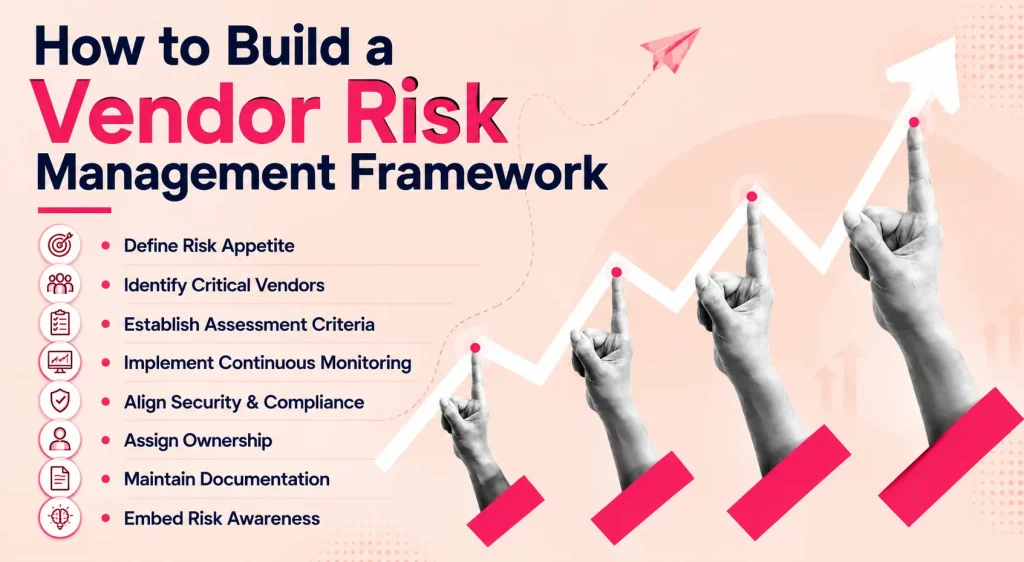
A vendor risk management framework is the structured set of stages and controls that turn vendor risk management from a concept into a repeatable, audit-ready discipline. Different sources break the framework into anywhere from 4 to 8 phases. What matters is that all of these activities are covered, not the exact count.
Data return or destruction, access revocation, archive
Clean exit with no residual exposure
Below, each stage of the framework expanded.
Stage 1: Identification, Screening, and Tiering
Vendor risk management begins before a vendor is formally engaged. A business owner identifies a need, submits an intake request, and the vendor enters the screening pipeline.
Screening at this stage includes sanctions screening against global watchlists (UN, EU, DFAT, OFAC) and other law enforcement lists, PEP (Politically Exposed Person) screening, AML/CTF compliance verification, adverse media monitoring, and detection of 4th- and 5th-party relationships.
Once screening clears, vendors are tiered by criticality, typically into Tier 1 (high risk / mission-critical), Tier 2 (medium), and Tier 3 (low). Tiering determines how much scrutiny the rest of vendor risk management applies.
Stage 2: Due Diligence and Risk Assessment
Once tiered, vendors move into due diligence. Tier-appropriate due-diligence questionnaires (DDQs) are dispatched to the vendor and internal stakeholders, covering risk domains including:
Information Security and Cyber Risk
Privacy and Data Protection
Financial Viability
Operational Competency
Concentration
Reputational
Technology
Sub-Contractor (4th-party)
Financial Crimes
Anti-Money Laundering
Human Resources and Background Screening
Location and Country
ESG
Evidence is collected, validated, and scored. Initial and residual risk ratings are assigned, and vendor risk management advances only if residual risk falls within the organization’s appetite.
Stage 3: Contracting and Risk Mitigation
Identified risks need to be translated into enforceable contractual controls: SLAs, data protection agreements, audit rights, right-to-terminate clauses, insurance requirements, sub-processor restrictions, and exit obligations.
When contract review and risk assessment are connected, the contract reflects what the assessment surfaced. When they aren’t, the contract reflects whatever legal negotiated last time and the assessment findings sit in a separate report.
Stage 4: Onboarding and Vendor Information Management
With contracts signed, the vendor moves into operational onboarding. The focus is on building a complete, structured vendor record: legal entities, hierarchies, sites, categories, products and services, key contacts, financial data, document repository, and 4th- and 5th-party relationships.
A self-service vendor portal can streamline onboarding: vendors register, upload required documents (ownership documents, insurance certificates, attestations), and submit information directly into the platform rather than via email. AI-driven document extraction validates the uploaded information and flags discrepancies.
Stage 5: Ongoing Monitoring and Performance Management
This is where most vendor risk management programs fail. Traditional approaches collect a thorough due diligence package at onboarding and then go silent until the next annual review. By then, the vendor’s risk profile may have changed completely.
A modern vendor risk management program includes continuous monitoring across:
Adverse Events Monitoring. AI-powered scanning of news sources like The Wall Street Journal, Bloomberg, Associated Press, Reuters, and MSNBC, plus configurable feeds drawn from 10,000+ data sources, with auto-classification into risk domains like litigation, data breaches, and financial events.
Sanctions Monitoring. Continuous re-screening against global watchlists.
Financial Health. Ongoing review of credit ratings, going-concern indicators, and key financial metrics.
SLA and KPI Performance. Automated tracking of vendor performance against contractual commitments, with self-reporting through the vendor portal or integration with ITSM tools like ServiceNow.
Stage 6: Governance and Issue Management
Monitoring surfaces signals. Governance is what the organization does with them.
This stage includes Quarterly Business Reviews (QBRs), Strategic Business Reviews (SBRs), and VMO meetings with pre-populated agendas and tracked action items; issue and gap tracking with automated escalation rules; balanced scorecards combining performance, risk, and compliance metrics; vendor relationship health surveys; and action item assignment across internal teams and vendors.
Stage 7: Offboarding and Termination
When a vendor relationship ends, structured offboarding ensures no residual exposure: automated offboarding checklists for IT, Data, Finance, HR, and Contracts; triggering contractual obligations such as Certificate of Data Destruction; revocation of system access; knowledge transfer; and archive of historical vendor records integrated with ITSM systems.
Without this step, vendors exit operational systems but remain in the risk surface.
How to Perform a Vendor Risk Assessment
A vendor risk assessment is the structured process of evaluating a specific vendor’s risk profile within the broader vendor risk management framework. The mechanics of performing one well are similar regardless of industry:
1. Define the scope. What services or products will the vendor provide, what data will they access, which systems will they touch, and which regulatory requirements apply? Scope determines depth.
2. Run initial screening. Check the vendor against sanctions lists, adverse media, PEP databases, and AML/CTF requirements before investing time in a full assessment.
3. Determine criticality and tier. Apply your tiering model. A Tier 1 vendor with access to customer data and core systems gets a different assessment than a Tier 3 office-supply vendor.
4. Dispatch tier-appropriate DDQs. Use standardized assessments aligned to frameworks like SIG, CAIQ, ISO 27001, NIST SP 800-53, or HITRUST, plus domain-specific questionnaires for privacy, financial viability, and operations.
5. Collect and validate evidence. SOC 2 reports, ISO 27001 certificates, financial statements, business continuity plans, insurance certificates. Validation matters: a clean SOC 2 doesn’t automatically mean a vendor is safe.
6. Score the risk. Calculate inherent risk (the exposure if no controls existed) and residual risk (the exposure given the controls that are in place). Document both.
7. Decide and document. Accept, mitigate, or walk away. If mitigation is needed, translate the findings into contractual controls in Stage 3 of the framework.
8. Schedule reassessment. Annual for Tier 1, less frequent for lower tiers, plus event-driven reassessment when adverse events, sanctions changes, or financial deterioration trigger it.
The biggest mistake in a vendor risk assessment is treating it as a one-time event. The assessment is the start of vendor risk management, not the end.
What Are the Tools for Vendor Risk Assessment?
A mature vendor risk management program uses a layered set of tools, not a single one. The categories that matter:
Due-diligence questionnaires (DDQs). Structured assessments aligned to standards like SIG, CAIQ, ISO 27001, NIST SP 800-53, or HITRUST.
Sanctions and PEP screening tools. Automated checks against UN, EU, DFAT, OFAC, and other watchlists, with AML/CTF compliance verification built in.
Adverse media monitoring. AI-powered scanning across news sources and configurable feeds, with auto-classification into risk domains like data breaches, litigation, and financial events.
Cybersecurity ratings. Externally observable cyber-posture scores that surface technical risk without requiring a fresh assessment each time.
Financial health intelligence. Credit ratings, going-concern indicators, and financial-statement reviews.
Contract lifecycle management. AI-based extraction of SLAs, obligations, pricing, insurance terms, expiry, and renewal dates from executed contracts.
Performance management dashboards. SLA and KPI tracking with credits, earnbacks, and exception reporting.
Vendor portals. Self-service interfaces for vendor registration, document submission, performance self-reporting, and survey response.
Workflow automation. No-code workflow engines that handle intake, screening, DDQ dispatch, approvals, reminders, and escalations.
Reporting and analytics. Ad-hoc reporting, dashboards, and integration with BI tools like Tableau and Power BI.
The most capable approach unifies these categories on one platform. Running them on separate tools creates exactly the fragmentation that breaks vendor risk management in the first place.
What Are the KPIs for Vendor Risk Management?
KPIs for vendor risk management measure whether the program is actually reducing risk, not just generating activity. The categories worth tracking include:
Program Coverage KPIs
Percentage of active vendors in inventory and risk-tiered
Percentage of Tier 1 vendors with current (in-cycle) assessments
Percentage of vendors with 4th-party relationships mapped
Risk and Compliance KPIs
Average residual risk score by tier
Number of vendors with open risk findings, by severity
Average time to remediate Critical and High findings
Percentage of vendors with valid certifications and attestations (SOC 2, ISO 27001, etc.)
Number of adverse events detected and triaged per quarter
Performance KPIs
SLA adherence rate across the vendor portfolio
Service credits accrued vs earnbacks recovered
Issue volume, age, and resolution time
Quarterly Business Review (QBR) completion rate for strategic vendors
Operational and Efficiency KPIs
Average vendor onboarding cycle time
DDQ turnaround time
Audit-readiness score (percentage of evidence available on demand)
Reassessment on-time rate
These KPIs become meaningful only when they’re tracked continuously in one system rather than reconstructed quarterly from five different spreadsheets.
Third Party Vendor Risk Management: What’s Different
Third party vendor risk management is the broader umbrella that includes vendor risk management but extends to every external relationship — brokers, agents, contractors, partners, and any party your business depends on. The mechanics of the framework are the same, but a few extensions matter:
Concentration risk across the third-party ecosystem. Not just vendor-level concentration, but ecosystem-level: how many of your critical vendors depend on the same upstream cloud provider, for instance.
Fourth- and fifth-party visibility. Your vendor’s vendors. Critical in financial services, healthcare, and any regulated industry where DORA, OCC, or HIPAA-equivalent requirements apply.
Regulator-defined scope. In banking and financial services, regulators define what counts as a “third party” more broadly than commercial procurement does. The third party vendor risk management framework needs to match the regulator’s definition, not procurement’s.
For most organizations, vendor risk management and third party vendor risk management run on the same platform, with the third-party umbrella adding scope and depth rather than a separate process.
Even organizations with documented vendor risk management struggle with the same recurring gaps:
Manual workflows that don’t scale. Spreadsheets and email-based DDQs work for fifty vendors and collapse at five hundred.
Fragmented inventories. Procurement, IT, and Legal each maintain their own lists that never fully reconcile.
Static, point-in-time assessments. Annual reviews catch a snapshot but miss everything that changes in between.
Disconnected contract and risk data. Contract terms live in one system, risk scores in another, performance data in a third.
Limited 4th- and 5th-party visibility. Most vendor risk management programs never look past the first hop.
No AI model governance. AI tools enter the business through existing vendors faster than vendor risk management is updated to govern them.
These challenges are structural, not procedural. Fixing them requires connecting the stages of vendor risk management rather than running each one in a separate tool.
Best Practices for Vendor Risk Management
Across regulated and non-regulated industries, the same best practices show up in mature programs:
1. Tier every vendor. Not all vendors deserve the same scrutiny. 2. Move from point-in-time to continuous monitoring. Annual assessments cannot keep up with how fast vendor risk changes. 3. Look beyond cybersecurity. Financial, operational, reputational, ESG, geopolitical, and concentration risks are increasingly material. 4. Capture 4th and 5th parties. Your vendor’s vendors are your problem. 5. Embed risk findings into contracting. Build SLAs, audit rights, data-protection clauses, and termination triggers into every contract directly from assessment findings. 6. Automate the repeatable. Intake, screening, DDQ dispatch, reminders, scoring, and reporting are all automatable. 7. Govern the relationship, not just the onboarding. Most vendor risk tools stop after the contract is signed. Real risk emerges during the engagement. 8. Get cross-functional buy-in early. Vendor risk management works only when InfoSec, procurement, legal, compliance, and the business agree on the operating model. 9. Maintain audit-ready records. Regulators don’t just want a program; they want documented evidence that it ran the way you said it did. 10. Plan the exit. Offboarding is a control, not an afterthought.
Beyond the Program: Connecting Vendor Risk Management to Vendor Governance
A defined vendor risk management program solves the discipline problem: every vendor moves through the same stages, with documented evidence at each one. But vendor risk management doesn’t exist in isolation. It governs relationships with vendors whose contracts, performance, and AI usage all generate their own data, and managing those streams in separate systems creates exactly the kind of blind spots vendor risk management is supposed to eliminate.
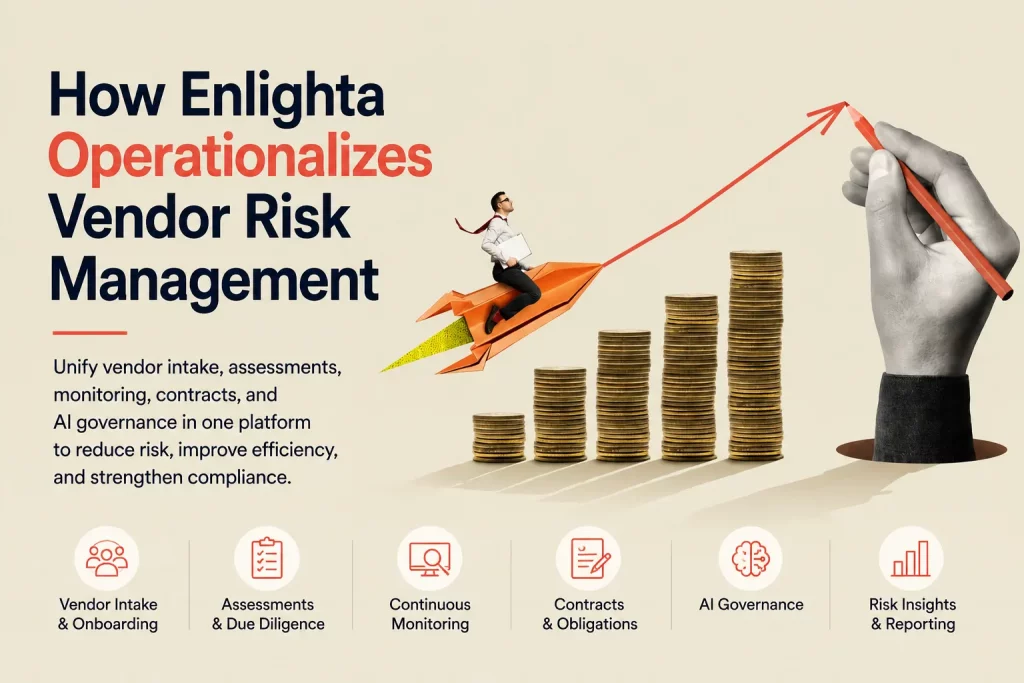
Enlighta is a platform built to unify the full vendor risk management lifecycle on a single AI-powered foundation, from intake and screening through due diligence, contracting, onboarding, performance and compliance monitoring, governance, and offboarding. Unlike traditional vendor risk tools that stop at the contract, Enlighta governs the actual relationship: SLAs, KPIs, issues, obligations, adverse events, and 4th/5th-party concentration risk all live in the same record as the vendor’s risk score. AI-powered contract lifecycle management extracts SLAs, obligations, pricing, and insurance terms automatically rather than requiring manual review.
The platform’s approach to vendor governance was recognized in 2024 when Enlighta won the SIG Future of Sourcing Award for Innovation in Governance and Compliance alongside PepsiCo, for a partnership scaling supplier performance, governance, and contract compliance across regions and service categories.
For organizations whose AI tool exposure is growing faster than vendor risk management can keep up with, Enlighta’s GovernAI module brings vendor risk and AI model risk into one unified governance layer, so vendor governance and AI governance run on the same platform rather than as two disconnected programs.
Conclusion
Vendor risk management is the discipline that turns vendor relationships from a hidden risk surface into a governed one. The stages of the framework — identification, due diligence, contracting, onboarding, monitoring, governance, and offboarding — are well established. What separates mature programs from checkbox-driven ones is whether those stages are connected in a single workflow with documented evidence, or whether each one runs in its own tool and the gaps between them are where vendor failures originate.
If you’re evaluating where your vendor risk management program stands today, or how the stages of your vendor risk management framework could work together in one platform, we’d be glad to walk you through it.
Frequently Asked Questions
What is an example of a vendor risk?
Common examples include a vendor experiencing a cybersecurity breach that exposes customer data, a supplier becoming insolvent, a vendor violating data-protection regulations like GDPR, a contractor caught in an ethical or labor-practices issue, or a supplier appearing on a sanctions list. Other examples include operational outages at a critical SaaS provider, concentration risk from over-reliance on a single vendor, and risks introduced through subcontractors the primary organization never directly assessed.
What is vendor risk management?
Vendor risk management is the discipline of identifying, assessing, mitigating, and continuously monitoring risks introduced by external vendors and service providers across the full vendor lifecycle. It covers cybersecurity, financial, operational, compliance, reputational, ESG, concentration, and AI-related risks.
How to perform a vendor risk assessment?
A vendor risk assessment follows a structured sequence: define the scope, run initial screening (sanctions, PEP, adverse media, AML/CTF), determine criticality and tier, dispatch tier-appropriate DDQs, collect and validate evidence (SOC 2, ISO 27001, financials), score inherent and residual risk, decide whether to accept, mitigate, or walk away, and schedule reassessment based on tier.
What are the tools for vendor risk assessment?
The core tools include due-diligence questionnaires, sanctions and PEP screening, adverse media monitoring, cybersecurity ratings, financial health intelligence, contract lifecycle management with AI extraction, performance dashboards, self-service vendor portals, workflow automation, and reporting and analytics. The most effective approach unifies these on one platform rather than running them as separate tools.
What is the framework for vendor risk management?
The vendor risk management framework typically includes seven stages: identification, screening and tiering; due diligence and risk assessment; contracting and risk mitigation; onboarding and vendor information management; ongoing monitoring and performance; governance and issue management; and offboarding and termination. Some frameworks compress these into four or five phases, but the same activities are covered.
What are the KPIs for vendor management?
Key KPIs for vendor risk management include program coverage (percentage of vendors tiered and currently assessed), risk and compliance KPIs (residual risk scores, open findings by severity, remediation time, valid certifications), performance KPIs (SLA adherence, service credits, issue resolution, QBR completion), and operational efficiency KPIs (onboarding cycle time, DDQ turnaround, audit-readiness, reassessment on-time rate).
Ready to elevate your vendor risk management capabilities? Get in touch with us today info@enlighta.com or click the button below.
Explore the full program: this guide is part of the Supplier Risk Management hub — the complete lifecycle, risk categories, KPIs and free templates in one place.
New to the whole discipline? Start with What Is Vendor Management? — the complete lifecycle guide covering selection, onboarding, performance, renewals and exit.
Tag:
Share Article:
Enlighta Team
Enlighta’s software solutions empower enterprises to increase business value and mitigate risks in supplier and third-party engagements through data-driven insights into demand, performance, contract compliance & spend, and process automation for demand, selection, invoice validation, vendor governance, and third-party risk monitoring.