Validate supplier invoices against contract terms and approved evidence
Supplier invoices can contain incorrect rates, quantities, unsupported expenses, unaccepted deliverables or contractual adjustments that have not been applied. Matching an invoice to a purchase order alone may not reveal these discrepancies.
For complex vendor engagements, each charge needs to be evaluated against the commercial terms and supporting information that apply to it: contracted rates, approved consumption, purchase commitments, acceptance records, expense authorization and applicable service-level adjustments. Different commercial models require different validation evidence; the right check depends on what the organization agreed to pay for.
Supplier agreements use different commercial models, and each requires a different approach to financial validation. Fixed fees must be checked against contracted scope and approved changes. Time-and-materials charges require validation of resource roles, hours and contracted rates. Volume-based charges depend on approved service volumes and unit prices. Deliverable and milestone payments depend on completion and acceptance, while outcome-based and shared-savings arrangements require evidence that their agreed conditions have been met.
Enlighta Vendor Spend Governance connects these financial controls to help organizations validate vendor charges, investigate discrepancies and improve visibility into expenditure.
Why matching an invoice to a purchase order is not enough
A purchase order establishes an authorized purchasing commitment, but it does not necessarily establish that every invoice line is correct. For complex services, the validation process may also need to consider the executed contract and amendments, the applicable pricing schedule or rate card, the purchase order and remaining commitment, actual service consumption or delivered quantities, resource roles, hours and approved rates, deliverable or milestone acceptance, authorized expenses and supporting receipts, contractual adjustments, service credits, penalties or rewards, and the applicable billing period and currency.
Validation reference
What it establishes
Contract
Agreed commercial terms, scope and conditions
Purchase order
Authorized financial commitment and available balance
Rate card or pricing schedule
Applicable rates and unit prices
Approved actuals
Reviewed consumption or service activity
Acceptance evidence
Completion and acceptance of deliverables or milestones
Adjustment records
Applicable credits, penalties, rewards or other contractual changes
Supplier invoice
Charges submitted for reconciliation
Not all of these records are mandatory for every invoice. The applicable evidence depends on the contract and charge type.
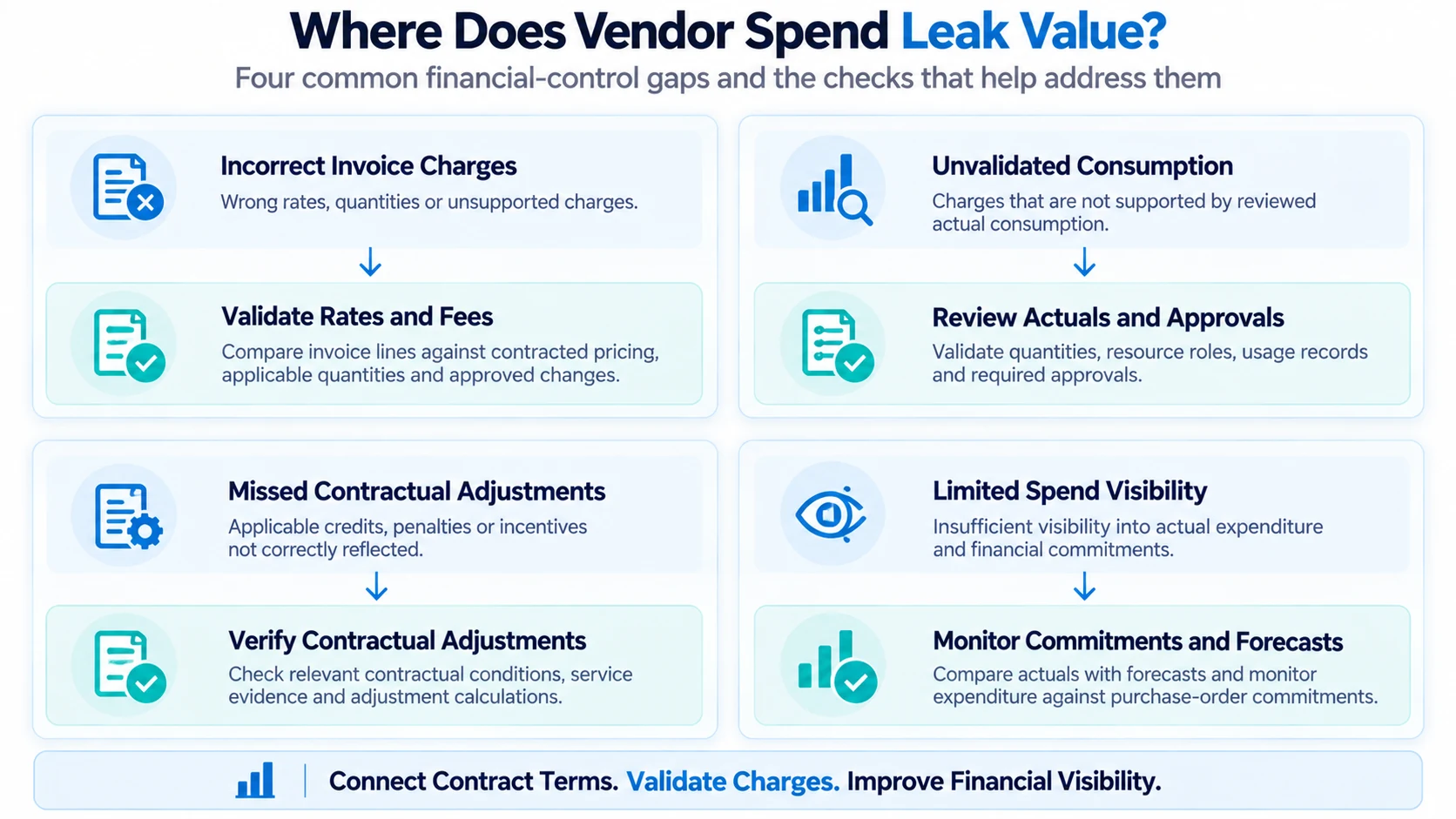
Four common financial-control gaps and the checks that help address them.
Different commercial models require different invoice checks
Commercial model
What needs to be validated
Example evidence
Fixed-price / fixed-fee
Contracted fee, applicable period, scope and approved changes
Contract, pricing schedule, approved change records
Time-and-materials
Resource role, hours or effort, applicable rate and required approvals
Rate card, approved timesheets, resource records
Volume- or consumption-based
Actual volume, applicable unit price and relevant consumption records
Approved actuals, usage data, contracted unit prices
Tiered pricing
Actual volume and the contractual tier calculation rule
Pricing schedule, volume records, calculation
Deliverable-based
Deliverable completion and acceptance conditions
Deliverable record, acceptance sign-off
Milestone-based
Milestone achievement and contractual payment condition
Milestone record, supporting evidence and acceptance
Outcome-based
Achievement of the agreed measurable result
Performance evidence, agreed baseline and measurement
Shared savings / gainsharing
Baseline, calculation method, qualifying results and reward terms
Approved baseline, formula, source data and verified results
The same invoice amount may require different validation depending on the commercial agreement. The applicable checks should reflect the pricing model, contractual conditions and evidence required for that engagement. These categories describe common arrangements; they are not a claim that every model is automatically calculated by Enlighta.
How Enlighta governs vendor spend
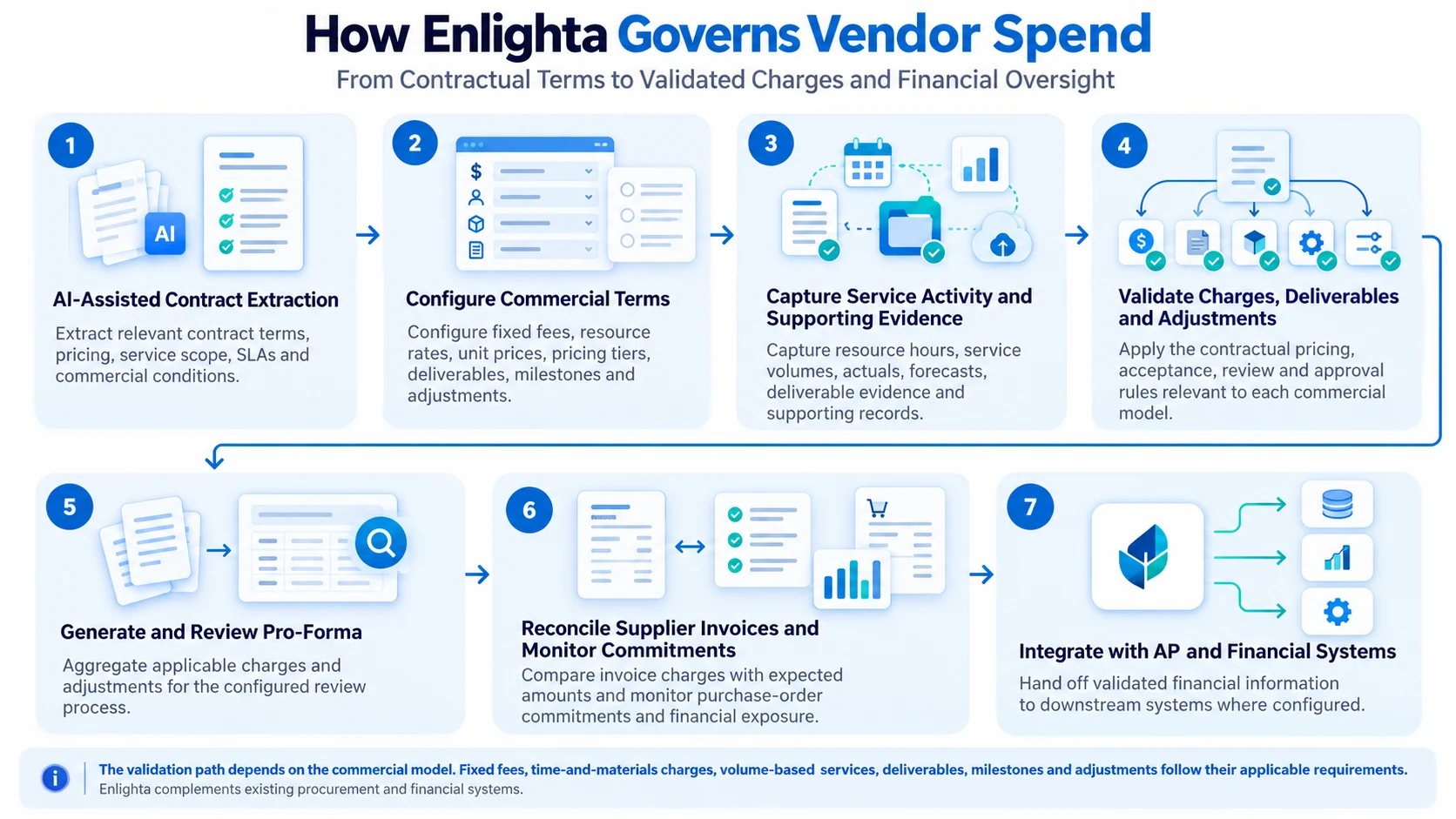
Vendor Spend Governance is not limited to consumption tracking. It connects contractual commitments, commercial pricing, service activity, deliverable acceptance, invoice validation, financial adjustments and spend oversight in one workflow, from establishing the commercial basis to handing off validated information to downstream financial systems where configured.
The validation path depends on the commercial model. Fixed fees, time-and-materials charges, volume-based services, deliverables, milestones and adjustments follow their applicable pricing, evidence and approval requirements. Enlighta complements existing procurement and financial systems.
Validate different invoice charges against their relevant evidence
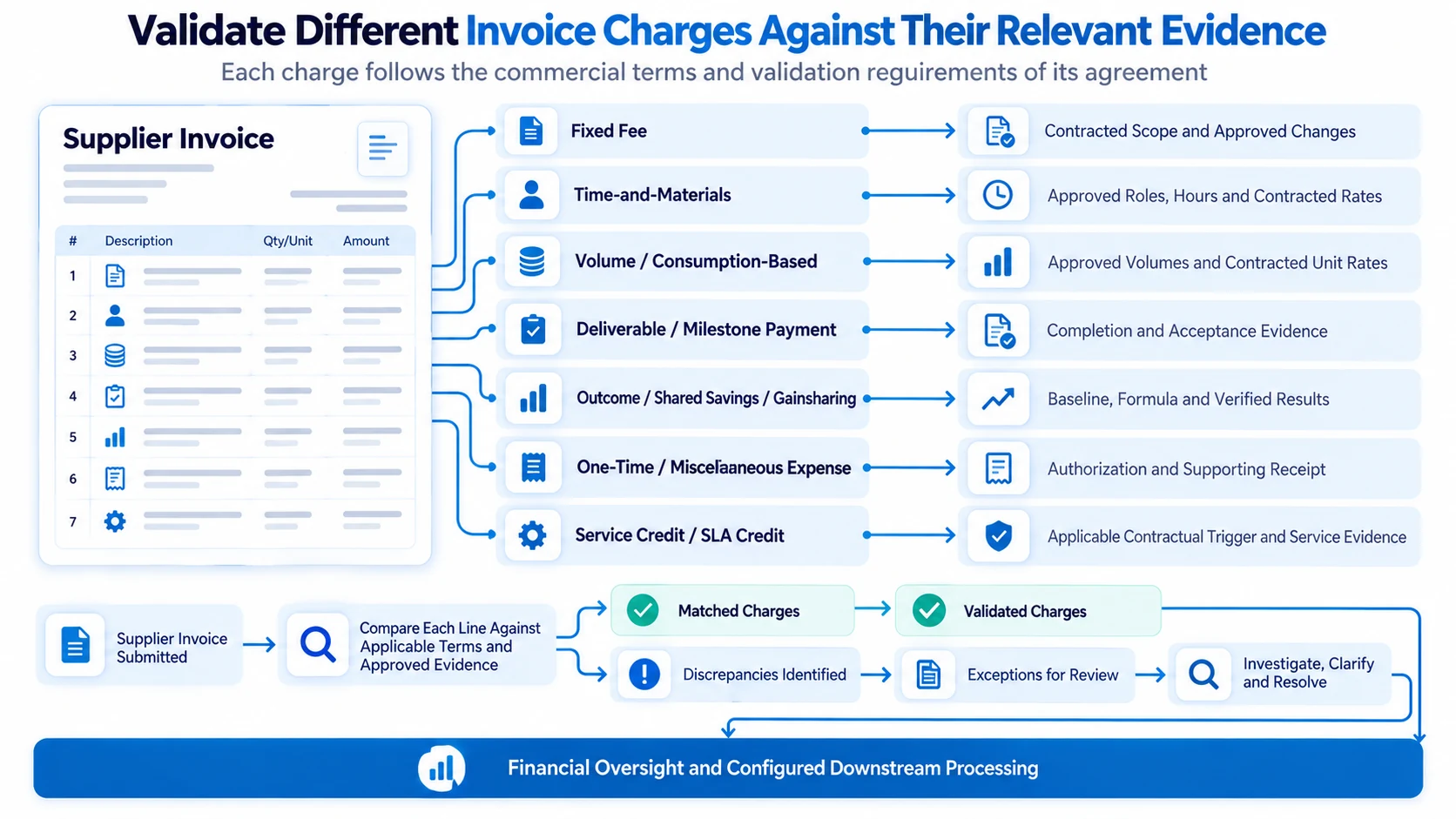
Illustrative validation flow showing how different supplier invoice charges can be checked against their applicable contractual terms and supporting evidence. Discrepancies are routed for review and resolution.
Matched charges and exceptions are alternative outcomes. Validated charges proceed through the configured downstream financial process; discrepancies are routed for review and resolution. Not every charge follows the same validation sequence.
How supplier invoice reconciliation works
1
Establish the approved commercial basis
Identify the applicable contract, amendments, pricing terms, purchase order, rate cards, billing period and currency. The purpose is to determine the contractual basis against which charges should be evaluated.
2
Identify and classify invoice line items
Review the supplier’s invoice and identify the applicable charge types: recurring fees, resource consumption, unit-based charges, milestones, expenses, incentives and service credits.
3
Select the relevant validation evidence
Determine which records are required for each charge. Not every charge requires consumption validation: fixed fees require contract and scope validation; time-and-materials requires approved roles, hours and rates; volume-based charges require actual volumes and unit prices; milestones require acceptance evidence; expenses require authorization and receipts; credits and incentives require their relevant contractual conditions.
4
Compare submitted and expected charges
Compare the submitted invoice amounts against the expected charges established using the applicable commercial terms and approved information: quantity or volume, resource role, hours or units, contracted rate or unit price, billing period, milestone or deliverable status, applicable credits and adjustments, and PO commitment and available balance, where relevant to the commercial model.
5
Identify discrepancies
Incorrect rate; incorrect quantity or hours; unapproved additional resources; unsupported expenses; missing acceptance evidence; incorrect tier application; incorrect or missing contractual adjustment; unrecorded contract amendment. A discrepancy is a review trigger, not proof of supplier misconduct.
6
Review and resolve exceptions
Route exceptions to the appropriate accountable reviewer. The process may require reviewing the contract and supporting records, confirming whether an amendment or approval exists, requesting clarification or supporting evidence from the supplier, recording the review decision, and correcting the relevant expected or invoiced amount where appropriate. Exceptions are not automatically resolved by AI.
7
Record the validation outcome
Distinguish matched and validated charges, exceptions requiring further review, resolved discrepancies, and information handed off to downstream accounts-payable or financial systems where configured. Enlighta does not independently execute supplier payments.
Example: an illustrative time-and-materials rate validation
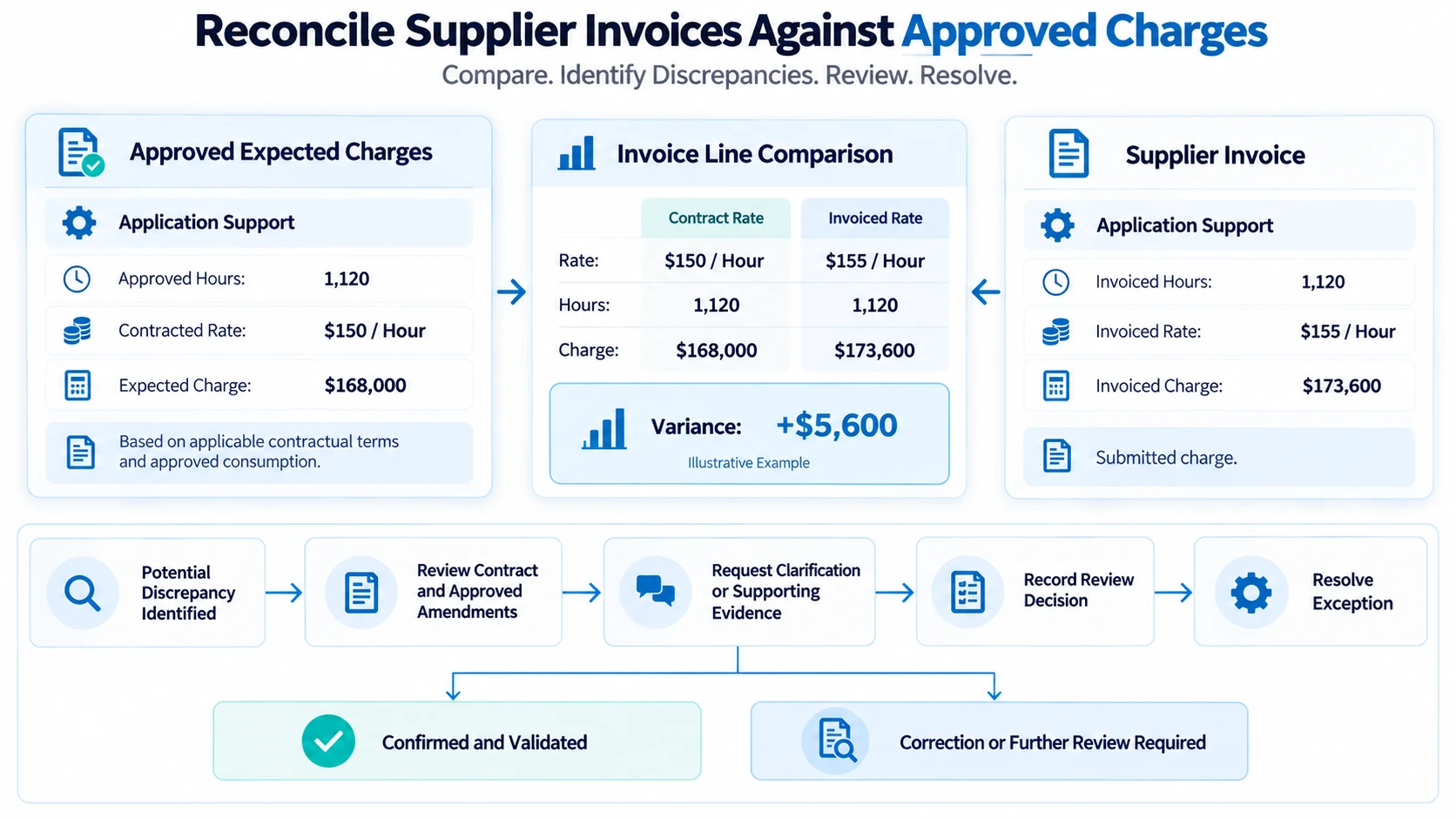
Illustrative example. Not a real Enlighta customer transaction or a verified customer saving.
This example demonstrates how an hourly charge can be checked against approved resource hours and contracted rates. Other commercial models use their own validation requirements. A supplier submits an invoice for 1,120 hours of application-support services. The invoiced amount is higher than the expected amount because the supplier applied a rate of $155 per hour instead of the contracted rate of $150 per hour. The discrepancy should be reviewed against the contract and any approved amendments before determining whether the invoice requires correction.
Item
Value
Approved hours
1,120
Contracted rate
$150/hour
Invoiced rate
$155/hour
Expected charge (1,120 × $150)
$168,000
Invoiced charge (1,120 × $155)
$173,600
Difference
$5,600
The role of pro-forma invoices
A pro-forma invoice is a preliminary statement of expected charges. It can be reviewed against the applicable contract terms and approved information before the supplier issues the final invoice. The sequence runs: expected charges are established using the relevant commercial terms and approved inputs; a pro-forma is generated and reviewed where configured; the supplier submits the final invoice; the final invoice is reconciled against the reviewed and approved charges; and discrepancies are handled through the applicable exception process. The pro-forma is not the supplier’s final invoice, and not every implementation automatically generates or approves all pro-forma components.
AI-assisted invoice validation
AI-assisted capabilities can help extract relevant information from supplier invoices and supporting documents, compare available information with configured commercial terms and approved records, and highlight potential discrepancies for review. AI does not automatically approve invoices, guarantee error-free validation, reconcile every line without human intervention, determine legal interpretations, or process payments. The exact capability, matching scope and exception workflow depend on configuration, data availability and integration.
Invoice exceptions are not vendor risks
An invoice exception is a financial discrepancy that requires review: an incorrect rate, a quantity mismatch, a missing receipt, an unapproved charge or a missing service credit. A vendor risk is a broader issue concerning the supplier’s ability, conduct, security, compliance or operational performance. A financial discrepancy may reveal a larger issue, but the two remain distinct categories, and not every invoice exception is a vendor risk.
Validate supplier invoices with confidence
Enlighta Vendor Spend Governance connects contract terms, approved consumption, acceptance evidence and invoice information so each charge can be validated against the right basis and discrepancies reach an accountable reviewer.
Supplier invoice validation checks each invoice line item against the applicable contractual terms, approved consumption, acceptance evidence and supporting records, rather than only matching the invoice total to a purchase order.
Why is purchase-order matching not enough?
A purchase order establishes an authorized purchasing commitment, but it does not establish that every invoice line is correct. Rates, quantities, expenses, acceptance status and contractual adjustments all need their own validation evidence.
Do different commercial models require different validation checks?
Yes. Fixed fees, time-and-materials, consumption-based charges, milestones, outcome-based arrangements and shared savings each have a different calculation basis and require different evidence.
Does Enlighta Vendor Spend Governance replace ERP or accounts-payable systems?
No. It complements source-to-contract, procure-to-pay, ERP and accounts-payable systems by connecting contract terms, approved consumption and invoice information for validation and oversight. Core accounting and payments remain with the relevant enterprise systems.
Can AI validate invoices automatically?
AI-assisted capabilities can help extract information from invoices and supporting documents, compare available information with configured terms and approved records, and highlight potential discrepancies for review. Final validation and approval remain with accountable reviewers.
What happens when an invoice line does not match?
Discrepancies are routed as exceptions to the appropriate reviewer, who may request clarification or supporting evidence from the supplier, record a review decision and correct the expected or invoiced amount where appropriate.
This article describes Enlighta’s documented capabilities and illustrative workflows. Figures in the example are illustrative only; the exact scope depends on the configured implementation.
Tag:
Share Article:
E S
Enlighta’s software solutions empower enterprises to increase business value and mitigate risks in supplier and third-party engagements through data-driven insights into demand, performance, contract compliance & spend, and process automation for demand, selection, invoice validation, vendor governance, and third-party risk monitoring.