How Enlighta uses AI to support supplier evidence and document validation
Supplier risk assessments depend on more than the information a third party provides. Organizations also need to establish whether submitted policies, certificates, questionnaires and other supporting documents are relevant, complete, current and sufficient to address the requirements being assessed.
For Third-Party Risk Management (TPRM) teams, this creates two related but distinct challenges: collecting the required supplier evidence and validating whether that evidence meets the organization’s requirements.
Enlighta uses AI-assisted automation and governance workflows to support supplier document review, evidence validation and compliance activities. The objective is to help teams organize information, identify potential gaps and focus their attention on findings requiring further investigation, while retaining human oversight of important risk and compliance decisions.
Why supplier evidence review requires more than document collection
Suppliers are regularly asked to provide documents that demonstrate their security, operational, regulatory and contractual compliance. Depending on the engagement and applicable due-diligence requirements, these may include information security and privacy policies, SOC 2 and PCI compliance certificates, insurance certificates, business continuity documentation, incident response and vulnerability management policies, audit reports, completed due-diligence questionnaires, and other supporting records.
Receiving these documents is only the beginning. A submitted information security policy, for example, may describe an organization’s approach to access control and incident response without providing sufficient evidence that the relevant controls are implemented and operating effectively. A certificate may have expired, a document may relate to a different legal entity, or a submitted policy may not address all the requirements relevant to the supplier’s services.
TPRM teams therefore need to establish not just whether evidence exists, but whether it addresses the right requirement and warrants acceptance.
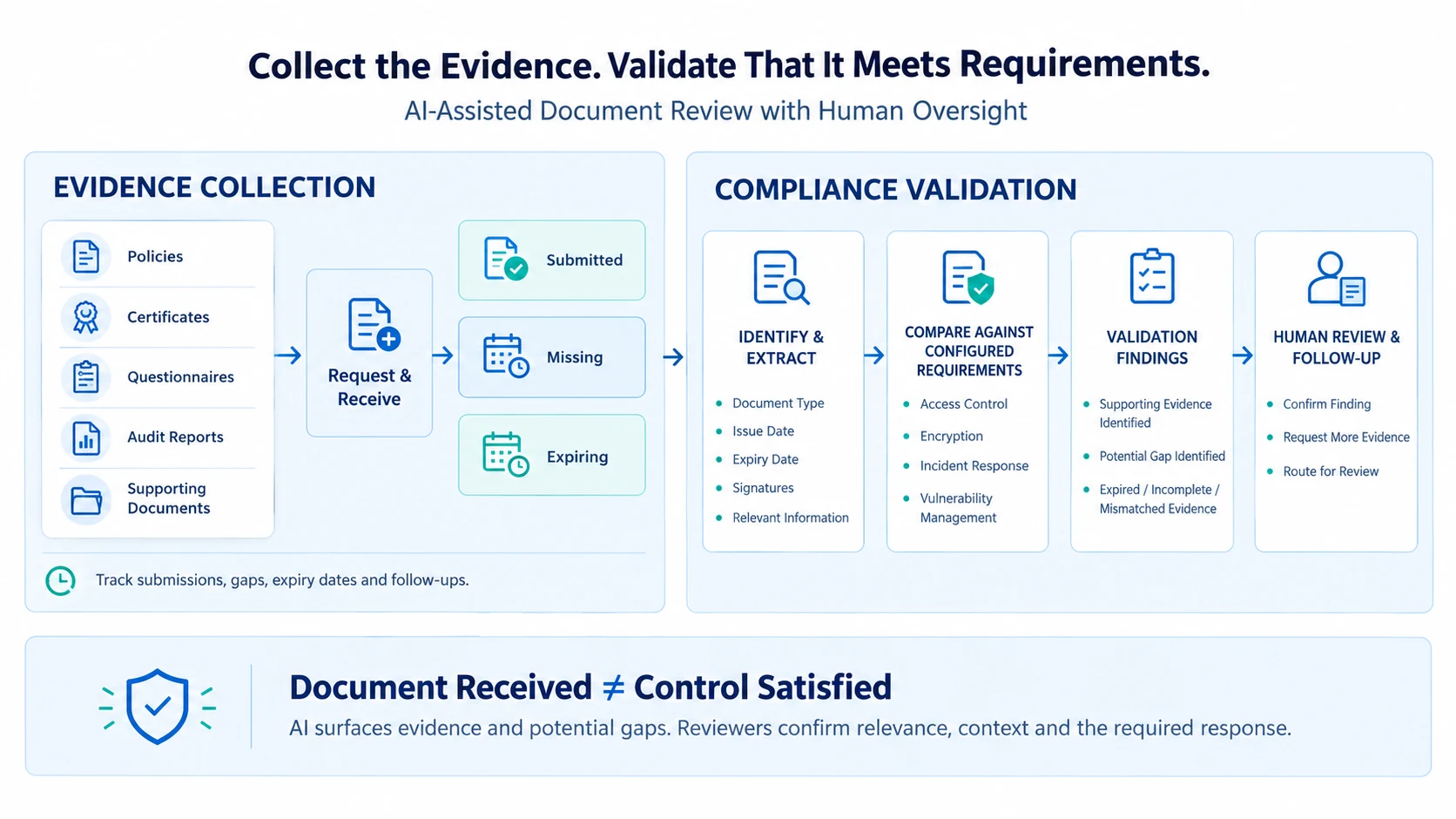
Collect the evidence. Validate that it meets requirements. AI-assisted document review with human oversight.
Evidence collection and evidence validation are different activities
An effective evidence-management process separates collecting supplier information from evaluating its suitability. Evidence collection establishes whether the required documents and information have been received. Evidence validation evaluates whether the submitted material satisfies the applicable requirements and identifies gaps that may need further attention.
Evidence Collection
Identifies required evidence; requests policies, certificates and audit reports; records supplier submissions; tracks missing or outstanding items; tracks expiry dates and follow-ups; organizes submitted evidence.
Compliance Validation
Identifies document types and applicable validation criteria; reviews document content against configured requirements; extracts relevant information and document details; identifies missing, expired, incomplete or mismatched evidence; flags potential compliance gaps and exceptions; produces validation findings for review.
The distinction is fundamental: receiving a document does not mean that a control is satisfied.
Where AI supports supplier document validation
1
Identify document types and extract relevant information
AI-assisted document review can help identify the type of document submitted and extract relevant information such as document type and purpose, issue and expiry dates, signatures and relevant document details, information relating to applicable controls or requirements, and relevant clauses or statements within the document.
2
Compare submitted evidence with configured requirements
A document’s presence does not establish that it meets an organization’s expectations. AI-assisted evidence validation can evaluate submitted policies, certificates, controls and supporting documentation against configured organizational requirements. For example, an information security review may involve requirements covering access control, encryption, incident response and vulnerability management.
3
Identify missing, expired or incomplete evidence
AI-assisted document review can help surface potential evidence-quality issues including missing supporting documents, expired certificates or policies, incomplete information, inconsistent document details, requirements not adequately supported by the submitted evidence, and potential gaps between documented policies and required controls. An identified gap should be treated as a finding for review rather than an automatic conclusion that a supplier is non-compliant.
4
Summarize validation findings
AI-assisted summaries can help highlight relevant document coverage, identify potential missing controls and present findings in a format that supports reviewer investigation, making it easier to prioritize documents and focus on specific areas requiring clarification or additional evidence.
5
Support exception review and follow-up
When a document does not appear to satisfy a configured requirement, the finding may need further investigation. Depending on the configured workflow, the issue can be routed for review, additional evidence can be requested, and follow-up can be tracked. The reviewer remains responsible for confirming whether the evidence is acceptable and determining the appropriate response.
A practical example: validating an information security policy
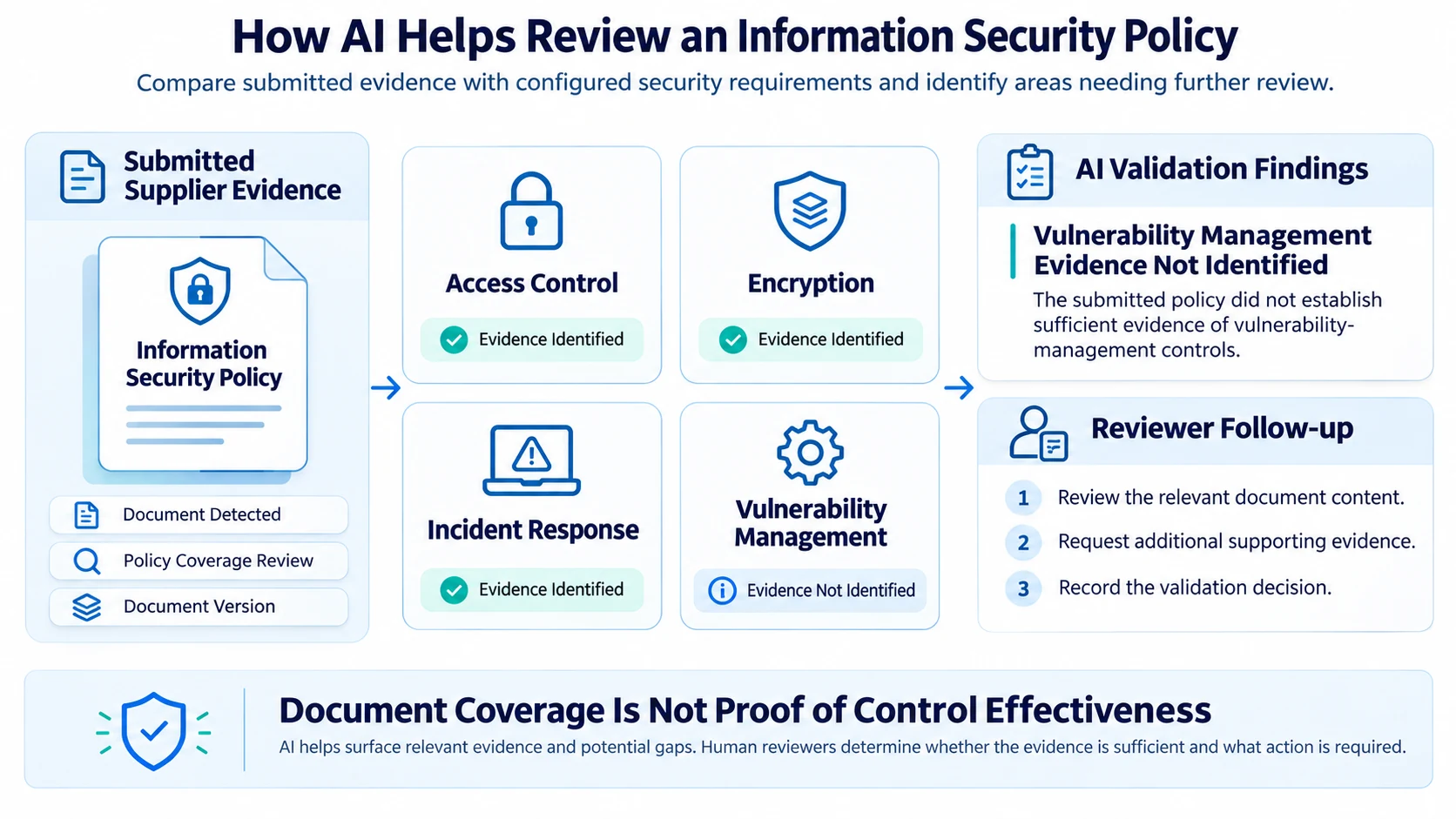
Consider a supplier that submits an information security policy as part of a TPRM assessment. The organization’s requirements cover four areas: access control, encryption, incident response and vulnerability management.
Based on the information-security-policy validation scenario demonstrated in Enlighta’s TPRM environment. Document coverage is not proof of control effectiveness.
Requirement
Validation observation
Access control
Supporting information identified
Encryption
Supporting information identified
Incident response
Supporting information identified
Vulnerability management
Sufficient supporting evidence not identified
Instead of treating the document as fully compliant simply because it was submitted, the validation process highlights the area requiring further review. The reviewer can then examine the relevant document content, request additional vulnerability-management evidence or determine whether the submission needs clarification. AI can help identify where evidence appears to be missing, but the reviewer determines whether the available information satisfies the organization’s requirements.
This example is based on the information-security-policy validation scenario demonstrated in Enlighta’s TPRM environment. It is illustrative of the review process, not a claim that a policy document alone proves that the underlying controls are operating effectively.
From supplier submission to review-ready evidence
1
Define evidence requirements
Establish the documents and supporting information required for the supplier based on the applicable assessment, control requirements and engagement context.
2
Request and collect evidence
Request the relevant policies, certificates, questionnaires, audit reports and supporting documentation. Collection may be manual or automated depending on the configured workflow and enabled capabilities.
3
Identify documents and extract information
Identify the submitted document type and extract relevant information such as issue dates, expiry dates, signatures and applicable content.
4
Validate against requirements
Compare the available document information and supporting evidence with the configured criteria. Identify potential gaps, missing information, expired documents and other exceptions.
5
Review and confirm findings
A designated reviewer examines the findings, verifies the document context and determines whether further evidence, clarification or corrective action is required.
6
Record outcomes and follow up
Record the validation outcome and maintain visibility into outstanding evidence, follow-up activities and relevant expiry or review requirements through the configured governance process.
Why human review remains essential
AI-assisted document validation can help teams process information more consistently, but document interpretation and compliance decisions still require accountable review. A document may contain a relevant policy statement without providing sufficient evidence that the corresponding control is operating effectively. Similarly, an apparent gap may result from an alternative document, a different naming convention or supporting evidence submitted separately.
Reviewers therefore need to consider whether the document relates to the correct supplier and requirement, whether the information is current and relevant, whether the submitted evidence adequately addresses the control, whether additional information or clarification is needed, and whether the finding requires remediation or a formal compliance decision. AI-generated findings should support this assessment rather than replace it.
How Enlighta supports AI-assisted supplier evidence validation
Enlighta publicly describes AI-assisted automation across the TPRM lifecycle, including supplier document validation, evidence validation, compliance validation and the identification of potential information gaps. These capabilities complement evidence collection, assessment and governance workflows.
The current Demo Center includes a live Obligations Management demonstration covering AI-powered document intelligence, collection, validation, monitoring and audit-ready evidence. A separate Evidence Intake & Document Intelligence capability is listed as coming soon.
The exact automation available depends on the module, release and configuration of the implementation.
See how Enlighta supports supplier evidence and compliance governance
Explore the available demonstrations in the Enlighta Demo Center or request a demo to discuss your supplier evidence and compliance workflows.
AI supplier evidence validation uses AI-assisted document analysis to review submitted supplier information against configured organizational requirements. It can help identify document details, potential missing information, expired evidence, inconsistencies and possible compliance gaps for further review.
What is the difference between evidence collection and evidence validation?
Evidence collection is the process of requesting and receiving supplier documents and tracking outstanding submissions. Evidence validation evaluates whether the submitted information meets the applicable requirements and identifies potential gaps requiring review.
Which supplier documents can be reviewed?
Depending on the implementation and configured requirements, supplier evidence may include security policies, certificates, insurance documents, questionnaires, audit reports and other compliance-related records.
Can AI identify expired or missing supplier evidence?
AI-assisted document review can help identify relevant document dates and highlight potentially expired, incomplete or missing evidence. Reviewers should confirm the findings and determine the appropriate follow-up.
Does AI replace TPRM reviewers?
No. AI assists with document identification, information extraction and gap detection. Reviewers remain responsible for interpreting findings, confirming evidence suitability, determining compliance outcomes and deciding on appropriate actions.
Is evidence collection the same as compliance validation?
No. A supplier can submit every requested document and still have gaps in the evidence required to demonstrate control effectiveness. Collection tracks receipt; validation evaluates whether the evidence meets the relevant requirements.
Is Enlighta's dedicated Evidence Intake & Document Intelligence module currently available?
The current Enlighta Demo Center lists Obligations Management as a live demonstration and the separate Evidence Intake & Document Intelligence capability as coming soon. The availability and scope of specific AI-assisted evidence functions should be confirmed for the relevant implementation.
This article describes Enlighta’s publicly documented AI capabilities and illustrative workflows. The dedicated Evidence Intake & Document Intelligence module is listed as coming soon; availability of specific functions should be confirmed for the relevant implementation.
Tag:
Share Article:
E S
Enlighta’s software solutions empower enterprises to increase business value and mitigate risks in supplier and third-party engagements through data-driven insights into demand, performance, contract compliance & spend, and process automation for demand, selection, invoice validation, vendor governance, and third-party risk monitoring.