From adverse events to risk action: how Enlighta supports continuous vendor intelligence
A supplier’s risk profile can change significantly after onboarding. A cyber incident, financial deterioration, regulatory action, ownership change or operational disruption may introduce new risks into an existing third-party relationship.
These developments often appear first in external information sources, including news publications, regulatory announcements, financial information and cybersecurity intelligence.
The objective is not simply to collect more news. It is to identify events that may materially change supplier risk and connect them to informed investigation and action.
Why monitoring external events matters in third-party risk management
Traditional third-party due diligence provides an important baseline for understanding supplier risk. However, information collected during an initial assessment may not reflect developments that occur months later.
A supplier may experience a financial downturn, become involved in litigation, face a regulatory investigation, suffer a cybersecurity incident or encounter an operational disruption. These events can affect the organization’s existing exposure even when the supplier has not submitted an updated assessment.
Examples include a supplier experiencing financial deterioration or insolvency concerns, a new sanctions match or regulatory enforcement notice, a cybersecurity incident or material change in security ratings, a fire or closure affecting an important operating facility, an ownership change or merger involving a critical supplier, a disruption affecting a fourth-party or supply-chain dependency, and adverse news involving legal, operational or reputational concerns.
Without an appropriate monitoring process, such developments may remain disconnected from the organization’s supplier records, assessments and governance activities.
What types of external risk events should organizations monitor?
External risk monitoring should cover more than cybersecurity and adverse media. A supplier relationship can be affected by developments across several risk areas.
Financial and Corporate
Financial deterioration, insolvency indicators, mergers and acquisitions, ownership changes and other significant corporate developments.
Sanctions, Litigation and Regulatory
Potential sanctions matches, litigation and legal proceedings, regulatory notices, fines and enforcement actions. A potential match should be examined in context before it is treated as a confirmed finding.
Operational and Geographic
Fires and facility incidents, strikes and workforce disruptions, facility closures, geopolitical developments, and material site or location changes.
Cyber
External cybersecurity rating changes, cyber incidents, reported data breaches and other cybersecurity-related developments.
Supply Chain
Fourth-party events, subcontractor-related developments, supplier dependencies and disruptions affecting the extended supply chain.
Adverse news is not limited to one risk category. External reporting can reveal developments relating to financial stability, regulatory and legal exposure, operational disruptions, cybersecurity incidents or supply-chain dependencies. The relevant event should therefore be classified according to the nature of the underlying development rather than treated as a separate risk domain.
The value of monitoring these sources is not just discovering an event. It is understanding how that event relates to the organization’s supplier ecosystem.
Why an external risk signal needs supplier context
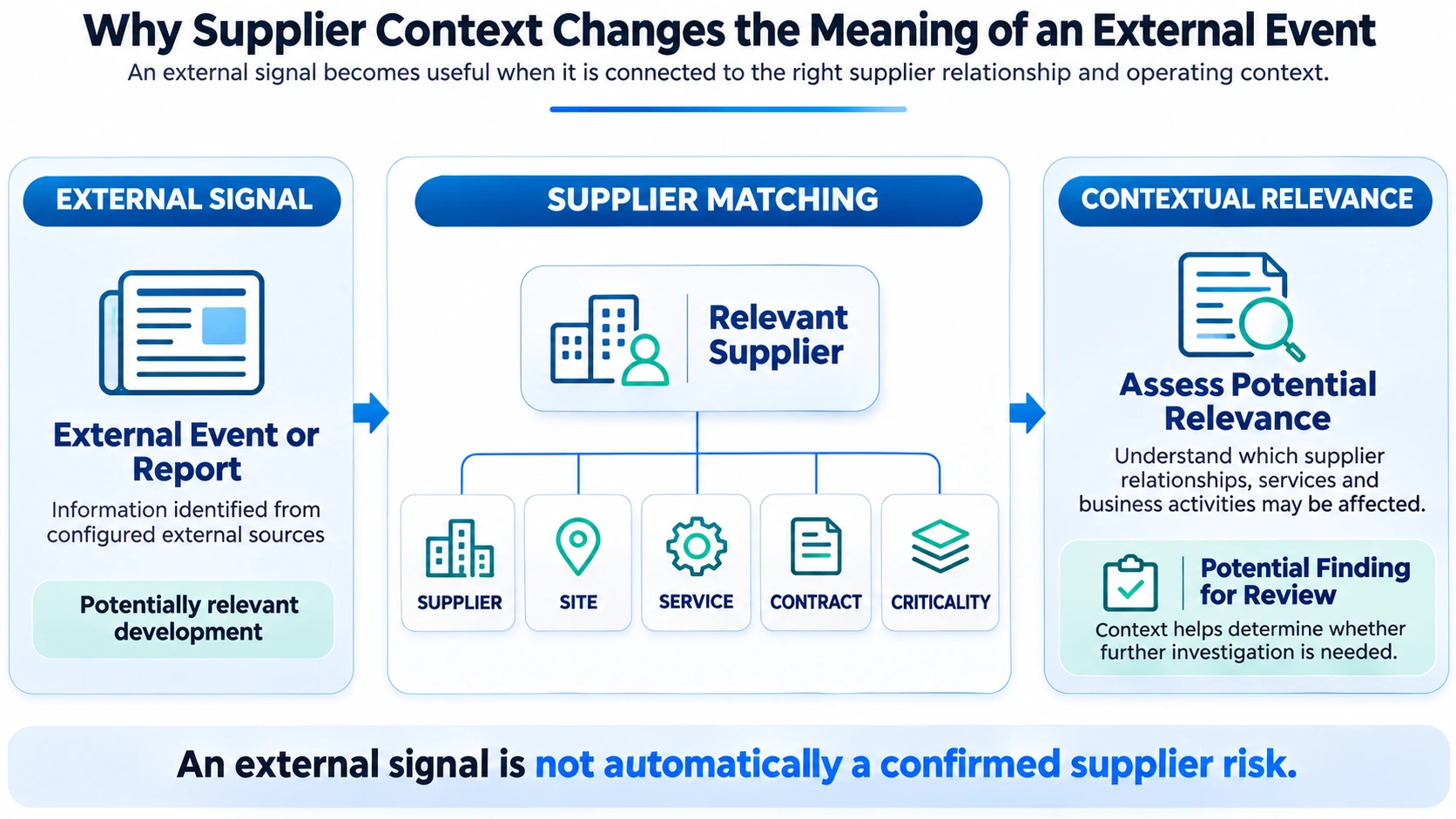
An external news report does not automatically establish that a particular supplier is exposed to a material risk. The event must first be associated with the correct organization and evaluated against the context of the supplier relationship.
Consider a report about a manufacturing facility affected by a fire. Which supplier operates the affected facility? Is it associated with the correct legal entity? Does the supplier provide a critical service? Does the organization depend on that particular site? Are any contracts or business units potentially affected?
The same event may have very different implications for different organizations. A facility disruption may be a limited operational issue for one buyer but a material supply-continuity concern for another that depends heavily on the affected supplier.
External events need to be connected to the relevant supplier relationship before their potential business significance can be assessed.
How Enlighta connects external events with vendor risk
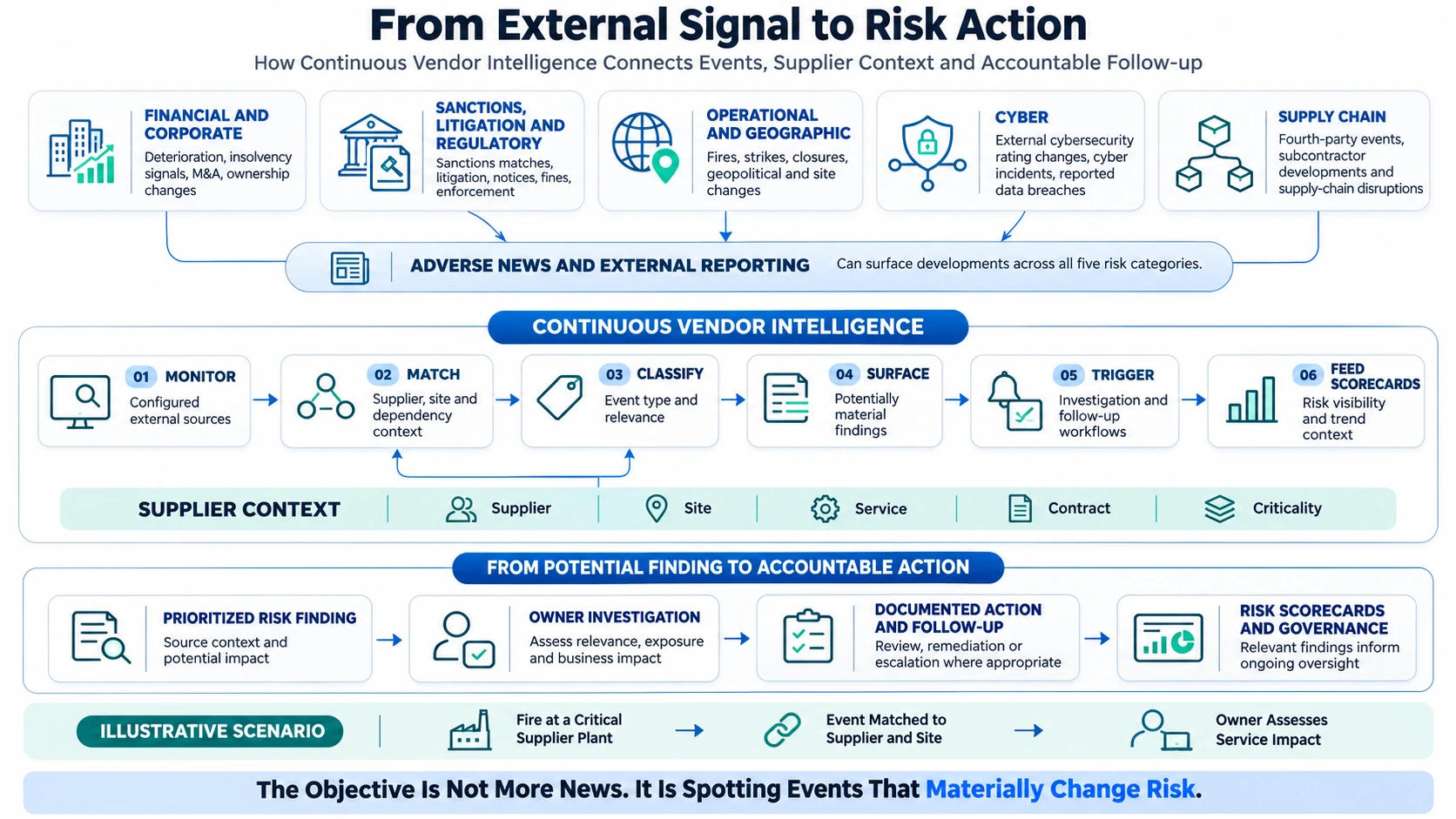
Enlighta’s external risk monitoring approach can be understood through six connected stages.
Illustrative external risk monitoring across five risk categories — financial and corporate, sanctions litigation and regulatory, operational and geographic, cyber, and supply chain — with adverse news and external reporting able to surface developments across all of them.
Relevant external information is gathered from configured intelligence sources and monitoring feeds, including news publications, blogs, sanctions information, financial and corporate information, cybersecurity intelligence and other relevant external data.
2
Match events to the relevant supplier
An external event is associated with the correct supplier or related entity, considering available supplier information, legal entity details, sites and relevant third-party relationships. This step is important because similar company names and subsidiaries can otherwise create irrelevant matches.
3
Classify the event
Once a relevant event has been identified, it is classified according to its nature and potential risk category, such as financial, regulatory, operational, or cyber. Classification is not the same as confirming the materiality of the risk.
4
Surface relevant findings
The monitoring process helps distinguish potentially material developments from general news. Relevant findings are presented with their source context, associated supplier and available event details.
5
Trigger appropriate investigation or follow-up
When an event warrants attention, the next step is to determine who should investigate it. Depending on the configured workflows, this may include notifying stakeholders, assigning an owner for impact assessment, requesting additional information, initiating further due diligence, or escalating material concerns.
6
Feed relevant findings into risk scorecards
External signals can feed relevant risk scorecards and management views, where configured, helping organizations understand changing exposure and identify suppliers that may require additional oversight.
From an external event to an accountable risk action: an example
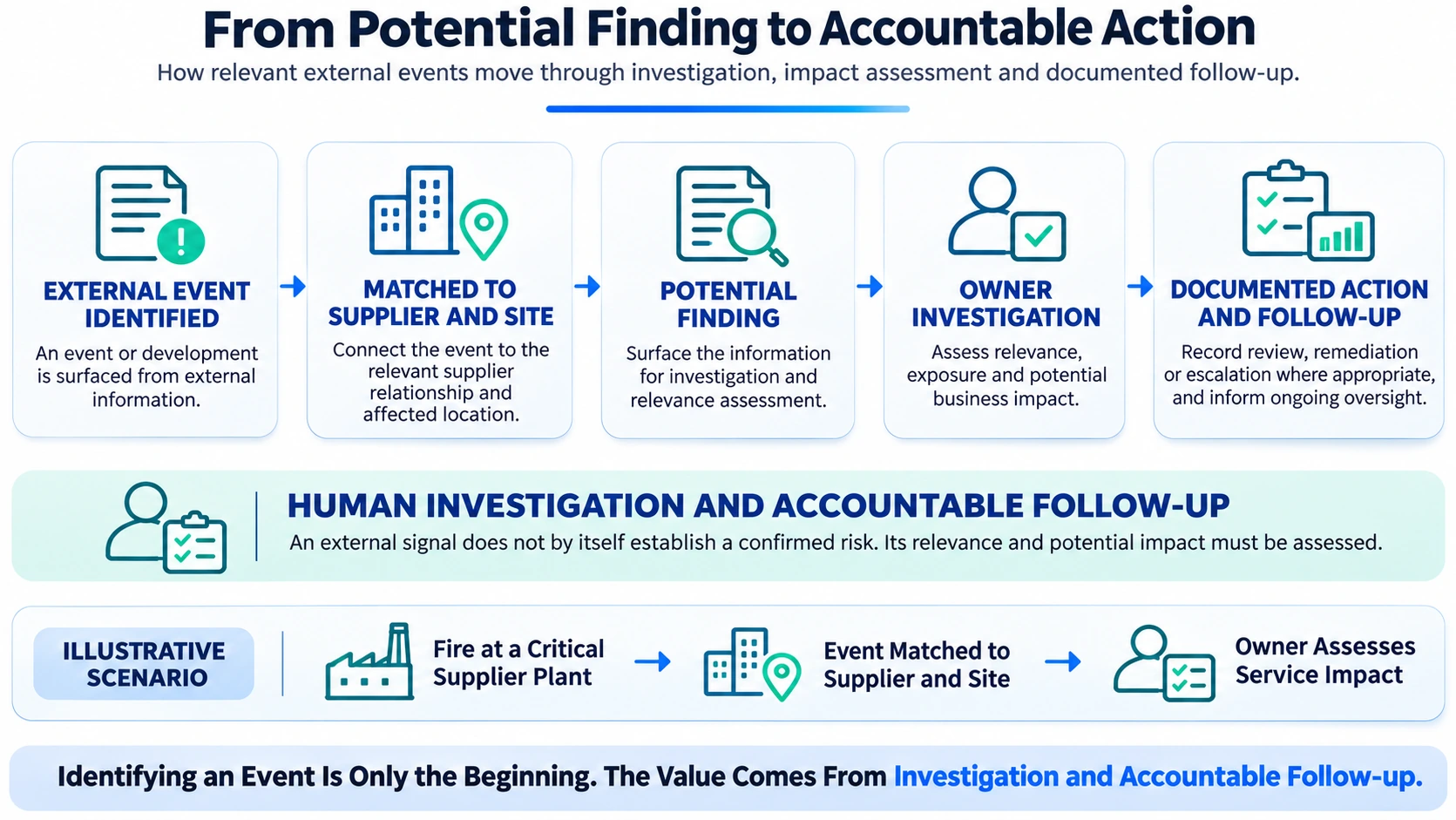
Consider a fire that disrupts an operating facility belonging to a critical supplier. The event is reported through an external news source.
1. Event identification
A report of a fire is identified through a configured external source.
2. Supplier and site matching
The event is associated with the relevant supplier and operating location.
3. Business impact assessment
The reviewer examines which services, contracts or business activities may be affected.
4. Ownership and investigation
The finding is routed to the appropriate owner for impact assessment and supplier follow-up.
5. Governance response
The organization may request further information, review contingency arrangements, initiate remediation or escalate the issue.
6. Ongoing monitoring
Relevant developments and follow-up outcomes remain connected to the supplier’s risk context.
Illustrative scenario drawn from Enlighta’s TPRM presentation. An event does not automatically result in a confirmed risk or a predefined response.
Potentially relevant external events should be investigated in context, with appropriate action and follow-up documented by the responsible owner.
Why more alerts do not automatically mean better risk management
External intelligence can generate a significant volume of information. An effective monitoring program needs to distinguish relevant events from general news, duplicate reporting and potential false matches.
Factor
What to evaluate
Source relevance
Is the information coming from a source suitable for the event being evaluated?
Entity matching
Does the event concern the correct supplier, subsidiary, site or dependency?
Event relevance
Does the development relate to a risk area relevant to the supplier relationship?
Business context
Is the affected supplier important to a critical service, location or business process?
Materiality
Could the event meaningfully affect the organization’s risk exposure?
Follow-through
Is there a clear owner and a documented investigation or response where required?
AI-assisted classification and matching can help organize this information, but human validation remains important for ambiguous matches and material risk decisions.
Connecting continuous monitoring with the wider TPRM lifecycle
External risk intelligence should not operate as an isolated alerting tool. It becomes more useful when connected with the broader third-party risk management lifecycle: screening, onboarding and segmentation, risk assessment, continuous monitoring, contracts and obligations, performance monitoring, governance and remediation, and offboarding.
This approach helps ensure that monitoring informs assessments and governance rather than producing alerts that remain disconnected from the rest of the TPRM process.
How Enlighta supports continuous vendor intelligence
Enlighta’s published TPRM and Adverse Events Monitoring materials describe capabilities for monitoring supplier-related external information, classifying adverse events and connecting relevant information to vendor risk management.
The published capability descriptions include monitoring relevant news and external intelligence sources, configuring sources for targeted supplier monitoring, AI-assisted classification of adverse events, tracking historical events by supplier, configuring email notifications, and connecting external intelligence with supplier risk information and scorecards.
The exact source coverage, cadence, integrations and available workflow steps depend on the modules and configuration enabled for the implementation.
From external intelligence to informed action
Explore Enlighta’s approach to continuous third-party risk management and vendor governance.
What is adverse events monitoring in third-party risk management?
Adverse events monitoring is the process of identifying external developments that may affect supplier risk. These can include financial deterioration, litigation, sanctions, data breaches, operational disruptions, adverse news and supply-chain events.
What is the difference between adverse events monitoring and continuous risk monitoring?
Adverse events monitoring focuses on external developments involving suppliers and related entities. Continuous risk monitoring is broader and can also include cybersecurity indicators, financial information, compliance developments, fourth-party exposure, internal findings and supplier performance changes.
How does AI help classify adverse events?
AI-assisted classification can help organize external information into relevant categories, such as legal issues, data breaches and financial events. This makes information easier to review, but the relevance and materiality of a finding still require appropriate validation.
Why is matching an event to the right supplier important?
An event may involve a subsidiary, related company, operating site or supply-chain dependency. Matching helps establish whether the reported development concerns the correct supplier relationship before further investigation takes place.
Does every adverse event require remediation?
No. Some events may be irrelevant to a particular supplier relationship, while others may require investigation, additional due diligence or escalation. The response should reflect the event's credibility, relevance, potential impact and supplier criticality.
How does external intelligence support vendor risk scorecards?
Relevant external findings can inform the organization's assessment of supplier exposure and help identify changes requiring further review. The precise scorecard impact depends on the configured risk framework and review process.
Can Enlighta send alerts about adverse events?
Enlighta's published Adverse Events Monitoring information describes configurable email notifications to designated users and groups. The available notification sources and cadence should be confirmed for the relevant implementation.
This article describes Enlighta’s documented monitoring capabilities and an illustrative workflow. The dedicated Continuous Monitoring adverse-events interactive module is listed as coming soon; availability should be confirmed for the relevant implementation.
Tag:
Share Article:
E S
Enlighta’s software solutions empower enterprises to increase business value and mitigate risks in supplier and third-party engagements through data-driven insights into demand, performance, contract compliance & spend, and process automation for demand, selection, invoice validation, vendor governance, and third-party risk monitoring.