our services:
Enlighta Solutions
were on social media:
Search
People also search for:
AI Ambition and AI Governance
The Gap Between AI Ambition and AI Governance Has Never Been Wider
Artificial intelligence is moving faster than the governance programs designed to contain it. Worker access to AI tools increased by 50% in 2025 alone. The number of companies with 40% or more of their AI projects in active production is expected to double in 2026 (Deloitte State of AI in the Enterprise, 2026). Yet the infrastructure to govern these systems responsibly remains critically underdeveloped across most organizations.
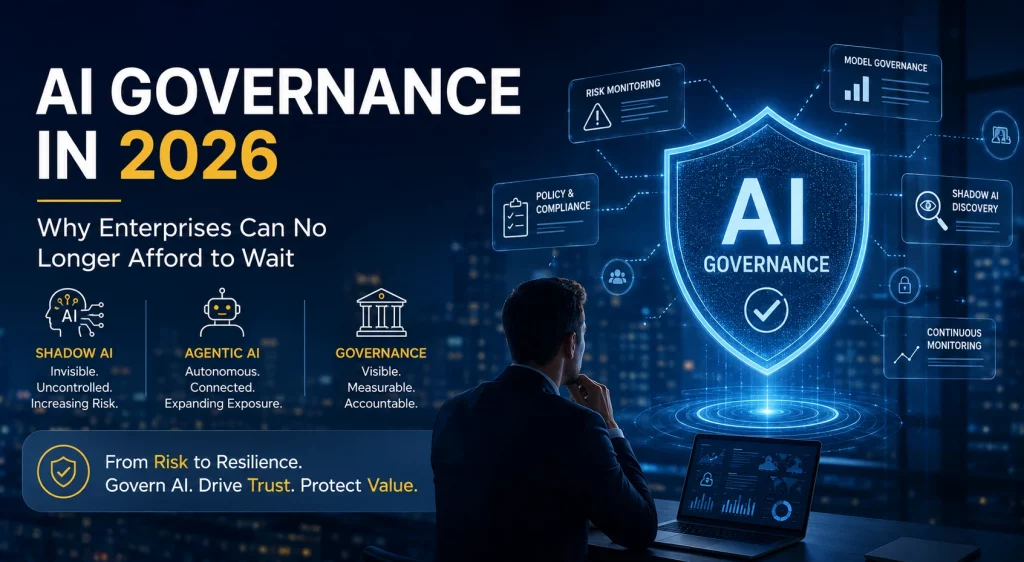
Three converging forces are bringing this governance gap into sharp focus for enterprise risk leaders in 2026: the explosion of AI portfolios beyond what manual oversight can track, the rapid expansion of shadow AI into the core of everyday business workflows, and growing board-level pressure to show demonstrable returns before committing further AI investment.
This article examines each of these forces—drawing on the most current industry research—and explains what organizations must do to close the gap before it becomes a liability.
1. AI Governance Adoption Is Rising, But Value Still Lags
The most significant benchmark finding of 2026 comes from ModelOp’s 2026 AI Governance Benchmark Report: The AI Portfolio Explosion, based on a global survey of 100 senior AI leaders.
Key statistics at a glance
Commercial AI governance platform adoption surged from 14% in 2025 to nearly 50% in 2026 More than two-thirds of organizations still rely on manual or projected ROI assessments, even for AI systems already in production Most enterprises now connect agentic AI systems to between 6 and 20 external tools and services, materially expanding third-party risk exposure with every new deploymentThe report describes what it calls an “AI value illusion”—as deployment speed accelerates and AI portfolios expand, visibility and accountability consistently lag behind. Organizations move AI initiatives into production in months rather than years, but lack the monitoring infrastructure to know whether those systems are actually delivering, drifting, or creating hidden exposure.
The platform adoption jump—from 14% to nearly 50% in a single year—confirms that enterprise leaders recognize manual governance cannot scale. But adoption without operationalization is not governance. Having a platform is not the same as having enforced controls, continuous monitoring, and traceable accountability. That gap is precisely where enterprise risk accumulates.
What this means for your organization: If you are still relying on spreadsheets, policy documents, or quarterly manual reviews to manage AI risk, you are operating in a category that the data clearly identifies as the problem, not the solution.
2. Shadow AI Has Become an Enterprise Crisis—Not a Policy Problem
Shadow AI—the use of unapproved AI tools outside organizational security controls—is no longer a fringe concern. It is now one of the most actively exploited attack surfaces in enterprise environments.
Recent analysis from industry sources confirms that employees are adopting unapproved AI tools faster than security teams can identify them. A significant portion of this activity occurs through personal accounts that are completely invisible to traditional network monitoring. Organizations experiencing data policy violations related to AI usage are now doing so at an average of 223 incidents per month, according to Netskope’s 2026 research.
The financial exposure is not theoretical. IBM’s 2025 Cost of a Data Breach Report confirms that incidents involving shadow AI significantly inflate breach costs beyond the already record-high industry average of $4.88 million. Only 37% of organizations currently have formal AI governance policies in place, according to IBM’s own data—meaning the remaining 63% are operating without meaningful guardrails.
The character of the risk is also changing. Traditional shadow AI involved employees sharing a document or query with a consumer AI tool—a single, contained interaction. The 2026 threat surface is fundamentally different.
Agentic shadow AI involves autonomous agents with API access that:
- Chain actions across multiple services (CRM, email, databases, customer data platforms)
- Run continuously without human review
- Make decisions at machine speed using instructions that may have been written by someone who has since left the organization
According to Microsoft’s 2026 Cyber Pulse report, more than 80% of Fortune 500 companies now use active AI agents built with low-code and no-code tools. Only 10% of those organizations have a clear strategy to govern them. The average enterprise manages 37 deployed agents, and more than half of those agents run without any security oversight or logging.
Traditional network monitoring was never designed to catch this. Policy documents cannot prevent it. The only effective response is continuous, automated AI model discovery—identifying sanctioned and unsanctioned tools across the enterprise in real time, before an agent with broad system access causes an incident that cannot be contained retroactively.
3. AI Governance Is Now a Board-Level Strategic Priority
The third major shift in 2026 is organizational: AI governance has moved from the compliance function to the boardroom.
Research from Data Society (April 2026) confirms that organizations scaling AI most successfully are those that treat governance as a strategic enabler rather than a risk constraint. Governance structures provide the confidence senior leadership needs to expand AI initiatives. Organizations that can clearly articulate how their AI systems are governed are demonstrably more trusted by customers, regulators, and institutional stakeholders.
The inverse is also true, and it is showing up in investment data. Forrester research suggests that approximately 25% of planned 2026 AI spend may slip into 2027 as boards hesitate to commit further investment without clear governance accountability. The pipeline is being held back not by a lack of AI capability, but by a lack of board confidence in the controls surrounding that capability.
This creates a direct strategic cost to governance immaturity. Organizations that cannot demonstrate continuous, auditable oversight of their AI systems are not just accepting regulatory risk—they are delaying returns on AI investment that competitors with mature governance programs are already capturing.
The implication for enterprise risk and technology leaders is clear: governance is no longer a constraint on AI value creation. It is a prerequisite for it.
What Effective AI Governance Looks Like in 2026
Given the scale and speed of the current AI environment, effective governance requires continuous, automated controls across six core dimensions. A policy document covers none of them. A manual review cycle covers them at a point in time, not continuously.
Security covers prompt injection, shadow AI discovery, and access control at the API proxy layer—intercepting every model interaction before data reaches an unauthorized system.
Safety enforces scope boundaries at runtime, blocking AI models that have quietly expanded beyond their intended purpose through vendor updates the enterprise never explicitly authorized.
Reliability addresses model drift—the slow degradation in AI performance as the world changes or input distributions shift. Continuous structured testing is required to detect drift before business outcomes are affected.
Accountability means that when an AI-influenced decision causes harm, the organization can reconstruct exactly who approved what, when, and under what conditions. Dynamic stakeholder maps and timestamped approval workflows make accountability traceable rather than reconstructed.
Data and Privacy requires that sensitive information—contracts, customer records, financial projections—is intercepted and redacted before it reaches any external model, with a full audit log of every request.
Societal Impact addresses the regulatory expectation of demonstrable fairness. Scheduled and ad hoc bias assessments aligned to the EU AI Act and emerging global standards are now a compliance requirement for high-risk AI systems, not a voluntary practice.
How Enlighta GovernAI Addresses the 2026 Governance Gap
Enlighta GovernAI is purpose-built to address each of these dimensions in a unified platform—replacing fragmented, manual oversight with continuous, automated controls across every AI model in an organization’s inventory.
GovernAI continuously discovers sanctioned and unsanctioned AI tools across the enterprise, applies runtime policies at the API proxy layer, maintains dynamic accountability workflows, and generates the audit-ready documentation that regulators and boards are increasingly demanding. It also monitors for concept and data drift—giving risk teams early visibility before performance degradation reaches the business.
For organizations whose third-party vendor ecosystem now includes AI model providers, GovernAI extends governance to the supply chain: evaluating AI vendor security posture, detecting hidden fourth-party and fifth-party model relationships, and continuously monitoring the AI systems your vendors are using on your behalf.
The scale of what manual governance cannot cover in 2026 is exactly what GovernAI is designed to automate.
The 2026 Governance Imperative
The data from this year’s industry research converges on a single conclusion: the window for treating AI governance as a future consideration has closed.
AI portfolios have grown beyond what manual oversight can track. Shadow AI has expanded beyond what policy documents can prevent. Board confidence—and consequently AI investment pipeline—depends on demonstrable governance accountability. Regulatory enforcement across the EU AI Act, DORA, NIS2, and emerging US federal standards is creating real financial consequences for organizations that cannot produce audit-ready evidence of control.
The question in 2026 is not whether your organization needs a robust AI governance program. The question is how much accumulated exposure your organization has already accepted while governance was treated as optional.
Ready to assess your AI governance posture?