our services:
Enlighta Solutions
were on social media:
Search
People also search for:
Vendor Management KPIs
Vendor Management KPIs: Top Metrics to Track Vendor Performance | Enlighta
Managing vendors without the right metrics is like driving blindfolded. You might be moving — but you have no idea where you’re headed or when something’s about to go wrong.
Organizations today work with dozens, sometimes hundreds, of third-party vendors. Each one carries operational dependencies, financial implications, and compliance risks. Without a clear framework of vendor management KPIs, procurement and vendor governance teams are left reacting to problems instead of preventing them.
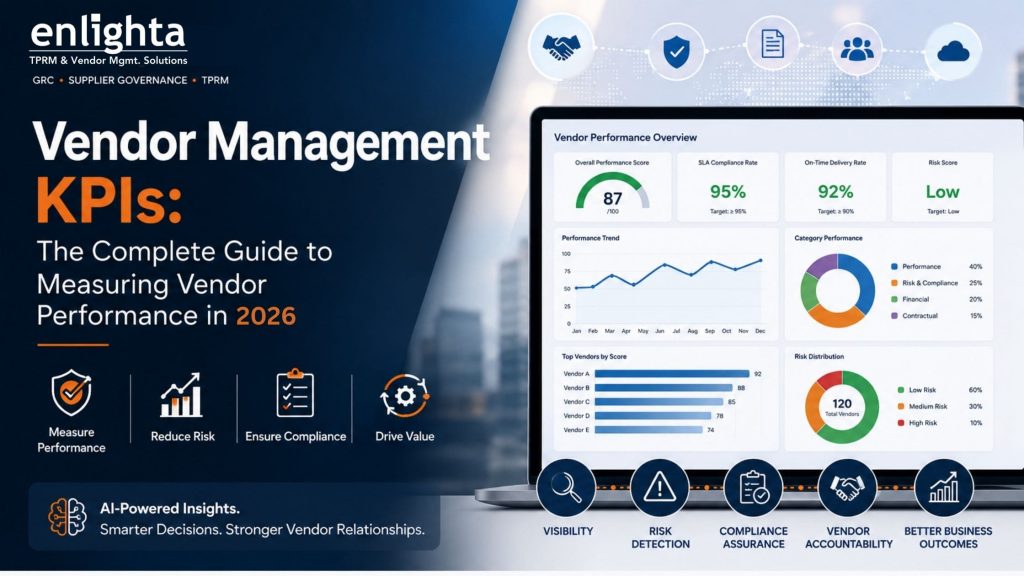
This guide covers everything you need to know about vendor management key performance indicators — what they are, why they matter, which ones to track, and how a platform like Enlighta helps you operationalize them at scale.
What Are Vendor Management KPIs?
Vendor management KPIs (Key Performance Indicators) are measurable values that help organizations evaluate how effectively their vendors are performing against agreed-upon expectations. These metrics span across performance quality, financial compliance, risk posture, and contractual adherence.
A well-structured vendor KPI framework gives organizations:
- Objective visibility into vendor health and performance
- Early warning signals before issues escalate into disruptions
- Accountability mechanisms that vendors agree to upfront
- Data-driven leverage during contract renewals and negotiations
- Audit-ready evidence for regulatory and compliance requirements
Without KPIs, vendor relationships are subjective, relationship-driven, and impossible to benchmark or compare at scale.
Why Vendor Management KPIs Matter More Than Ever
The risk landscape for third-party vendors has never been more complex. Supply chain disruptions, data breaches through vendor access, regulatory mandates like SOC 2, ISO 27001, and DORA — all of these are putting enormous pressure on vendor governance teams.
According to industry research, a significant percentage of data breaches originate from third-party vendors. Yet many organizations still rely on annual reviews or informal check-ins to manage these relationships.
KPIs change this dynamic. They make vendor governance proactive, not reactive. They shift conversations from “we think there’s an issue” to “the data shows a 12% drop in SLA compliance over the last quarter — let’s address it.”
The 7 Core Categories of Vendor Management KPIs
1. Performance & Service Delivery KPIs
These metrics track whether a vendor is actually delivering what they promised.
Key Metrics:
- SLA Compliance Rate — Percentage of service level agreements met within the defined period. Anything below 95% warrants a conversation.
- On-Time Delivery Rate — Measures delivery accuracy against committed timelines. Critical for manufacturing, logistics, and software delivery.
- Defect Rate / Error Rate — Volume of defective deliverables or errors per batch/cycle.
- First-Time Resolution Rate — For service vendors: how often are issues resolved on the first interaction without escalation?
- Mean Time to Resolve (MTTR) — Average time to resolve incidents or service requests.
Why It Matters for Enlighta Users: Enlighta’s vendor governance module allows teams to configure SLA benchmarks and auto-flag vendors falling below threshold — without needing manual tracking.
2. Financial & Cost Management KPIs
Vendor relationships are commercial relationships. Tracking the financial health of your vendor portfolio is essential.
Key Metrics:
- Cost vs. Budget Variance — Are vendors delivering within agreed cost structures? Persistent overruns signal contract management failures.
- Invoice Accuracy Rate — What percentage of invoices are submitted correctly without disputes? Low accuracy wastes finance team hours.
- Savings Realized vs. Target — For procurement-led negotiations, are cost savings actually being captured?
- Total Cost of Vendor Ownership (TCVO) — Includes vendor fees, internal oversight costs, risk mitigation costs, and onboarding/offboarding costs.
- Payment Terms Compliance — Is the vendor meeting financial reporting and invoicing timelines per contract?
Pro Tip: TCVO is often overlooked. A “cheap” vendor that requires heavy internal oversight, frequent escalations, or audit remediation can cost more than a premium vendor with clean delivery.
3. Risk & Compliance KPIs
This is where vendor management KPIs intersect with TPRM (Third-Party Risk Management). These metrics are increasingly important for regulated industries — BFSI, healthcare, government, and tech.
Key Metrics:
- Risk Assessment Completion Rate — What percentage of vendors have completed periodic risk assessments on schedule?
- Policy Compliance Score — Are vendors adhering to your organization’s security, privacy, and operational policies?
- Audit Finding Rate — Number of findings flagged per vendor audit cycle. Trending upward is a red flag.
- Vendor Security Questionnaire (VSQ) Response Time — How quickly vendors respond to due diligence requests.
- Critical Control Deficiency Rate — Percentage of vendors with one or more critical control gaps identified.
- Regulatory Non-Compliance Incidents — Any breaches of GDPR, HIPAA, ISO standards, or other applicable regulations.
Enlighta’s Advantage: With Enlighta’s TPRM module, risk assessments are automated, tracked, and linked directly to vendor profiles. Every compliance gap is logged, escalated, and timestamped — creating an audit-ready trail.
4. Relationship & Communication KPIs
Performance isn’t just about outputs — how a vendor communicates and collaborates is equally critical.
Key Metrics:
- Escalation Rate — How often do issues need to be escalated beyond the primary contact? High escalation rates signal poor account management.
- Vendor Responsiveness Score — Average time for vendors to acknowledge and respond to requests or communications.
- Stakeholder Satisfaction Score (CSAT) — Internal team satisfaction with vendor relationship and communication quality.
- Executive Review Participation Rate — Are senior vendor contacts showing up for QBRs and strategic reviews?
5. Contract & Obligation Management KPIs
Contracts are only as good as the obligations being tracked.
Key Metrics:
- Contract Renewal Rate — What percentage of vendor contracts are renewed vs. terminated? Low rates signal systemic dissatisfaction.
- Obligation Fulfillment Rate — Percentage of contractual obligations (deliverables, milestones, reporting) completed on time.
- Contract Exception Rate — How often are non-standard terms introduced during negotiations?
- Days to Contract Execution — Time taken from initiation to signed contract. Bottlenecks here delay vendor onboarding.
Enlighta’s CLM module maps every contractual obligation to a vendor profile, sends automated alerts as deadlines approach, and tracks fulfillment rates — eliminating the need for spreadsheet-based tracking.
6. Innovation & Strategic Value KPIs
For strategic and preferred vendors, track the value they add beyond service delivery.
Key Metrics:
- Continuous Improvement Initiatives Submitted — Is the vendor proactively bringing ideas to improve service or reduce cost?
- Technology Adoption Rate — Are they keeping pace with your tech stack and integrations?
- Strategic Alignment Score — Does the vendor’s roadmap align with your long-term organizational goals?
7. Onboarding & Lifecycle KPIs
Often overlooked but important, especially as organizations scale their vendor portfolios.
Key Metrics:
- Time to Onboard — From contract signature to operational go-live. Benchmark against industry norms.
- Onboarding Completion Rate — Percentage of required onboarding tasks (security reviews, system access, training) completed.
- Offboarding Completeness Score — Are data, access, and assets properly returned/terminated when a vendor relationship ends?
Building a Vendor Scorecard: Putting KPIs Into Practice
Tracking individual KPIs is only the first step. The real value comes from consolidating them into a Vendor Scorecard — a structured view that gives each vendor a composite performance score.
A well-designed vendor scorecard typically includes:
| Category | Weight | KPIs Tracked |
| Service Delivery | 30% | SLA Compliance, MTTR, Defect Rate |
| Risk & Compliance | 25% | Risk Assessment Completion, Audit Findings |
| Financial | 20% | Invoice Accuracy, Cost Variance |
| Relationship | 15% | Responsiveness, CSAT |
| Contract Obligations | 10% | Obligation Fulfillment, Renewal Rate |
Weights should be adjusted based on vendor criticality. A tier-1 critical vendor (e.g., cloud infrastructure provider) will have a different scorecard than a tier-3 commodity vendor.
Common Pitfalls in Vendor KPI Management
1. Tracking Too Many KPIs
More is not better. 40 metrics per vendor creates noise, not insight. Focus on 8–12 high-signal KPIs per vendor category.
2. No Baseline or Benchmarks
KPIs without baselines are meaningless. Define what “good” looks like before you start measuring.
3. Manual Tracking in Spreadsheets
Spreadsheets can’t send alerts, can’t aggregate across hundreds of vendors, and are error-prone. Automated platforms are essential at scale.
4. KPIs Not Tied to Contracts
If a KPI isn’t written into the contract, there’s no accountability. SLAs and performance metrics need to be contractually binding.
5. One-Size-Fits-All Approach
Different vendor tiers require different KPI frameworks. Treat strategic vendors differently from transactional ones.
How Enlighta Helps You Track Vendor KPIs at Scale
Enlighta is purpose-built for organizations that manage complex vendor portfolios. Here’s how it directly enables KPI management:
- Centralized Vendor Profiles — Every vendor’s performance data, risk scores, and contract obligations are unified in one place.
- Automated Risk Assessments — Schedule, send, and track risk assessments without manual follow-up.
- SLA & Obligation Tracking — Link contractual commitments to live performance data with automated alerts.
- Custom Scorecards — Build category-specific scorecards that reflect your organization’s vendor tiering strategy.
- Audit-Ready Reporting — Generate governance reports in minutes, not days.
- AI-Powered Insights — Enlighta’s GovernAI module surfaces vendor risk patterns and anomalies that human reviewers may miss.
Vendor management KPIs are not a compliance checkbox — they’re a strategic asset. When implemented correctly, they give vendor governance teams the data they need to make confident decisions: who to renew, who to remediate, and who to replace.
The organizations that win at vendor governance in 2025 won’t be the ones with the most vendors — they’ll be the ones with the clearest visibility into their vendor ecosystem.
Ready to move beyond spreadsheets?