
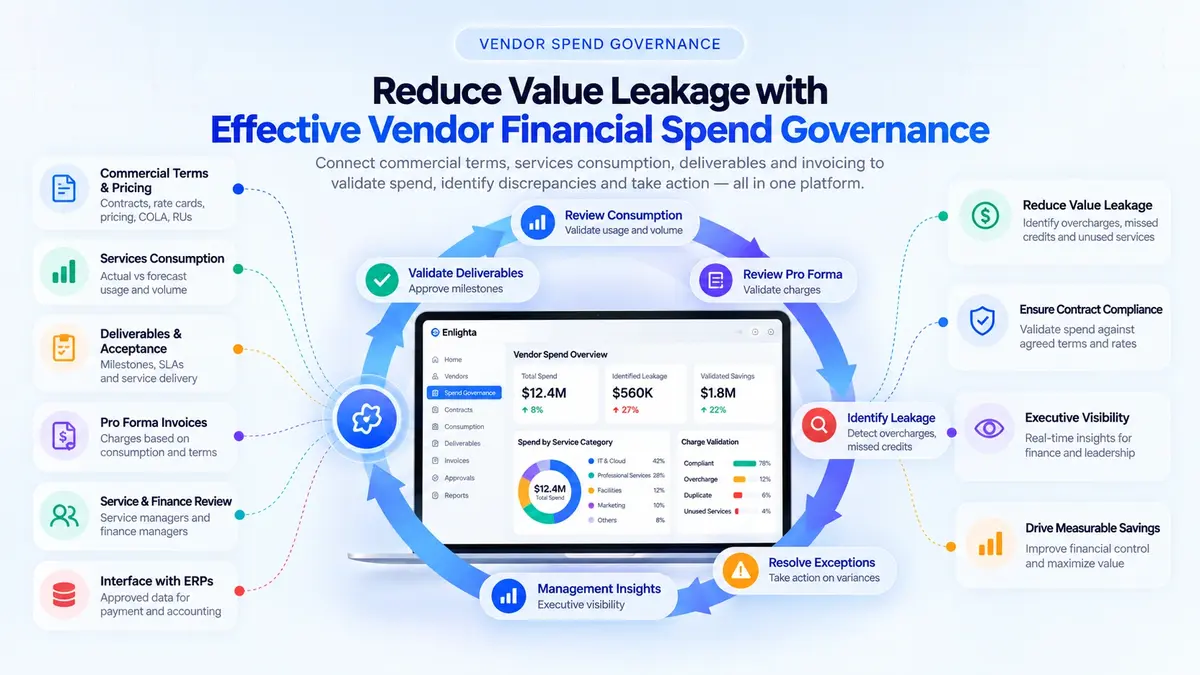
Where does vendor spend leak value?
Vendor spend leakage is not caused by a single issue. It occurs at several points between agreeing commercial terms and validating the charges a supplier submits.
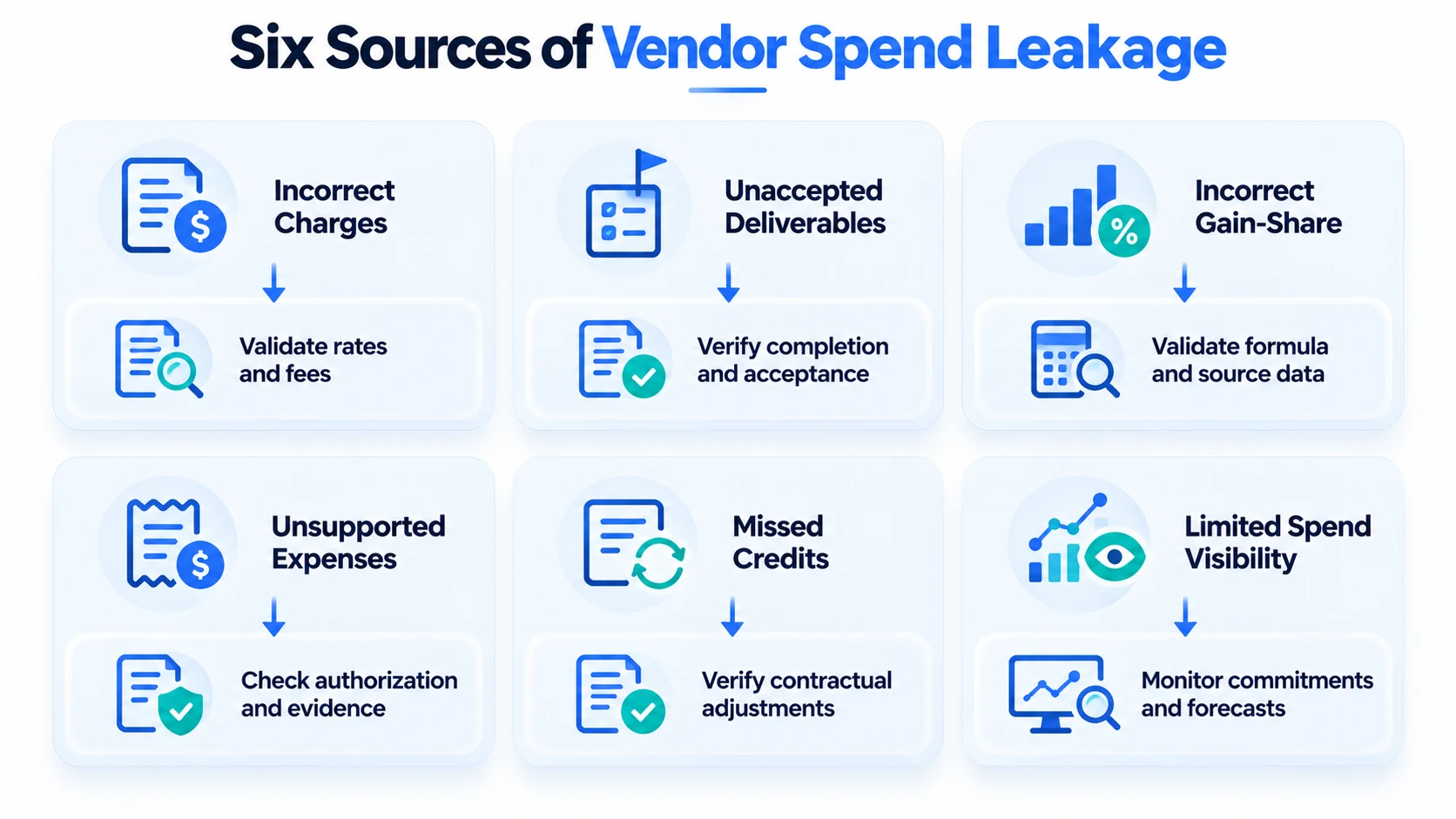
Incorrect or Unsupported Invoice Charges
A supplier invoice may contain an incorrect fixed fee, rate, quantity, milestone payment, gain-share calculation or additional charge. Each line needs to be evaluated against the commercial terms and supporting evidence that apply to it.
Unverified Consumption, Deliverables and Milestones
For some engagements, payment depends on approved usage or resource units. For others, it depends on delivered services, accepted milestones or completion of contractual deliverables. Capturing an activity or receiving an invoice does not, by itself, establish that payment is due.
Incorrect Gain-Share, Incentives and Contractual Adjustments
Revenue-share arrangements, performance incentives, service credits, penalties and rewards may depend on specific contractual triggers and calculations. Organizations need to verify the relevant source data, eligibility conditions, measurement period and calculation, and ensure applicable credits or adjustments are accounted for correctly.
Unsupported One-Time and Miscellaneous Expenses
Travel, training, ad hoc services and other additional expenses may require contractual eligibility, authorization, receipts or other supporting records. These charges should be reviewed against the applicable rules rather than automatically accepted as part of a recurring invoice.
Limited Visibility into Spend and Commitments
Even when individual charges are valid, the overall engagement may be trending above forecast, approaching purchase-order limits or accumulating unresolved exceptions. Connecting invoice validation with forecasts, commitments, changes and financial reporting helps stakeholders understand the wider exposure.
What is Enlighta Vendor Spend Governance?
Enlighta Vendor Spend Governance provides a governance layer over vendor expenditure, connecting contractual commitments, service delivery, commercial calculations, approved charges and ongoing spend oversight.
It complements existing procurement and financial systems, including source-to-contract (S2C), procure-to-pay (P2P), source-to-pay (S2P), ERP and accounts-payable systems. It helps connect the commercial terms with the operational evidence and approval processes needed to establish what should be charged, what has been validated and how expenditure compares with expectations.
The validation basis depends on the agreement. A usage-based charge may require approved quantities and rates; a milestone payment may require acceptance evidence; a gain-share charge may require qualifying revenue data and an agreed formula; and a one-time expense may require authorization and supporting documentation.
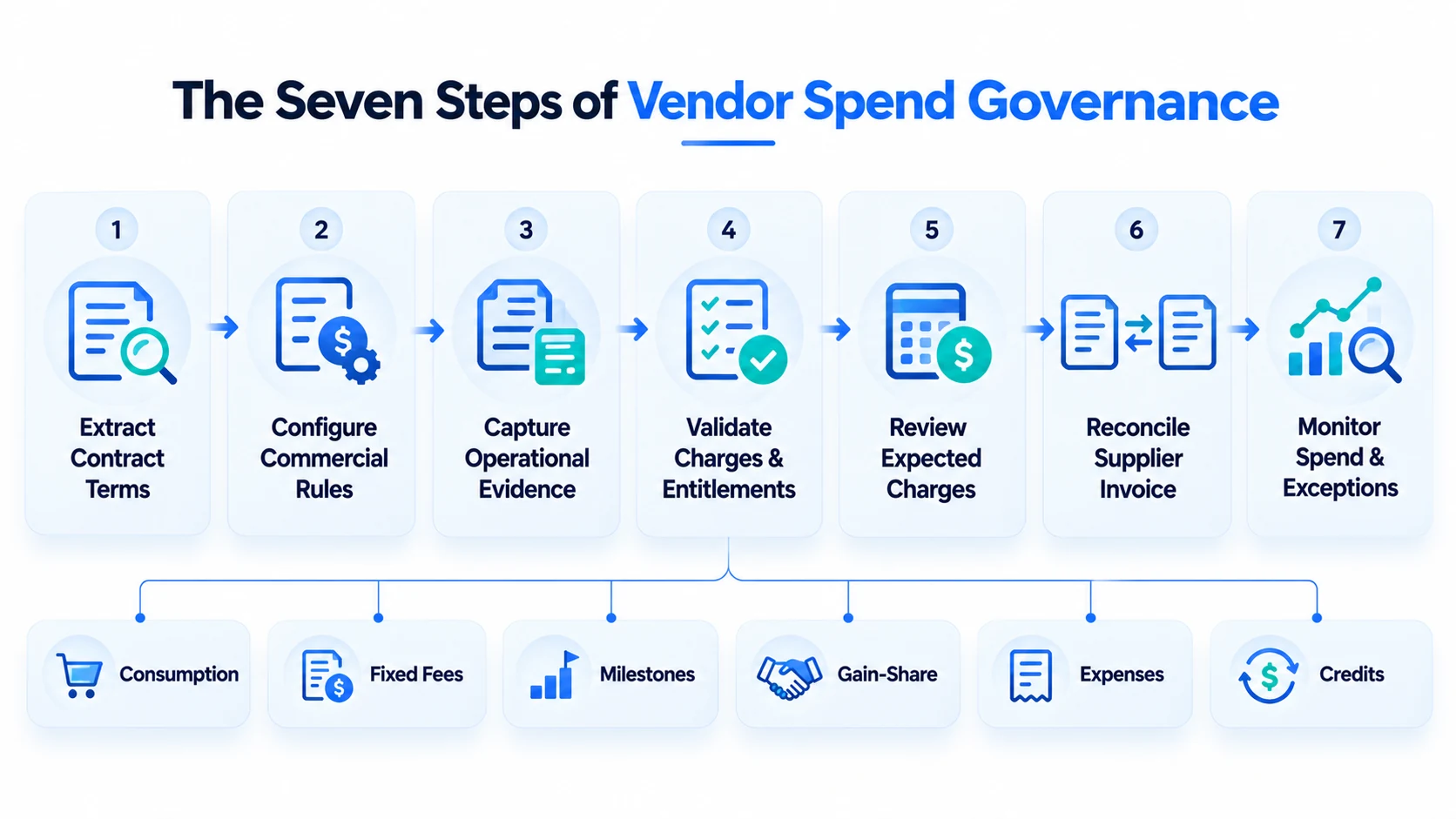
How it works: seven connected stages
Enlighta connects the stages of financial governance into a practical workflow, from establishing the commercial baseline to monitoring spend and investigating discrepancies.
Extract Contract Commercials with AI Assistance
The first step is to establish the commercial baseline for the vendor engagement.
Enlighta’s contract data extraction capabilities can help identify relevant commercial information from contractual documents, including:
- Contract pricing and applicable rates
- Resource units and consumption-related terms
- Fixed fees and other recurring charges
- Deliverables and milestone conditions
- Service-level agreements and applicable credits
- Relevant commercial conditions and adjustments
The extracted information provides a starting point for configuring the applicable financial-governance process. The relevant terms should be reviewed and confirmed before they are used for subsequent calculations and validation.
Financial validation needs a reliable commercial baseline. Extracting relevant information helps reduce the effort involved in locating and setting up the terms required for the workflow.
Configure Commercial Terms and Pricing
Vendor engagements do not all follow the same pricing model. Enlighta’s financial-governance workflow needs to reflect the applicable commercial structure for each engagement.
Depending on the contract, this may include:
- Fixed recurring fees
- Consumption-based rates
- Resource units, roles, and applicable rates
- Location and currency considerations
- Deliverable-based or milestone-based payments
- One-time expenses and miscellaneous charges
- Incentives and applicable service-level credits
The purpose is to make the relevant commercial rules available for subsequent consumption validation, charge calculation, and invoice review.
Not every charge should follow the same validation process. A fixed fee, an approved consumption charge, and a payment linked to an accepted milestone may each require different evidence and review conditions.
Configuring the applicable commercial terms helps make the basis for expected charges clearer and supports more consistent financial controls.
Capture Operational Evidence and Financial Inputs
The information needed to validate a charge depends on the commercial arrangement.
Depending on the engagement, relevant inputs may include:
- Actual consumption, resource units and forecasts
- Service delivery records and accepted deliverables
- Completed payment milestones and supporting acceptance evidence
- Qualifying sales, revenue or performance results for gain-share or incentive calculations
- Billing periods and agreed fixed-fee conditions
- Approved ad hoc expenses and supporting receipts
- Applicable service credits, resource credits, penalties, rewards and other adjustments
- Purchase orders, contract amendments and relevant financial records
Enlighta supports the capture of actual and forecasted spend through spreadsheet imports, online entry and external data feeds such as ERP sources. Other operational evidence must be available through the appropriate records and configured workflows.
Collecting the relevant evidence establishes the basis for calculating and reviewing each charge, rather than assuming that every payable amount comes from consumption.
Validate Delivery, Payment Entitlements and Adjustments
Before a charge is treated as payable, the organization needs to establish whether the contractual conditions have been satisfied.
The validation process should follow the commercial model:
- Consumption: Validate the quantity, applicable rate and approval of actuals.
- Fixed fees: Validate the agreed fee, scope and billing period.
- Deliverables and milestones: Verify completion, acceptance and any required approval.
- Gain-share and incentives: Validate the agreed formula, qualifying source data, eligibility conditions and measurement period.
- Ad hoc expenses: Check authorization, contractual eligibility and supporting documentation.
- Credits and adjustments: Verify the applicable trigger, amount and supporting evidence.
For service-delivery workflows, the relevant review may involve a service-track lead followed by service-tower lead validation where required by the configured process.
A fixed fee should not automatically be routed through an hours-based review, and a milestone payment should not be treated as approved merely because it appears on an invoice.
Each charge is reviewed against the correct commercial rule and the evidence required to establish whether it is due.
Generate and Review the Pro-Forma Invoice
After the applicable charges, supporting information, and required approvals have been reviewed, the financial workflow can assemble the expected charges into a pro-forma invoice for review.
The expected charges may combine several commercial models, each with its own validation basis:
| Illustrative invoice line | What must be validated |
|---|---|
| Monthly fixed fee | Contracted amount, service scope and billing period |
| Resource consumption | Approved actuals, resource units and contractual rate |
| Payment milestone | Completion and acceptance evidence, milestone conditions and approvals |
| Gain-share or revenue-share | Agreed formula, qualifying sales or revenue data and calculation period |
| One-time expense | Authorization, eligibility and supporting receipt or record |
| Service or resource credit | Applicable contractual trigger, calculation and supporting evidence |
An invoice can combine several commercial models. The expected amount should be assembled from the relevant validated charges and adjustments, with a clear supporting basis for each line. Pro-forma review helps stakeholders examine that expected amount before reconciling the supplier’s submitted invoice.
Each line item has its own contractual basis and supporting information. Applicable credits and adjustments must be reflected according to the contract and the relevant review process.
The pro-forma review helps establish the expected financial position before the supplier invoice is reconciled.
Bringing reviewed line items together gives stakeholders a clearer view of how the expected amount has been assembled and what supports each charge.
Reconcile Supplier Invoices Against Reviewed and Approved Charges
Generating and reviewing a pro-forma invoice is not the end of the process. When the supplier invoice arrives, its line items need to be reconciled against the relevant reviewed and approved expected charges.
Enlighta’s invoice-validation workflow is intended to help identify discrepancies between what is expected and what the supplier has billed. Depending on the configured process, reconciliation may be supported by AI-assisted checks or manual review.
Potential exceptions include:
- A rate that does not match the applicable commercial terms
- A quantity that differs from the validated consumption
- A charge that lacks the required supporting evidence
- A contractual adjustment that has not been reflected correctly
- A discrepancy associated with a commercial amendment or change
When a discrepancy is identified, it needs to be investigated rather than treated as automatically resolved. The appropriate exception process can involve additional internal review or supplier clarification, depending on the issue and the workflow.
Follow one vendor engagement through the connected workflow. Consider a contact-centre supplier whose agreement includes a fixed monthly fee, a resource-based charge, gain-share on qualifying sales, an additional approved expense and a service credit when specified service conditions are not met.
The review process evaluates each component differently. The fixed fee is checked against the contract and billing period. Resource charges are checked against approved actuals and rates. Gain-share is calculated using the agreed formula and validated sales data. The additional expense is checked against its authorization and supporting records. The service credit is evaluated against the relevant contractual conditions and service evidence.
The expected charges and applicable adjustments can then be compared with the supplier’s submitted invoice. Any unexplained difference becomes an exception for investigation, with further review or supplier clarification where required.
This is an illustrative commercial scenario, not a claim about a specific customer or a guarantee that every calculation is automated in every Enlighta configuration.
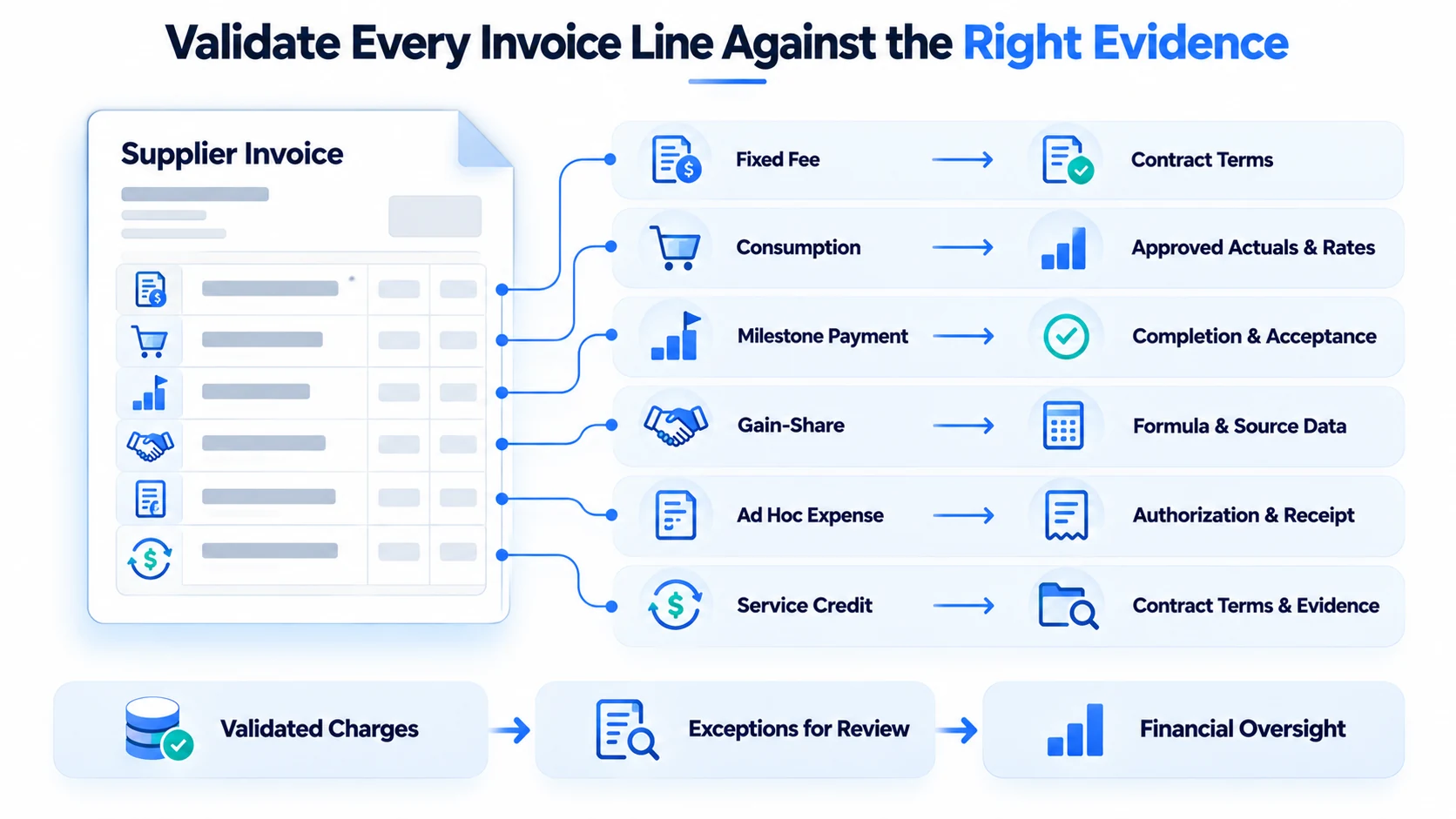
Comparing supplier invoices with the reviewed and approved financial position helps organizations identify discrepancies and improve the traceability of their financial decisions.
Monitor Spend, Commitments, and Financial Exposure
Invoice validation focuses on the individual charges. Spend monitoring provides a broader view of expenditure across the vendor engagement.
Enlighta Vendor Spend Management supports capturing actual and forecasted spend by month or year, converting spend into a common currency for reporting, and analysing expenditure through dashboards by dimensions such as spend category, cost centre, and sector.
Within the wider financial-governance workflow, relevant monitoring can also consider:
- Actual spend compared with forecasted spend
- Consumption and expenditure trends
- Spend in relation to purchase-order commitments
- Outstanding milestone approvals and deliverable acceptances
- Pending credits and gain-share calculations requiring review
- Unresolved expense and invoice exceptions
- Burn rate and potential overruns
- Applicable changes that may affect expected expenditure
This provides stakeholders with context beyond a single invoice. A charge may be valid under the contract, for example, while the overall engagement is still trending above its forecast or approaching a spending threshold.
Connecting invoice-level controls with broader spend visibility helps teams investigate discrepancies and recognize potential exposure earlier.
What connected controls deliver
Better visibility into vendor expenditure
Actual and forecasted spend can be captured and reviewed through reporting and dashboards, with analysis across relevant business dimensions.
A clearer basis for validating charges
Contractual commercial terms, consumption information, approvals, and expected line items can be connected within the financial-governance workflow.
More structured investigation of discrepancies
Differences between expected charges and supplier invoice line items can be identified for appropriate review and resolution.
Stronger oversight of financial exposure
Spend monitoring can help stakeholders understand trends, commitments, and potential overruns alongside invoice-level validation.
These controls support the objective of reducing potential value leakage. Actual outcomes depend on the quality of the source information, contractual terms, configured workflows, review practices, and how identified exceptions are resolved.
Where it fits in the procurement lifecycle
Enlighta Vendor Spend Governance and the Procurement Lifecycle
Source-to-contract, procure-to-pay, and source-to-pay describe related stages of the procurement lifecycle. They are not interchangeable terms, and Enlighta Vendor Spend Governance should not be positioned as a replacement for these processes or the systems that support them.
Enlighta focuses on governing the financial relationship between contractual commitments, actual service delivery, applicable charges, and ongoing spend.
This means connecting the commercial baseline with consumption, review and approval, invoice validation, and spend monitoring. It complements the wider procurement and financial environment by providing a more structured way to examine the expected and actual financial position of vendor engagements.