Beyond initial assessments: how Enlighta enables continuous third-party risk management
An operating model that connects AI agents, workflow automation, supplier information and management insight across the entire third-party lifecycle.
Third-party risk is growing. The work is becoming harder to manage.
Third-party risk management does not end when a supplier passes its initial assessment. Vendor relationships, external risk conditions, service performance, contracts and supply-chain dependencies continue to evolve throughout the relationship.
Periodic assessments provide an important view of supplier risk, but they cannot by themselves address every development that may occur between reviews. Financial deterioration, regulatory developments, cybersecurity incidents, operational disruptions and changes across fourth-party relationships can all affect a supplier’s risk exposure.
Expanding Supplier Ecosystems
Organizations depend on more suppliers, subcontractors, SaaS providers, technology vendors and fourth-party relationships. Understanding these dependencies requires visibility beyond direct supplier records.
Faster-Changing Cyber and Operational Risk
Supplier incidents, vulnerabilities, service disruptions and external developments can change exposure between periodic assessments.
Growing Regulatory and Compliance Pressure
Organizations need to maintain oversight of changing regulatory requirements, supplier policies, certifications, contractual commitments and compliance obligations.
Increasing Evidence and Review Burden
Screening vendors, collecting documents, validating evidence, reviewing contracts and following up on remediation require considerable specialist time.
Wider Business Impact
Supplier risk can affect service continuity, financial stability, regulatory compliance, reputation and critical business operations.
The real challenge
The challenge is not simply identifying more risks. It is ensuring that relevant information is evaluated, connected to the appropriate supplier context and routed to someone responsible for deciding what happens next.
48%of breaches in the Verizon 2026 Data Breach Investigations Report dataset involved a third party.
+60%year-over-year relative increase (not percentage points) in breaches involving third parties, according to the same report.
Source: Verizon 2026 Data Breach Investigations Report, published 19 May 2026. External research context, not an Enlighta product-performance claim.
What teams need: augmented capacity, not another silo
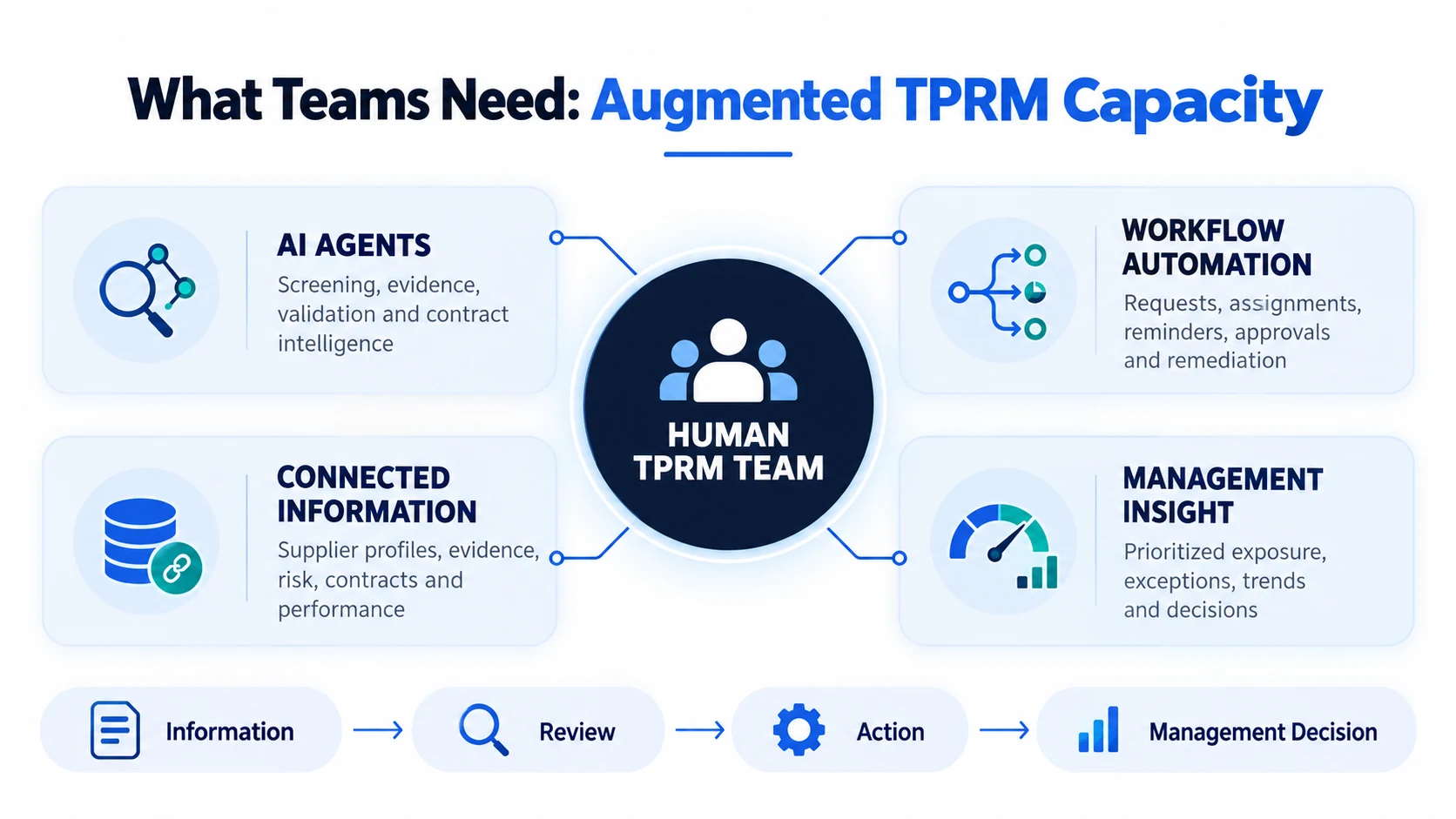
Continuous TPRM requires more than another screening tool or monitoring dashboard. Teams need connected capabilities that help them perform recurring work, coordinate follow-up and use information to make better decisions.
The four elements of the operating model, connected to the human team.
AI Agents
Support repeatable activities such as supplier screening, evidence collection, document validation, contract extraction and ongoing monitoring.
Workflow Automation
Coordinate requests, assignments, reminders, approvals, escalations and remediation follow-through.
Connected Information
Bring supplier profiles, evidence, risk information, contracts and performance into the appropriate business context.
Management Insight
Help stakeholders understand prioritized exposure, exceptions, performance trends and decisions requiring attention.
AI agents extend team capacity. Automation keeps work moving. Connected information provides context. Management insight supports decisions. People retain judgment, accountability and decision rights.
An AI agent team across the third-party lifecycle
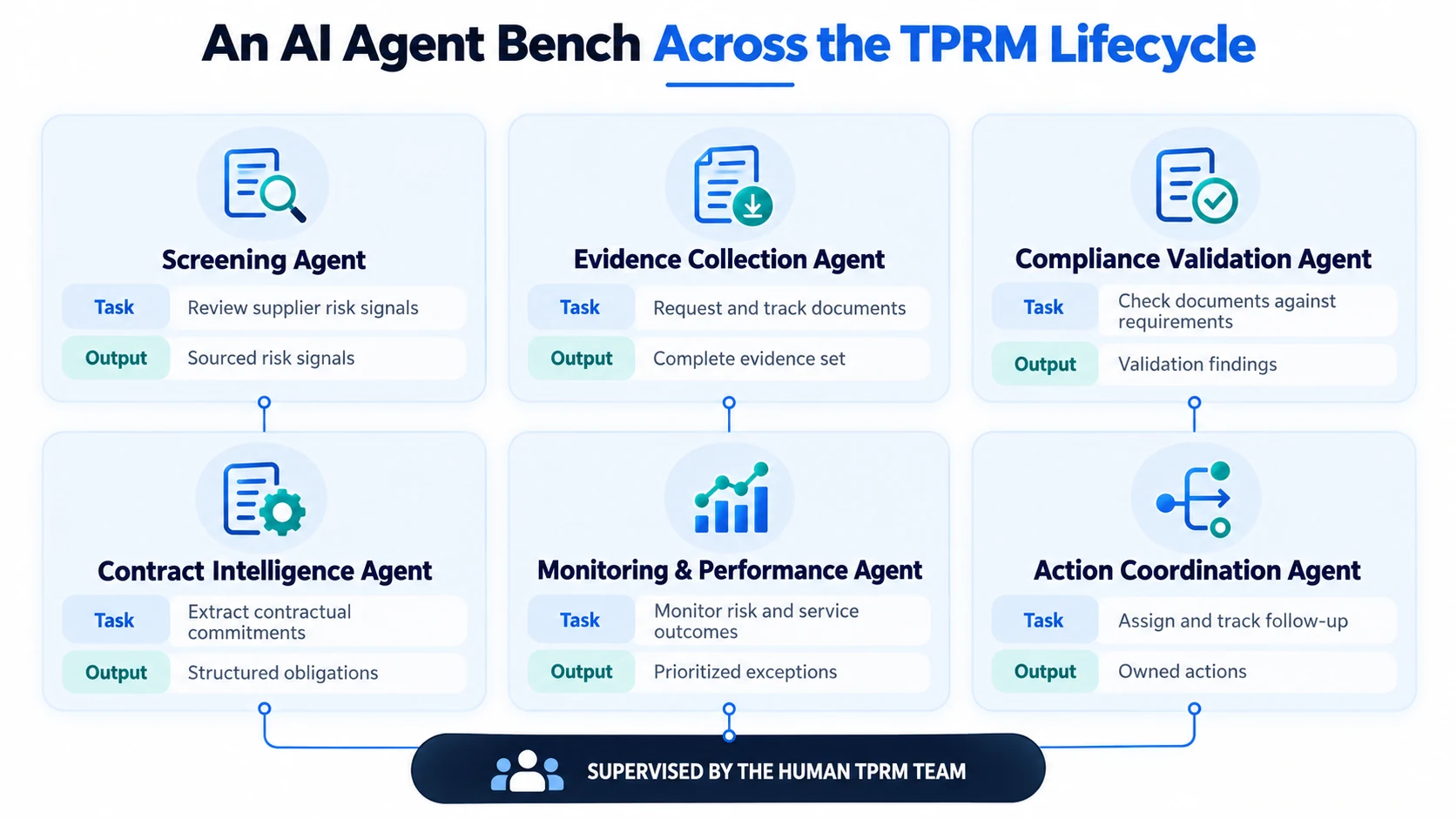
Different TPRM activities require different tasks, inputs and outputs. Enlighta’s agent-oriented operating model brings together specialized capabilities that support the TPRM team across screening, evidence, contracts, monitoring and action coordination.
Six functional agent roles, supervised by the human TPRM team.
Screening Agent
ResponsibilityScreen new and existing suppliers for potential risk indicators.InputsSupplier information and configured external risk sources, including adverse news, sanctions, litigation, financial indicators, sites and cyber-risk information.TaskIdentify potential risk signals and relevant matches for further investigation.OutputSourced risk signals.
Human checkpoint: The analyst verifies supplier identity, source credibility, relevance and the significance of potential findings.
Evidence Collection Agent
ResponsibilityCoordinate supplier evidence requests and collection.InputsRequired documents, questionnaires, certifications, policies and supporting records.TaskRequest documents, collect submissions, track missing evidence and coordinate follow-up.OutputA more complete evidence set for review.
Human checkpoint: The responsible reviewer determines whether the submitted material is sufficient for the intended assessment.
Compliance Validation Agent
ResponsibilityValidate supplier documentation against defined requirements.InputsSubmitted documents, document types and configured validation criteria.TaskIdentify document types and rules, extract relevant fields such as issue dates, expiry dates and signatures, and flag expired, incomplete or mismatched evidence.OutputValidation findings, including potential gaps and exceptions requiring review.
Human checkpoint: Reviewers validate material findings and decide how document issues affect the relevant assessment or compliance requirement.
Contract Intelligence Agent
ResponsibilityTurn contract information into structured commitments that can be managed.InputsSupported contract documents and associated metadata.TaskAssist with extracting obligations, SLAs, key dates, pricing, insurance requirements and other relevant contractual information.OutputStructured contractual commitments.
Human checkpoint: The contract owner validates critical clauses and extracted information before using them as authoritative obligations.
Monitoring & Performance Agent
ResponsibilityMonitor vendor risk and service performance throughout the relationship.InputsConfigured internal and external risk signals, vendor records, KPI/KRI trends, SLA results, issue ageing and remediation status.TaskSurface relevant risk developments, performance exceptions and recurring issues that may warrant attention.OutputPrioritized exceptions and monitoring information.
Human checkpoint: Risk and vendor-management teams evaluate materiality, context, required intervention and appropriate follow-up.
Action Coordination Agent
ResponsibilityConvert validated findings into owned work.InputsApproved findings, issues, tasks, deadlines and governance requirements.TaskRoute actions to owners, coordinate approvals, assign due dates, support escalation and track remediation.OutputOwned actions with follow-up and closure visibility.
Human checkpoint: Authorized personnel review and approve actions according to organizational governance.
The objective is not to deploy agents without oversight. It is to give the TPRM team more consistent capacity for repeatable work while preserving human review at important decision points.
These are functional agent roles from Enlighta’s TPRM presentation. Official released product names should be confirmed with Product before they are treated as fixed software-module names.
Monitor risk throughout the entire third-party lifecycle
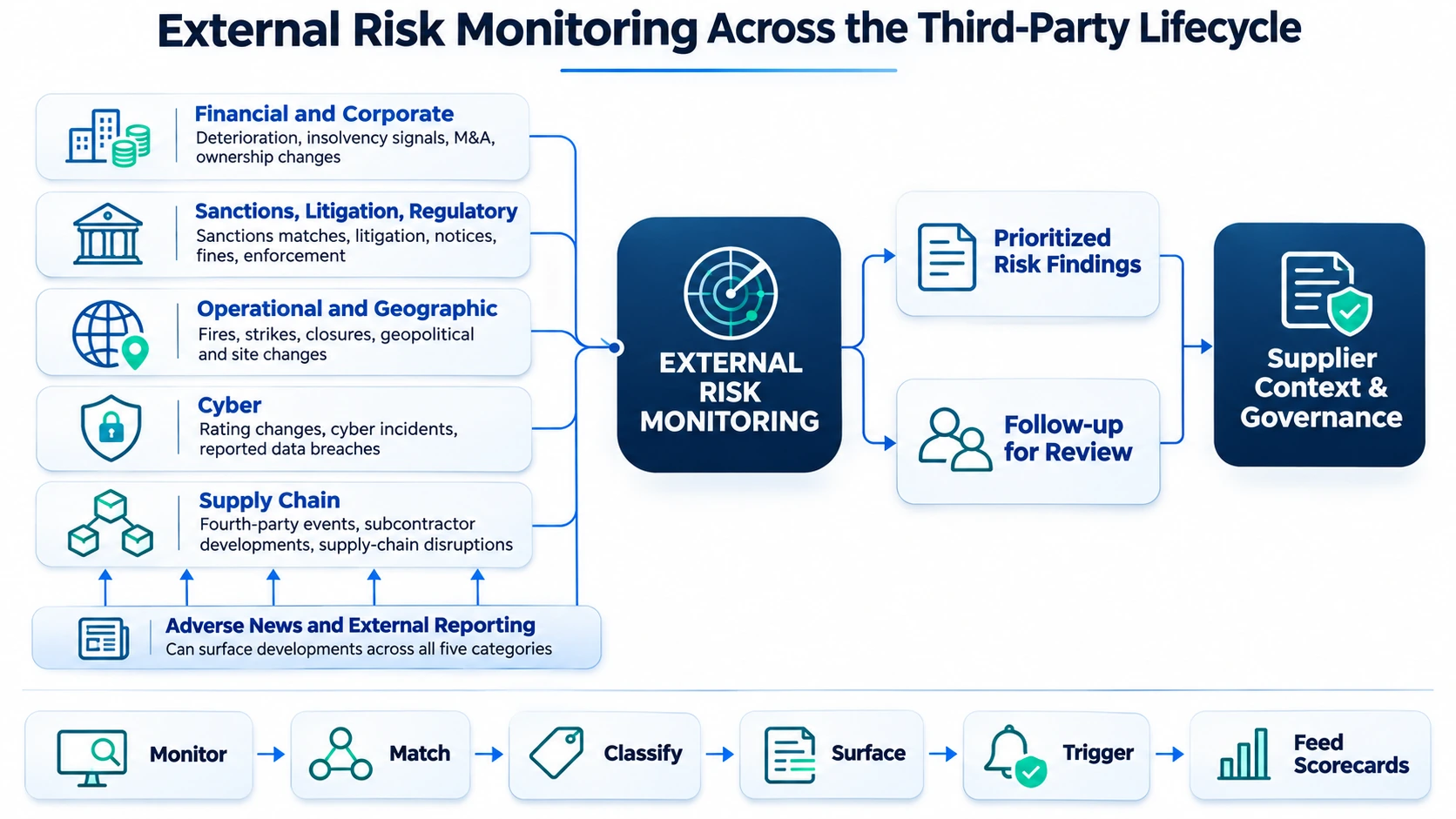
Third-party risk cannot be understood through contractual information or supplier-submitted assessments alone. Relevant developments may emerge from internal vendor records, external intelligence, regulatory sources and changes across the wider supply chain. Enlighta’s continuous TPRM approach connects relevant monitoring information with supplier context so that developments can be reviewed, prioritized and routed for further action.
Financial and Corporate Risk
Financial deterioration and potential insolvency signals
Mergers, acquisitions and ownership changes
Material financial developments
Changes affecting corporate stability
Sanctions, Litigation, Regulatory Risk
Potential sanctions and restricted-party matches
Litigation and regulatory notices
Fines and enforcement actions
Relevant changes in regulatory requirements
Operational and Geographic Risk
Fires and operational incidents
Strikes and service disruption
Facility closures and location changes
Geopolitical developments affecting operations
Cyber Risk
Cyber-risk rating changes and security incidents
Cyber incidents and reported data breaches
Supply Chain Risk
Fourth-party and subcontractor developments
Supply-chain incidents and emerging dependencies
Adverse news is not a separate risk domain. External reporting can surface developments across all five monitoring categories, and each development should be classified according to the nature of the underlying event.
Risk monitoring continues throughout the relationship; risk and performance reviews remain distinct.
Monitor configured external sources and internal vendor information.
Match potential events to the relevant supplier, site or relationship.
Classify the development according to its type and relevance.
Surface material findings for review.
Trigger an appropriate configured workflow or follow-up.
Feed scorecards and management views with the resulting information.
An external signal is not automatically a confirmed risk. Supplier identity, source credibility, event context and potential business impact should be reviewed before a finding informs a material decision. Monitoring cadence and coverage depend on supplier criticality, available sources and configured rules; not every source updates in real time and not every supplier receives identical monitoring.
Collect the evidence. Validate that it meets requirements.
Receiving a document does not establish that a supplier has satisfied a control or compliance requirement. Enlighta’s evidence-related processes cover two distinct activities.
Evidence Collection
Identifies required evidence; requests policies, certificates, audit reports and insurance documents; tracks submissions, missing information and follow-ups; and organizes evidence for reviewers.
Compliance Validation
Identifies document type and applicable validation rules; extracts issue dates, expiry dates and signatures; flags expired, incomplete or mismatched documents; and supports quality scoring and exception review.
Request and Collect→Validate and Identify Gaps→Resolve Exceptions
Collection confirms that evidence has been received. Validation helps determine whether it meets the relevant requirement. Human review remains important for material gaps, ambiguous documents and decisions about the adequacy of evidence.
Turn contract information into manageable obligations
Contracts contain obligations, service-level commitments, renewal dates, insurance requirements and other terms that must be understood and monitored throughout the relationship. Enlighta’s Contract Intelligence approach supports extracting relevant information from agreements and structuring commitments that can be reviewed and managed.
1. Contract Added
A supported agreement or contract document is made available for processing.
2. AI-Assisted Extraction
Relevant clauses, obligations, dates, owners and contractual terms are identified and structured.
3. Human Validation
The contract owner reviews the original clause and extracted fields, confirming that the information is accurate and complete.
4. Monitoring Setup
Validated commitments can be connected to responsible owners, dates, evidence requirements and follow-up tasks where supported by the configured workflow.
Illustrative example: a contract requires the supplier to provide an annual security certification. The relevant process identifies the obligation and its timing, captures the original clause, validates the extracted details, identifies the responsible owner and establishes the required evidence and follow-up path.
Not every new contract is automatically detected, and tasks are not automatically created unless the current released product supports that exact process. Extraction does not replace contract-owner review or legal interpretation.
Monitor vendor performance, SLAs and obligations throughout the relationship
A supplier may remain compliant with certain requirements while its service delivery deteriorates. Conversely, a supplier may meet its current performance targets while developing a financial, cybersecurity or regulatory concern. Risk monitoring and performance monitoring are related but distinct activities; organizations need both.
SLAs and KPIs
Uptime, response times, delivery, quality and other agreed performance measures.
Obligations
Reports, audits, insurance, certifications, renewals and other contractual commitments.
Trends and Exceptions
Repeated breaches, missed obligations, deteriorating KPIs and recurring service problems.
Follow-through
Responsible owners, corrective plans, deadlines and escalation.
Illustrative scenario: a critical SaaS supplier misses its uptime SLA twice and does not provide a required remediation report. The vendor manager reviews the performance trend, requests a corrective plan and evaluates whether contractual remedies or renegotiation should be considered. Performance management is about accountability and corrective action, not simply displaying SLA results.
Continuous TPRM is more than a point-in-time assessment
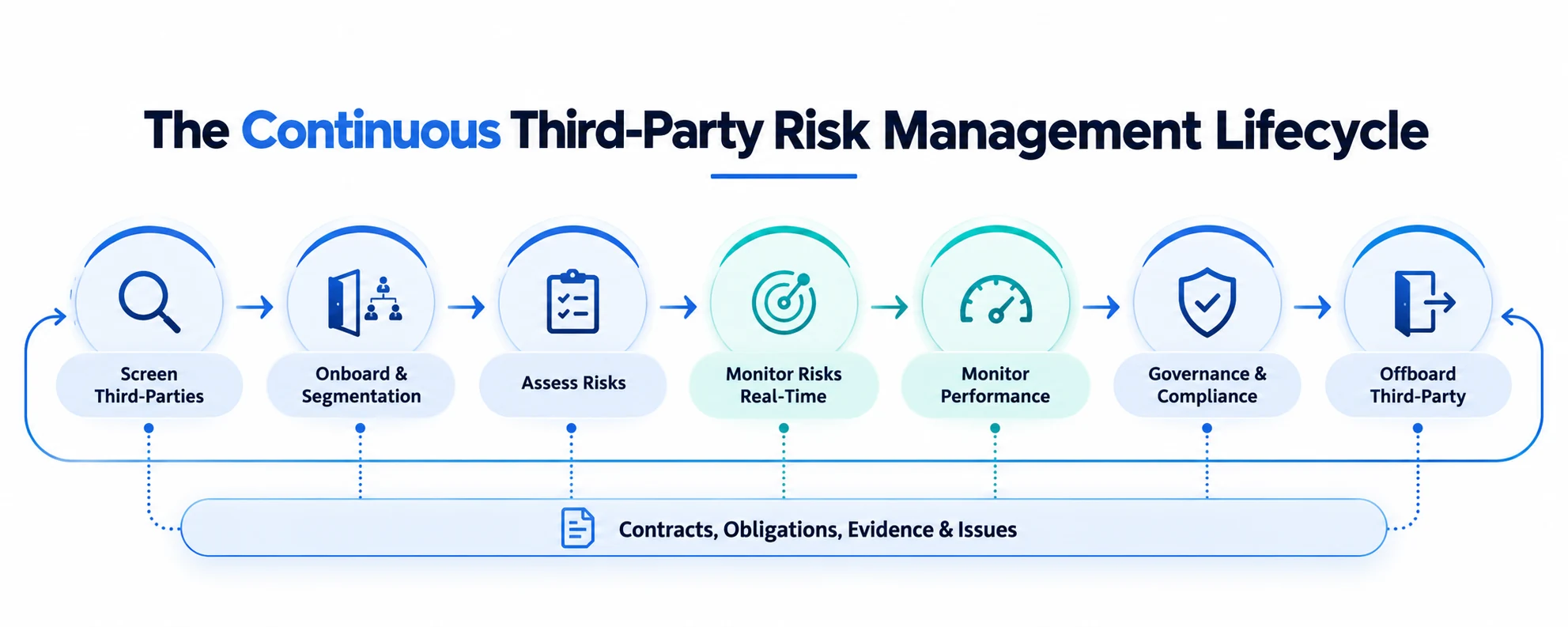
The third-party lifecycle itself runs from screening to offboarding. Contracts, obligations, evidence and issues are connected governance activities that span every stage rather than belonging to a single step.
The third-party lifecycle. Risk monitoring and performance monitoring are distinct, continuous activities across the relationship.
Screen Third-Parties
Onboard & Segmentation
Assess Risks
Monitor Risks Real-Time (monitoring cadence depends on configured sources and supplier criticality)
Monitor Performance
Governance & Compliance
Offboard Third-Party
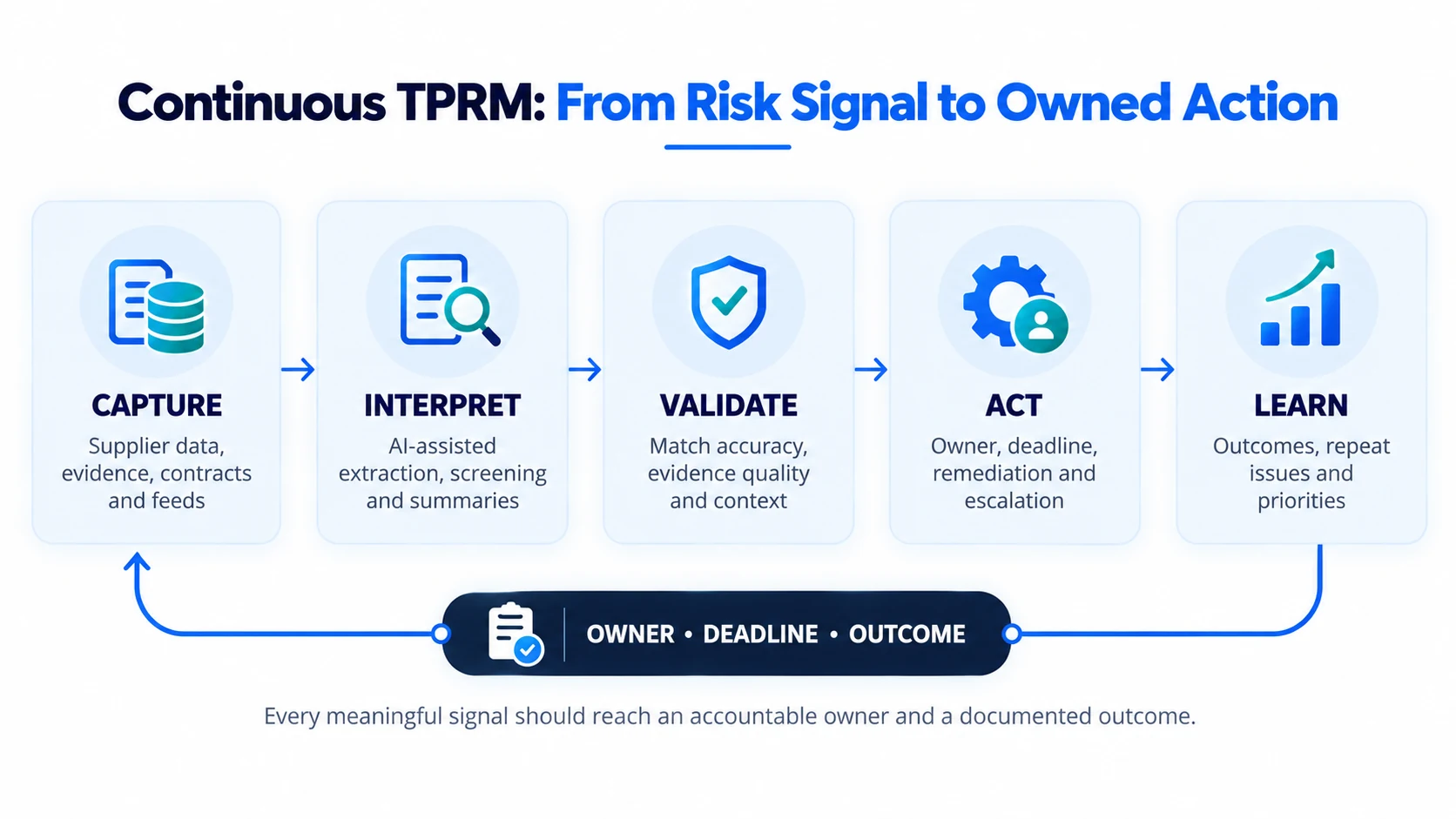
Three concepts work together and must not be confused: the third-party lifecycle above (the stages through which the relationship is governed), the AI-agent and automation operating model (the capabilities supporting the TPRM team), and the continuous operating loop of Capture, Interpret, Validate, Act and Learn that follows.
Continuous TPRM needs a closed loop, not a pile of alerts
Screening results, external signals, submitted evidence, contract obligations and performance information become valuable when they lead to appropriate action and documented outcomes. Enlighta’s operating model connects five activities.
Every meaningful signal should reach an accountable owner and a documented outcome.
1. Capture
Supplier information, documents, contracts and configured monitoring feeds.
2. Interpret
AI-assisted extraction, screening and summarization of relevant information.
3. Validate
Confirm match accuracy, evidence quality, completeness and risk context.
4. Act
Assign owners, deadlines, approvals, remediation actions and escalation paths.
5. Learn
Track outcomes, review recurring issues and update priorities and monitoring requirements where appropriate.
Continuous does not mean notifying everyone about every alert. The objective is proportionate review and appropriate follow-through. Actual triggers, integrations and workflow steps depend on configuration and released capabilities.
Insight matters when it changes what management does next
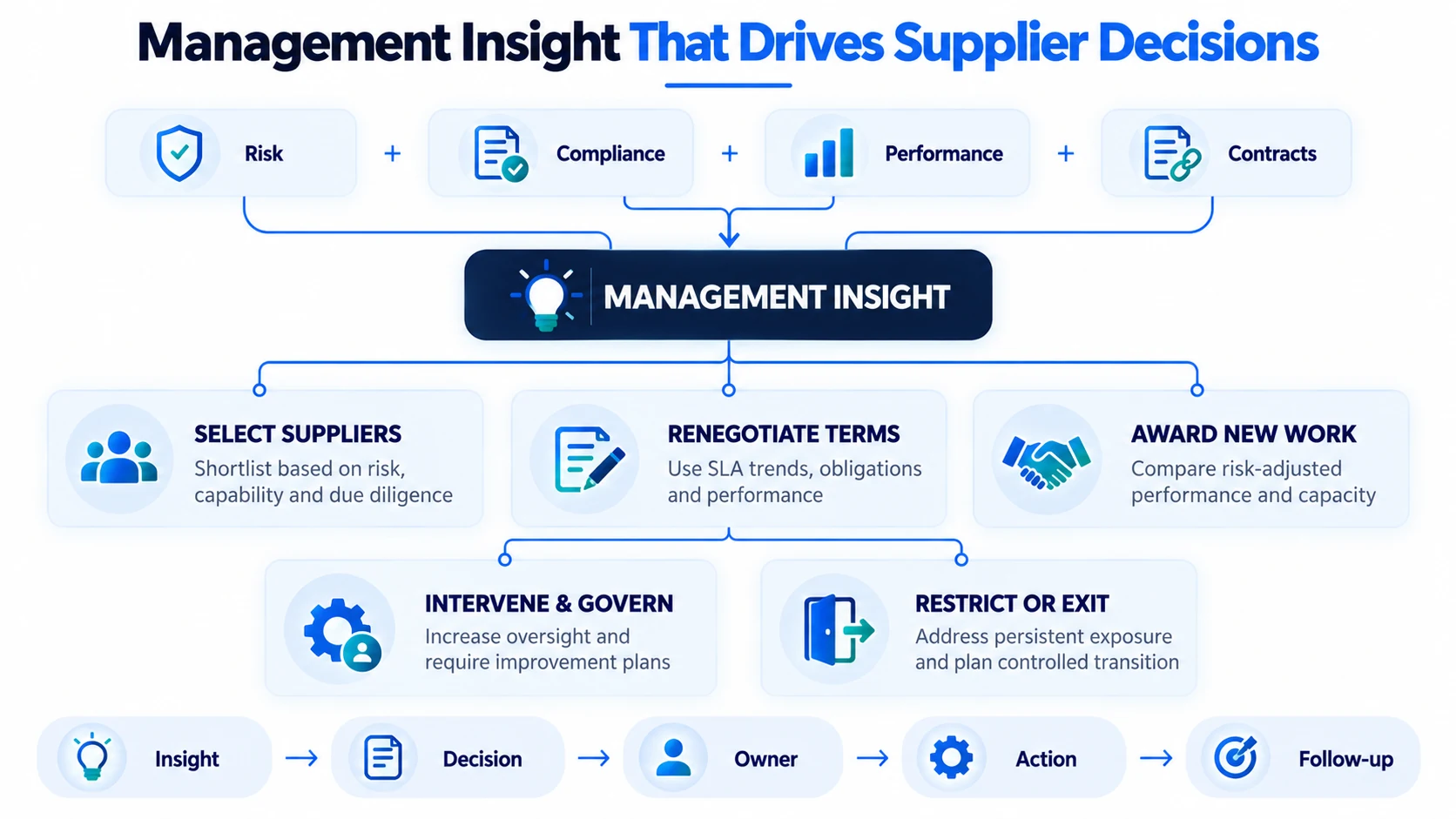
Insight informs supplier decisions; accountable management makes them.
Select the Right SuppliersWhich supplier should we choose?
Use screening, business criticality, capability, due-diligence results and control evidence to support supplier evaluation.
Renegotiate Contract TermsWhat needs to change in the contract?
Use SLA trends, missed obligations, performance exceptions, risk and commercial results to inform renegotiation.
Award New WorkWho has earned more business?
Compare suppliers on risk-adjusted performance, quality, resilience, compliance, capacity and delivery.
Intervene and Increase OversightWhere is additional management attention needed?
Use external events, repeated failures, criticality, outstanding remediation and declining performance to determine whether to increase reviews or require an improvement plan.
Restrict or ExitWhen is continued use no longer acceptable?
Consider unresolved exposure, repeat failures, available alternatives, contractual rights and transition readiness before restricting scope or planning a controlled exit.
Insight → Decision → Owner → Action → Follow-up → Evidence of Outcome. The decisions belong to accountable management. Analytics and AI-assisted information help inform them; they do not independently make them.
Continuous TPRM is more than a collection of individual capabilities
Enlighta connects the activities that make up third-party risk management rather than treating screening, evidence, monitoring, contracts, performance and remediation as separate tasks. AI agents support defined work. Automation coordinates the next steps. Connected information provides context. Management insight helps teams decide where to focus attention and what action may be appropriate. The result is a more connected operating model for continuous third-party governance, with people retaining judgment, accountability and decision rights.
Build a more continuous approach to third-party risk management
Enlighta’s Continuous TPRM approach brings together AI agents, workflow automation, connected information and management insight to support ongoing screening, evidence validation, risk monitoring, performance oversight and governance. The objective is to help teams identify relevant signals, validate findings, coordinate action and use the resulting information to make better supplier and business decisions.
Continuous TPRM is an operating model that connects AI agents, workflow automation, connected supplier information and management insight across the entire third-party lifecycle, from screening and onboarding through monitoring, contracts, performance, governance and offboarding.
What role do AI agents play in TPRM?
AI agents support repeatable activities such as supplier screening, evidence collection, document validation, contract extraction and ongoing monitoring. Human reviewers validate material findings and retain decision rights.
Does continuous monitoring cover external risk factors?
Yes. Depending on the configured sources, monitoring covers internal vendor information and external developments including financial, operational, regulatory, geopolitical, cybersecurity and fourth-party risks.
How is risk monitoring different from performance monitoring?
Risk monitoring identifies changing exposure from internal and external developments. Performance monitoring evaluates service delivery against SLAs, KPIs, obligations and trends. Both inform the broader governance process.
Does agentic automation make final supplier decisions?
No. AI agents assist with defined tasks and workflows coordinate action. Material decisions such as supplier approval, risk acceptance, restricting a supplier or ending a relationship remain with accountable people.
How does contract intelligence work?
Contract intelligence assists with extracting obligations, SLAs, key dates and other commitments from agreements. The contract owner validates the extracted information before it is used as an authoritative obligation.
How does Enlighta connect monitoring findings to action?
Findings move through a connected loop of capture, interpret, validate, act and learn. Validated findings are routed to owners with deadlines and tracked to documented outcomes, subject to the configured workflow.
This article describes Enlighta’s documented TPRM operating model and an illustrative workflow. Agent functions, integrations and autonomous actions depend on the product configuration and confirmed availability.
Tag:
Share Article:
E S
Enlighta’s software solutions empower enterprises to increase business value and mitigate risks in supplier and third-party engagements through data-driven insights into demand, performance, contract compliance & spend, and process automation for demand, selection, invoice validation, vendor governance, and third-party risk monitoring.